

Super Ideal Cut Diamonds vs GIA Excellent: The Ultimate Light Showdown
Are Super Ideal Cut Diamonds Worth the Premium?
Super ideal cut diamonds can be worth the extra cost if you value precise symmetry and top-tier light performance. But a well-chosen GIA Excellent diamond may look just as bright to you for less money. “Super ideal” is not a separate GIA grade, so don’t pay more for the label alone. Compare diamonds side by side and ask to see light-performance images before you decide.
The real test is what you can see: bright white light, flashes of color, and sparkle as the diamond moves. I’m Morris Mervis, and I’ll help you judge whether that extra precision is worth the price for your ring.
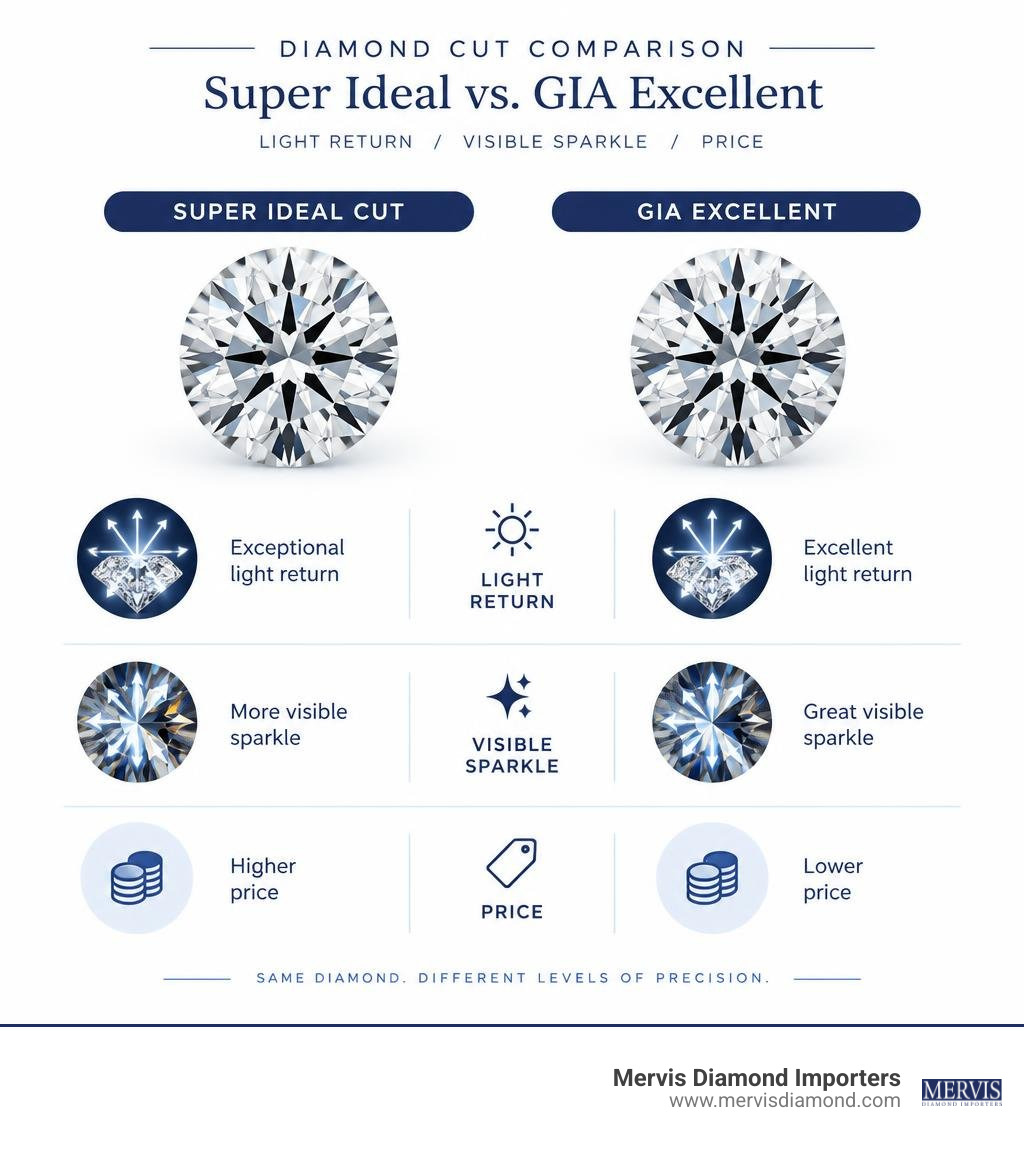
What Are Super Ideal Cut Diamonds?
When you begin searching for the perfect center stone, you quickly discover that cut is the most critical of the Four Cs. While color and clarity describe a diamond's natural material characteristics, cut reflects the human craftsmanship that unlocks its brilliance.
In mainstream diamond grading, the Gemological Institute of America (GIA) awards "Excellent" as its highest cut grade for standard round brilliant stones. Similarly, the American Gem Society (AGS) historically established the "AGS 0 Ideal" grade to recognize diamonds with superior light performance.
However, the diamond industry has a tier beyond standard grading benchmarks: super ideal cut diamonds.
A super ideal cut is not an official grade issued by traditional independent laboratories on standard lab reports. Instead, it represents an elite category of stones crafted to ultra-narrow mathematical tolerances. Cutters sacrifice extra rough diamond weight during polishing to achieve optical symmetry and light reflection.
While the GIA Excellent category includes a relatively wide spectrum of proportions—some performing significantly better than others—super ideal cuts live strictly within the absolute sweet spot of light return.
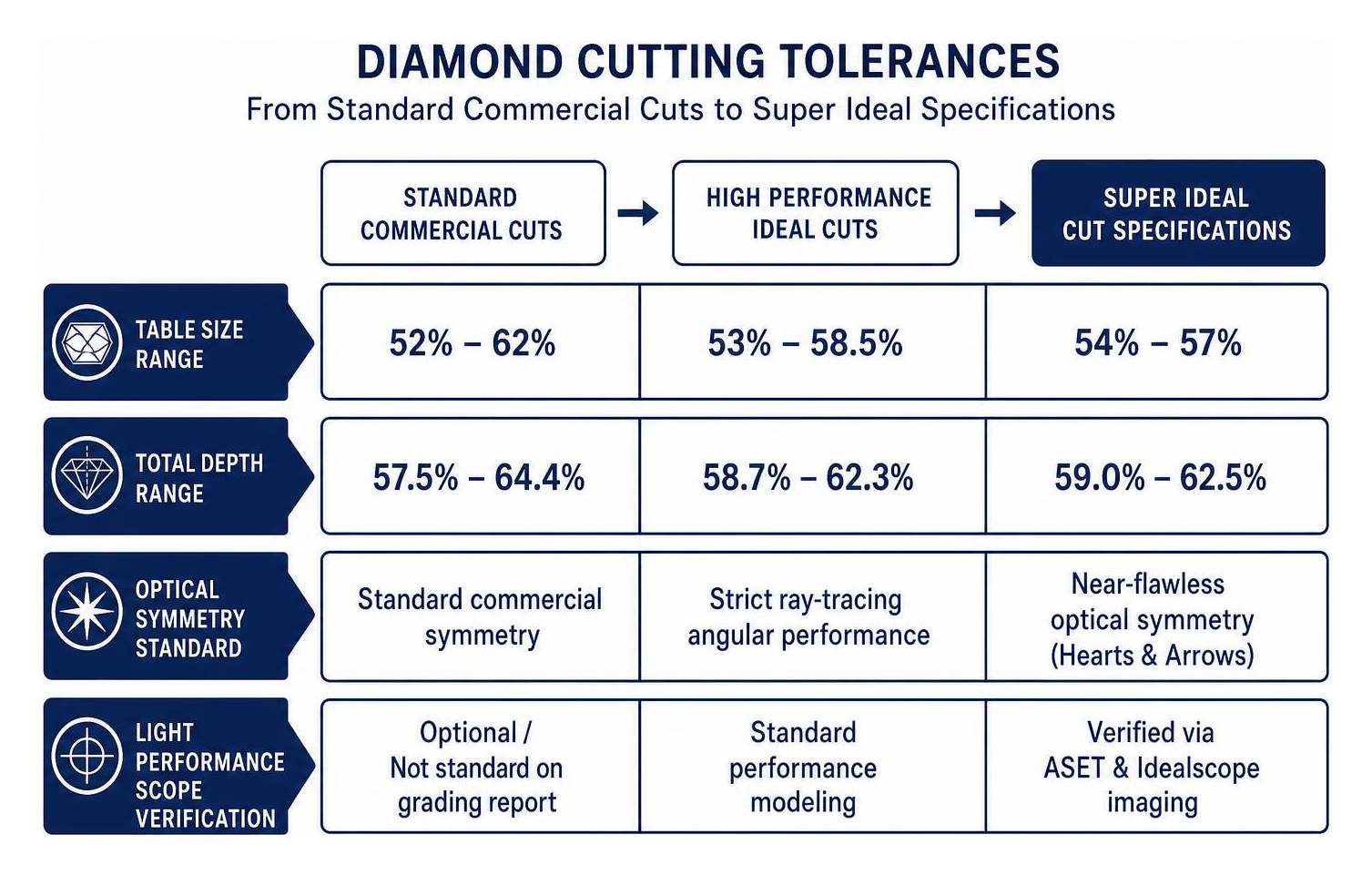
| Standard / Grade | Table Size Range | Total Depth Range | Optical Symmetry Standard | Light Performance Scope Verification |
|---|---|---|---|---|
| GIA Excellent | 52% – 62% | 57.5% – 64.4% | Standard commercial symmetry | Optional / Not standard on grading report |
| AGS Ideal (0) | 53% – 58.5% | 58.7% – 62.3% | Strict ray-tracing angular performance | Standard performance modeling |
| Super Ideal Cut | 54% – 57% | 59.0% – 62.5% | Near-flawless optical symmetry (Hearts & Arrows) | Verified via ASET & Idealscope imaging |
To understand how these stones are evaluated globally, the GIA diamond cut overview explains how facet interactions determine overall brilliance.
The Mathematical Precision Behind Super Ideal Cut Diamonds
Diamond cutting is a delicate balancing act governed by the laws of physics. If a stone is cut too shallow, incoming light strikes the pavilion facets at an angle that causes it to escape out the bottom (windowing). If it is cut too deep, light bounces across the interior at extreme angles and exits through the sides (fisheye or light leakage).
Super ideal cuts adhere to strict geometric guardrails:
- Table Percentage: Held strictly between 54% and 57%. This ensures a balanced window for light entry without making the top facet overly large.
- Total Depth Percentage: Kept between 59% and 62.5% to preserve maximum diameter while preventing light loss.
- Crown Angle: Kept between 34.0° and 35.0° to optimize the dispersion of light into spectral colors.
- Pavilion Angle: Kept tightly between 40.6° and 41.0° to serve as a mirror reflecting light back toward the viewer's eye.
- Girdle Thickness: Maintained as thin-to-medium or slightly thick. Checking a diamond girdle thickness chart helps buyers avoid stones that hide dead weight in their perimeter.
When crown angles and pavilion angles work in harmony, they create internal reflection that standard cuts cannot always replicate.
Evaluating Visual Performance: Brilliance, Fire, and Scintillation
A diamond's visual impact relies on three interconnected optical behaviors:
- Brilliance (Brightness): The total amount of internal and external white light returned to the eye.
- Fire (Dispersion): The separation of white light into vivid rainbow colors, produced primarily by the crown facets.
- Scintillation (Sparkle & Pattern): The flashes of light and dark contrast visible when the diamond, light source, or observer moves.
Understanding what makes a diamond sparkle comes down to light dynamics. A super ideal cut balances bright white flashes with rich chromatic fire while maintaining a crisp, balanced contrast pattern across the entire face of the gem.
Advanced Evaluation Tools: Beyond the Standard Grading Report

Because a standard grading report only lists two-dimensional measurements and averages, assessing a true super ideal cut requires specialized optical diagnostic tools.
Assessing Symmetry in Super Ideal Cut Diamonds with Hearts and Arrows
Optical symmetry goes beyond the surface symmetry noted on a lab certificate. When a round brilliant diamond possesses three-dimensional facet alignment, it exhibits a phenomenon known as the "Hearts and Arrows" pattern.
- The Arrows Pattern: Viewed from the top (table down) through a specialized reflector scope, you will observe eight crisp, symmetrical arrow shafts pointing outward.
- The Hearts Pattern: Viewed from the bottom (pavilion up), you will see eight uniform, well-defined hearts with minimal cleft separation or twisting.
Many retail stones show partial or distorted patterns, but true super ideal diamonds display uniform alignment across all 57 or 58 facets.
Decoding Light Return with ASET and Idealscope Imaging
To confirm that a diamond does not suffer from internal light leakage, gemologists rely on color-filtered reflector scopes:
- Idealscope: Uses a red reflector to reveal light return. Solid red indicates bright light reflection, black shows contrast reflection from the viewer's head, and clear or white areas indicate light leakage where light falls out of the stone.
-
Angular Spectrum Evaluation Tool (ASET): Developed by AGS, ASET provides a high-resolution optical profile:
- Red: Direct light return from overhead (the brightest light sources).
- Green: Low-angle light return from surrounding walls or horizons.
- Blue: High-contrast zones that create sparkle.
- White / Clear: Light leakage where light passes straight through.
A super ideal diamond will exhibit saturated red light return with balanced blue contrast points and near-zero white leakage under both diagnostic viewers.
Super Ideal Cut vs. GIA Excellent: Is the Price Premium Worth It?
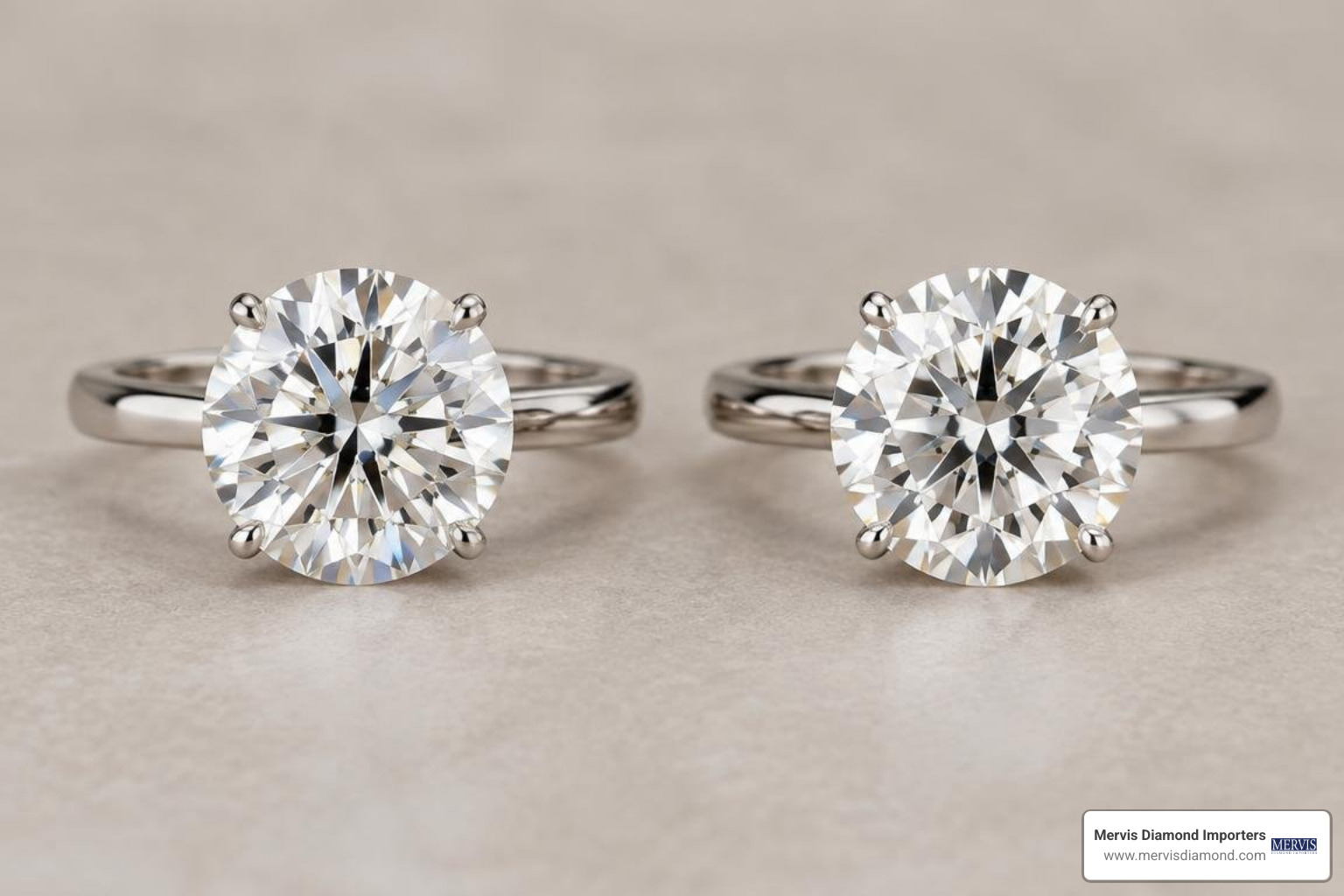
Because super ideal diamonds require extra polishing time and discard more rough diamond material, they carry a noticeable retail price premium. On average, a super ideal cut diamond can cost around $1,110 more than an otherwise comparable GIA Excellent cut diamond of similar carat weight, color, and clarity.
For some buyers, paying this premium provides total peace of mind that their diamond is mathematically optimal. However, in practical daylight and evening settings, the quality difference between a super ideal cut and a carefully vetted GIA Excellent diamond with ideal proportions is often marginal to the naked eye.
Instead of paying a branding premium for a "super ideal" label, many clients choose to invest that $1,110 price difference into a higher carat weight or an upgraded setting. When exploring round diamond engagement rings in Tysons Corner, seeing both options side by side allows you to decide if the subtle optical gain matches your personal priorities.
How to Inspect and Select Top-Performing Diamonds
Whether you are browsing online inventories or viewing gems in a showroom, you can filter for super ideal performance by using a few practical steps:
- Set Tight Search Filters: Look for a table between 54% and 57%, depth between 59% and 62.5%, crown angles around 34.0°–35.0°, and pavilion angles around 40.6°–41.0°.
- Request Optical Diagnostics: Ask for actual ASET, Idealscope, and Hearts and Arrows scope imagery rather than relying solely on computer-generated models.
- Evaluate 360-Degree Video: Check for dark central zones (obstruction) or lifeless outer edges in high-definition video.
- View in Mixed Lighting: Diamonds sparkle differently under bright spot lights than in natural shade or diffused office lighting.
- Examine Shape Nuances: If you are still selecting the right diamond shape, keep in mind that optical symmetry tools are most reliable on round brilliant cuts, while fancy shapes require distinct proportion criteria.
If you are shopping for diamonds in Montgomery County or visiting our showrooms in Rockville, MD, Tysons, VA, or Washington, DC, our gemologists can walk you through these scope evaluations in person.
Frequently Asked Questions About Super Ideal Diamonds
How much more does a super ideal cut diamond cost compared to a GIA Excellent cut?
A super ideal cut diamond typically commands a price premium of roughly $1,110 or more over a standard GIA Excellent cut of identical carat, color, and clarity. This extra cost reflects the added rough diamond weight polished away during manufacturing to achieve precise optical symmetry.
Can an untrained eye see the difference between GIA Excellent and a super ideal cut?
Under normal viewing conditions, most people find it difficult to distinguish a top-tier GIA Excellent diamond from a super ideal diamond. While reflector scopes clearly highlight the difference in light return and facet alignment, the real-world performance gap is subtle.
What proportion ranges should buyers target for ideal diamond performance?
To capture peak brilliance without paying an unnecessary markup, focus on round brilliant diamonds with a table percentage of 54% to 57%, a total depth percentage of 59% to 62.5%, crown angles between 34.0° and 35.0°, and pavilion angles between 40.6° and 41.0°.
Conclusion
Super ideal diamonds represent the pinnacle of diamond cutting precision. They offer maximum light return, textbook symmetry, and crisp contrast. However, you do not need an elusive marketing label to find a dazzling stone. By understanding proportion relationships and reviewing actual light performance imagery, you can find a diamond that matches top-tier brilliance at an exceptional value.
At Mervis Diamond Importers, we hand-select natural and lab-grown diamonds for optimal optical beauty. We invite you to explore our guide on understanding the Four Cs or schedule a private consultation at our Washington, DC, Tysons, VA, or Rockville, MD showrooms to view our curated collections side by side.