

How Much Does Gold Ring Resizing Cost and What Happens to the Extra Metal?
Gold Ring Resizing Costs: What You Need to Know First
Gold ring resizing commonly involves a base labor charge, plus added gold if the ring must be made larger. Making a ring smaller usually costs less because no new metal is needed, but there is still a minimum fee for cutting, soldering, reshaping, polishing, and inspecting the ring.
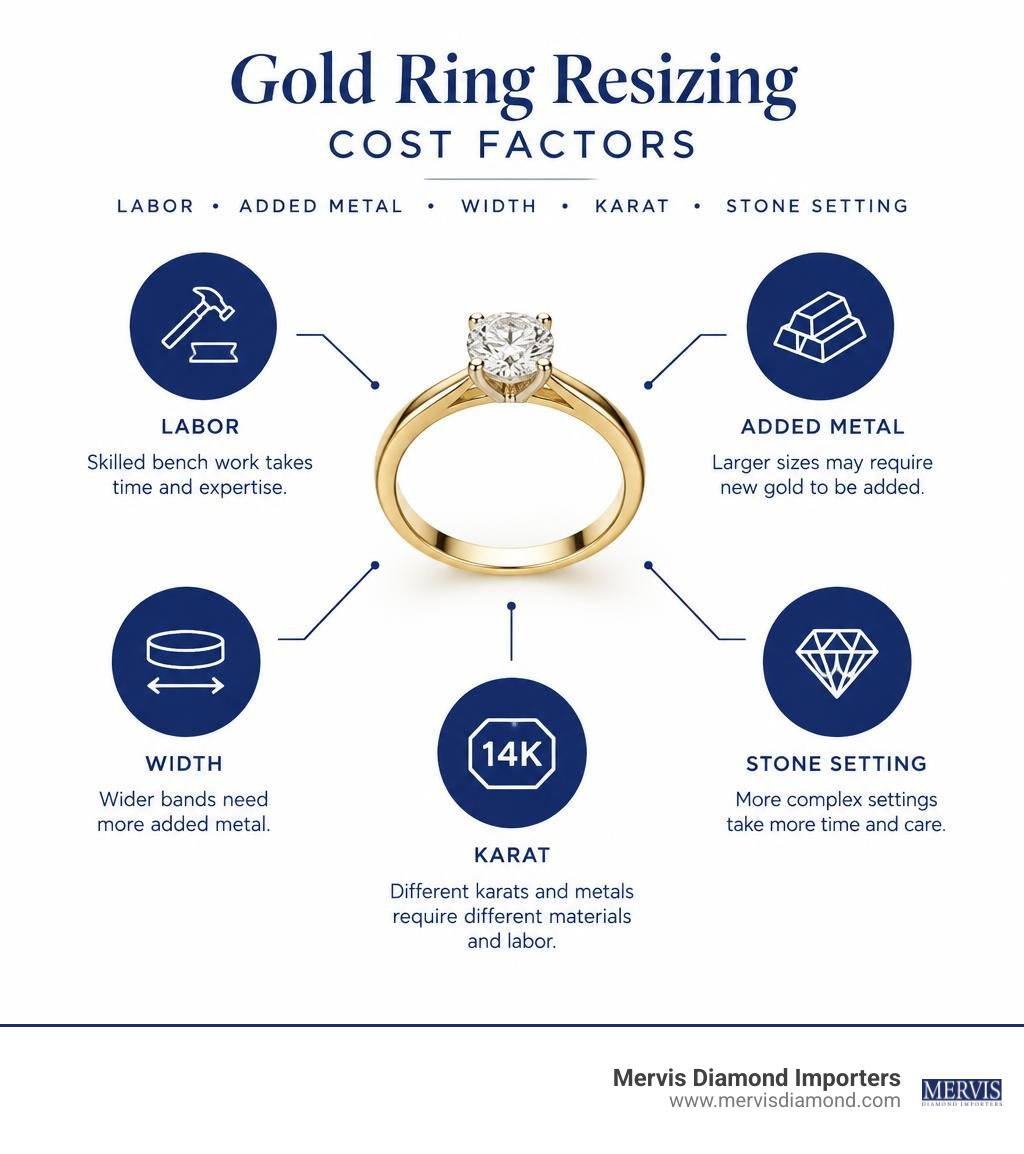
Your final quote depends most on:
- Direction and size of the change: Upsizing often costs more than downsizing.
- Gold type and karat: 14K, 18K, white gold, and platinum can require different materials and labor.
- Band width: A wide band needs more added metal when enlarged.
- Stones and setting style: Solitaire rings are often simpler than pave, channel-set, halo, or eternity designs.
- Ring condition: A thin, worn, or damaged shank may need repair or replacement instead of a basic resize.
Most standard resizing work takes about 1 to 2 weeks. For a change of more than two or three full sizes, or for a full eternity band, remaking the ring may be the safer long-term choice. The removed gold from a downsized ring is generally not credited against the repair price because the bench work remains the same and refining small pieces has costs.
I am Morris Mervis, and the next sections explain how a jeweler builds a clear resizing quote and when it makes sense to resize versus remake.
How Much Does Gold Ring Resizing Cost? Key Pricing Factors
When bringing a beloved ring to a master bench jeweler, understanding the pricing structure helps set clear expectations. The total cost of resizing is not an arbitrary figure pulled out of thin air. Instead, it is built on a precise formula that accounts for skilled bench time, the physical properties of the precious metal, and the structural complexity of your jewelry mounting.
In the jewelry industry, standard estimating tools like the Ring Resizing Cost Calculator – Estimate Jewelry Resizing Prices model pricing using a multi-factor system. To account for variations between lean independent workshops and high-end boutique bench jewelers, estimates typically apply a 0.85x lower bound and a 1.25x upper bound to the core calculated cost. For clients seeking professional jewelry repair in Washington DC, transparency in these variables ensures you receive the highest standard of craftsmanship at fair market rates.
The four pillars that determine your final quote include:
- Base Labor & Bench Setup: The fixed time required to evaluate, cut, align, join, reshape, clean, and refinish the ring.
- Band Dimensions (Width & Thickness): Determines the surface area that must be heated, soldered, and blended seamlessly.
- Metal Purity and Density: The karat of the gold (or use of platinum) dictates melting temperatures, specialized solders, and raw material costs.
- Setting Complexity: The presence of accent diamonds or delicate mountings requiring heat shielding, unsetting, or post-resize prong retightening.
| Ring Category & Width | Metal Karat / Type | Setting Complexity | Approximate Relative Cost Level |
|---|---|---|---|
| Slim Band (1.5mm – 2.0mm) | 14K Yellow Gold | Solitaire / Plain Band | Standard Base |
| Medium Band (2.5mm – 4.0mm) | 14K Yellow/Rose Gold | Side Accent Stones | Moderate |
| Medium Band (2.5mm – 4.0mm) | 18K White Gold | Pave / Halo | Moderate to High (includes Rhodium) |
| Wide Band (5.0mm – 8.0mm+) | 14K Yellow Gold | Plain / Channel Set | High (significant metal volume) |
| Any Width | 950 Platinum | Micro-Pave / Intricate | Premium (laser welding & high heat) |
Why Is There a Minimum Cost for Small Gold Ring Resizing Adjustments?
A frequent question we hear at our service counters is: "Why does adjusting my ring by only a quarter-size or half-size carry almost the exact same price as a full-size change?"
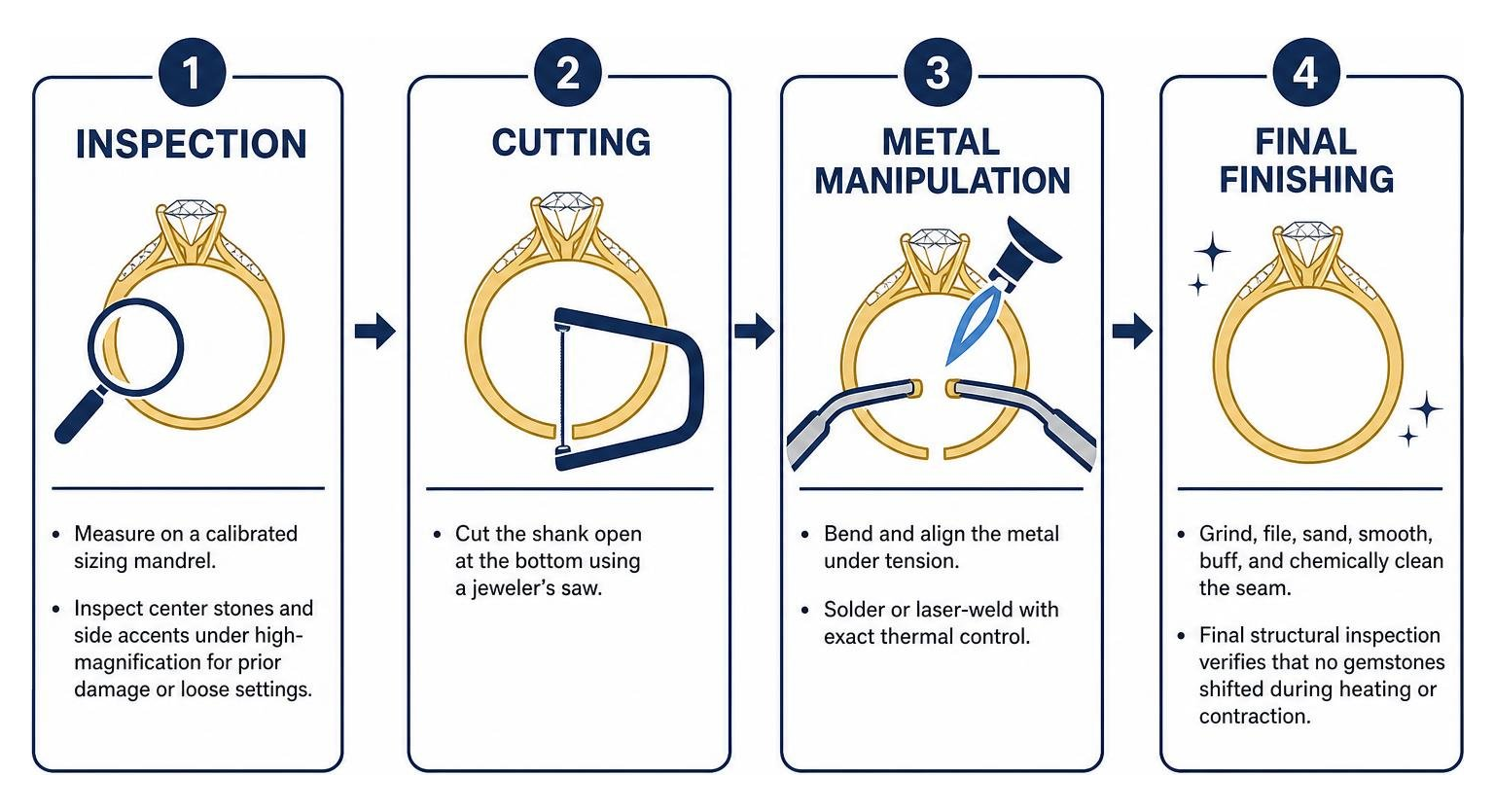
The answer lies in the fixed labor required for jewelry modification. Whether a jeweler alters the circumference of a band by 0.8 millimeters (a quarter size) or 2.5 millimeters (a full size), the physical bench procedure remains almost identical:
- The ring must be carefully measured on a calibrated sizing mandrel.
- The center stones and side accents must be inspected under high-magnification microscopy for prior damage or loose settings.
- The shank must be precisely cut open using a jeweler's saw.
- The metal must be bent, aligned under tension, and soldered or laser-welded with exact thermal control.
- The seam must be ground, filed, sanded, smoothed, buffed, and chemically cleaned.
- A final structural inspection verifies that no gemstones shifted during heating or contraction.
Because raw added gold makes up only a portion of the bill on modest size changes, the foundational bench fee accounts for the jeweler's precision, time, and workshop overhead.
Band Width and Setting Complexity Surcharges
Band geometry directly dictates how challenging a resizing job will be. A delicate 1.8mm band requires only a pinpoint flame or a brief laser pulse to achieve a flawless weld. Conversely, a substantial 6mm or 8mm men's wedding band absorbs massive amounts of heat, necessitating larger torches, specialized thermal shielding, and a significantly larger volume of matched gold solder.
Furthermore, stone settings introduce mechanical stresses whenever a ring's curvature changes. When bending a flat or circular shank to a new diameter:
- Prong & Solitaire Settings: Relatively straightforward; heat must be kept away from delicate center gems, but the basic head is rarely warped by minor shank bending.
- Pave & Micro-Pave Diamonds: Altering the ring's curvature changes the spacing between tiny beads of gold holding small diamonds. Every single accent stone must be inspected and individually tightened under a microscope.
- Channel Settings: Making the ring smaller compresses the channel rails, potentially crushing gemstones; upsizing widens the rails, causing stones to rattle loose. Both require setting surcharges.
- Halo Mountings: Intricate halos feature delicate galleries that can distort if subjected to direct heat transfer or uncalibrated mechanical bending.
If you wear intricate custom engagement rings in Northern Virginia, ensuring that your setting is handled by a team equipped with advanced microscopes and laser welders is critical to maintaining gem security.
Upsizing vs. Downsizing: The Process and What Happens to Extra Metal

The journey of resizing differs fundamentally based on whether you are expanding the diameter or making the ring smaller. Both procedures require master-level control to preserve the perfect circular geometry of the band and prevent structural weak points along the shank.
Downsizing Process: What Happens to the Cut-Out Gold?
When a ring is too loose, downsizing restores a secure, comfortable fit. The jeweler determines the exact excess circumference, marks the bottom of the shank (opposite the main setting), and carefully cuts out a small sliver of gold with an ultra-fine jeweler's saw blade. The two open ends are brought together into flush alignment, secured, and soldered using a karat-matched gold alloy.
A universal question clients ask is: "Do I get a discount or a credit on my bill for the gold you cut out?"
In professional jewelry studios, jewelers do not provide a scrap credit for the removed sliver of metal. Here is why:
- Microscopic Scrap Weight: A half-size reduction removes a sliver of gold that often weighs less than 0.1 to 0.2 grams. In scrap value, this represents a negligible financial sum.
- No Reduction in Labor: Downsizing requires full cutting, filing, precision alignment, torch soldering, seam blending, ultrasonic cleaning, and repolishing.
- Refining Costs & Scrap Loss: The removed sliver contains solder remnants and bench filings. Refining tiny, isolated scraps of alloyed gold incurs refining costs that outweigh the raw value of the metal piece.
When adjusting classic wedding bands in Washington DC, the bench fee covers the complete restoration of your heirloom, ensuring the seam is structurally invisible and robust.
Upsizing Process: How Jewelers Calculate Added Gold Metal Costs
Making a ring larger requires introducing new, matching precious metal into the band. While stretching on a mechanical sizing mandrel is sometimes used for plain, ultra-thick, unadorned bands (limited to a quarter or half size maximum), it is strictly avoided for fine diamond jewelry because it thins the band and warps stone settings.
For standard, high-quality upsizing, the jeweler cuts the bottom of the shank, spreads the ring to the target size, and inserts a precision-milled piece of matching gold called a "sizing bridge" or slug.
Jewelers calculate the added metal weight based on the band's exact width, depth (thickness), and the millimeter gap required for the size jump. If you bring in fine jewelry in Rockville MD for an upsizing, our bench specialists verify the karat purity to ensure the new insert perfectly matches the color, thermal expansion, and density of your original ring.
How Metal Type and Karat Affect Gold Ring Resizing
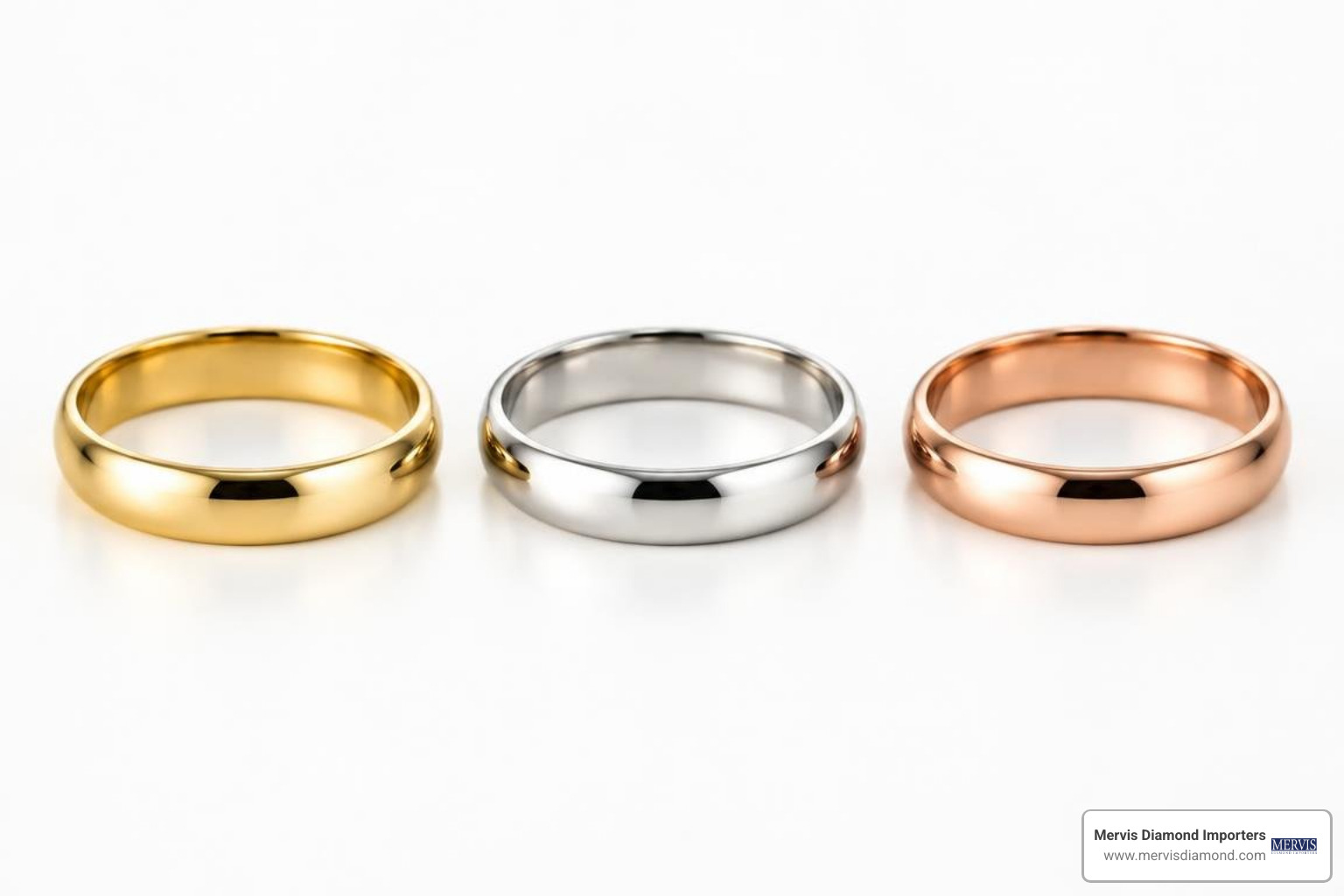
Gold is not a single uniform material; it is alloyed with copper, silver, zinc, and nickel or palladium to produce various colors and durability levels. These alloys behave differently under the intense heat of a jeweler's torch or the focused beam of a laser.
10K, 14K, 18K, and 24K Gold Ring Resizing Difficulty
Gold purity is measured in karats, with 24K representing 100% pure gold. As purity shifts, so do the metal's working characteristics:
- 10K Gold (41.7% Pure Gold): Extremely hard due to high base-metal content. It has a lower melting point and can be brittle if worked improperly. Matching solder color requires skilled mixing to avoid dark lines at the joint.
- 14K Gold (58.3% Pure Gold): The industry standard for resilience and beauty. Highly workable, takes solder cleanly, and provides exceptional structural strength after reshaping.
- 18K Gold (75.0% Pure Gold): Softer and richer in color. It solders beautifully but requires delicate handling during clamping and polishing to avoid removing excessive precious metal.
- Rose Gold (All Karats): Contains a substantial proportion of copper. Rose gold is notoriously heat-sensitive and prone to micro-cracking if quenched too quickly in liquid after soldering. It demands slow cooling and laser welding expertise.
Whether sizing an heirloom ring or adjusting modern diamond jewelry in Montgomery County, matched alloy chemistry prevents discoloration and structural degradation.
White Gold and Platinum vs. Yellow Gold Resizing
White gold and platinum carry distinct bench requirements that influence overall labor and finishing costs:
- White Gold Resizing: Natural white gold has a subtle warm, yellowish tint. To achieve a bright mirror sheen, white gold rings receive a micro-layer electroplating of rhodium (a rare platinum-group metal). Whenever white gold is heated and soldered, the original rhodium finish burns off near the repair zone. Therefore, every white gold resize must conclude with a comprehensive re-polishing and complete rhodium immersion dip, adding specialized materials and finishing steps to the final service.
- Platinum Resizing: Platinum melts at an astronomical 3,215°F (1,768°C)—far higher than gold. Jewelers must use dedicated platinum torches, protective eye filters, and pure platinum solder, or utilize high-energy laser welders. Platinum is denser, heavier, and requires specialized polishing compounds. Consequently, platinum resizing commands a higher labor tier.
If you are maintaining platinum or white gold pieces from our collection of fine jewelry in Tysons Corner VA, these finishing processes restore your jewelry to original showroom condition.
Timeline and Limitations: When Remaking a Ring Is Better Than Resizing
A professional ring resize typically takes 1 to 2 weeks. This timeframe ensures that the piece moves through thorough initial diagnostics, bench modification, chemical cleaning, stone retightening, and rigorous quality control testing without rushed heating or cooling cycles.
However, resizing has physical limits. Metal can only be stretched, bent, and soldered so many times before compromising structural integrity.
A jeweler will often recommend remaking or remounting a ring rather than resizing in the following scenarios:
- Dramatic Size Changes (Over 2 to 3 Full Sizes): Shifting a ring from a size 4 to a size 8 drastically flattens the crown, alters the seat beneath the main diamond, and splays the prongs outward, risking diamond loss.
- Full Eternity Bands: Eternity designs feature diamonds encircling 100% of the circumference with no plain metal section at the base. Cutting into an eternity band breaks the uniform spacing of the stones and destroys the structural basket.
- Pave Bands with Continuous Gallery Work: Micro-pave settings across more than three-quarters of the shank will buckle or drop stones when the arc curvature is modified.
- Severely Worn, Paper-Thin Shanks: If years of friction have worn the bottom of the band down to a razor-thin profile, soldering a new piece of metal onto weak host metal creates a failure point. A full shank replacement or new casting is required.
In these situations, our designers can create tailored custom rings in Washington DC by recreating your exact mounting to fit your current finger size while safely resetting your cherished original center diamond.
Frequently Asked Questions About Gold Ring Resizing
How long does it typically take to resize a gold ring?
Standard turnaround for expert resizing is 1 to 2 weeks. This window allows for careful metallurgical preparation, precision bench adjustment, stone tightening under magnification, ultrasonic cleaning, and thorough quality inspection. Rush services may be accommodated depending on workshop scheduling, but quality craftsmanship should never bypass structural cooling and setting checks.
Can eternity rings or intricate pave bands be resized safely?
True full eternity bands—where diamonds or gemstones wrap entirely around the band without any plain gold space—cannot be resized via standard cutting and soldering methods. Attempting to cut the ring disrupts the prong structure, causing adjacent diamonds to loosen or fall out.
For full eternity styles requiring a size change, jewelers typically recommend remaking the setting or replacing the mounting. For complex repairs and assessments, meeting with a master bench jeweler helps determine whether a partial bridge or a full custom remake is the safest path forward.
What should you verify before ordering ring resizing online or locally?
Before entrusting your jewelry to any service provider—whether using an online mail-in service or visiting a local showroom—always verify the following:
- Accurate Sizing Mandrels: Ensure your finger is measured using standard professional sizing rings matching the exact width of your intended band (wide bands fit tighter than thin bands).
- In-House Master Jewelers: Inquire whether your jewelry remains in a secure, local workshop or is shipped through multiple third-party consolidators.
- Setting Warranty & Insurance: Confirm that the jeweler takes full liability for stone tightness and gemstone safety during torch work.
- Comprehensive Lifetime Care: Review our jewelry appraisal warranty lifetime services explained page to see how routine cleanings, prong tightening, and documented valuations protect your fine jewelry over decades of daily wear.
Conclusion
A fine gold ring is designed to last a lifetime, evolving alongside you through every chapter of your journey. Whether your body changes, you inherit a precious family heirloom, or you are finalizing an engagement surprise, professional resizing restores comfort, beauty, and peace of mind.
At Mervis Diamond Importers, we treat every ring with meticulous attention to detail. From evaluating delicate prong structures to perfectly matching gold karat alloys and rhodium finishes, our master artisans ensure your jewelry returns to your hand fitting perfectly.
To keep your precious gems gleaming for decades to come, explore our comprehensive guide on how to care for a diamond ring or visit one of our convenient showrooms across the Washington DC, Maryland, and Northern Virginia regions.