

Unlocking Ring Traditions: Eternity Bands Versus Classic Wedding Rings
Eternity Ring vs Wedding Ring: What Sets Them Apart?
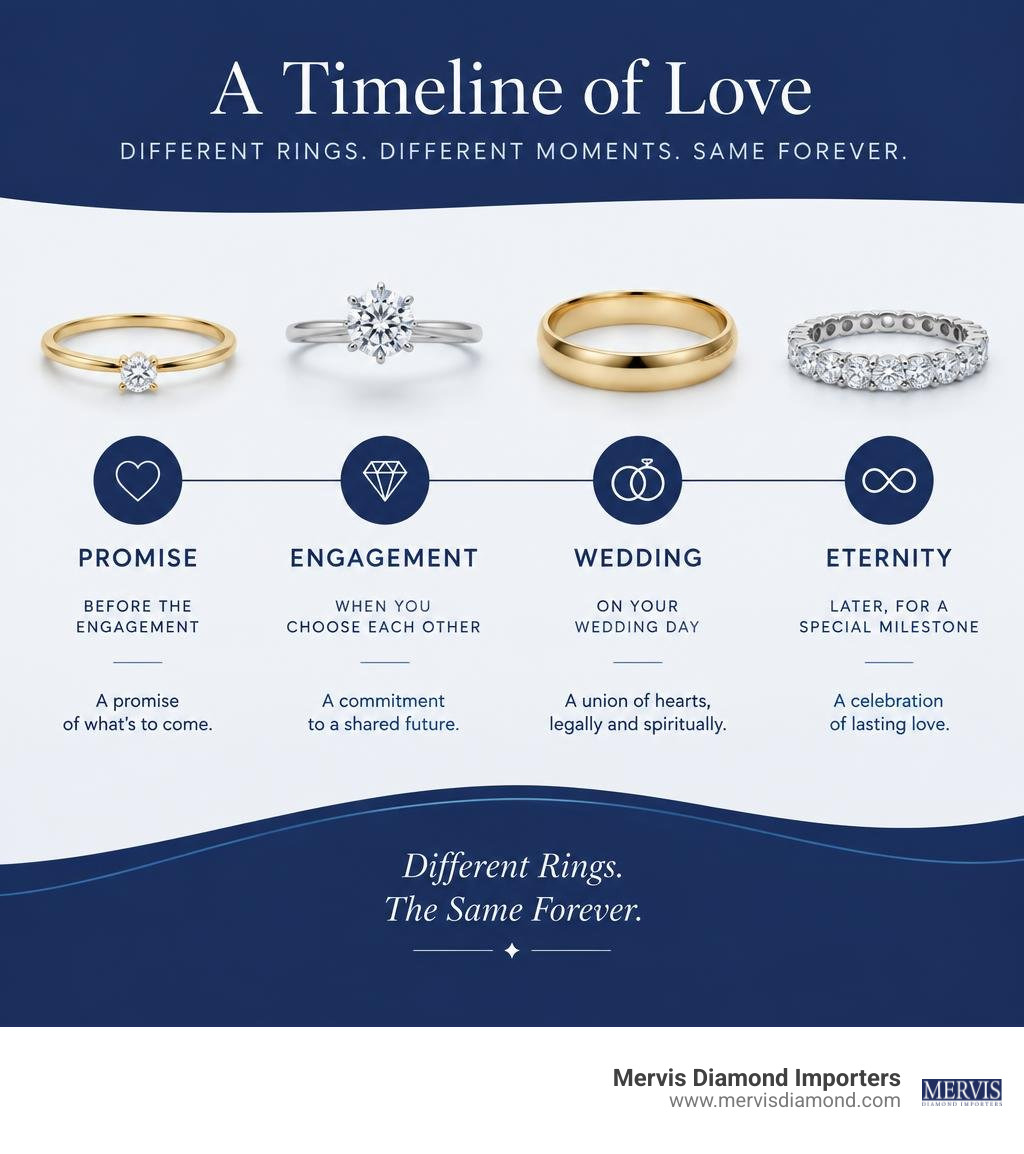
Choosing an eternity ring vs wedding ring starts with when and why it is given. A wedding ring is exchanged during the ceremony to mark a marriage. An eternity ring is often given later, for an anniversary or another milestone, to celebrate lasting love. Wedding bands can be plain or set with diamonds; eternity bands have stones across the top or all the way around.
Both can be meaningful choices. The best fit depends on the occasion, the look you prefer, and how the ring will feel in daily wear. I'm Morris Mervis, and I'll walk you through those differences so you can choose with confidence.
Eternity Ring vs Wedding Ring: Core Differences and Purposes
When building a bridal suite or selecting milestone jewelry, understanding how different bands function together brings clarity to the entire process. At their core, wedding bands and eternity rings serve distinct romantic purposes, follow different timelines, and feature unmistakable structural designs.
A wedding band is exchanged during the wedding ceremony. It represents the legal, spiritual, and emotional union of two partners—a sacred vow made on day one of a marriage. Traditionally crafted as a sleek metal band in yellow gold, white gold, rose gold, or platinum, wedding rings emphasize enduring strength and practical longevity.
In contrast, an eternity ring celebrates ongoing devotion. It is presented after the wedding, marking significant milestones such as a 5-year, 10-year, or 25-year anniversary, or the birth of a couple's first child. Its design is defined by an unbroken or semi-unbroken line of identically cut diamonds or gemstones, symbolizing that love has no beginning and no end.
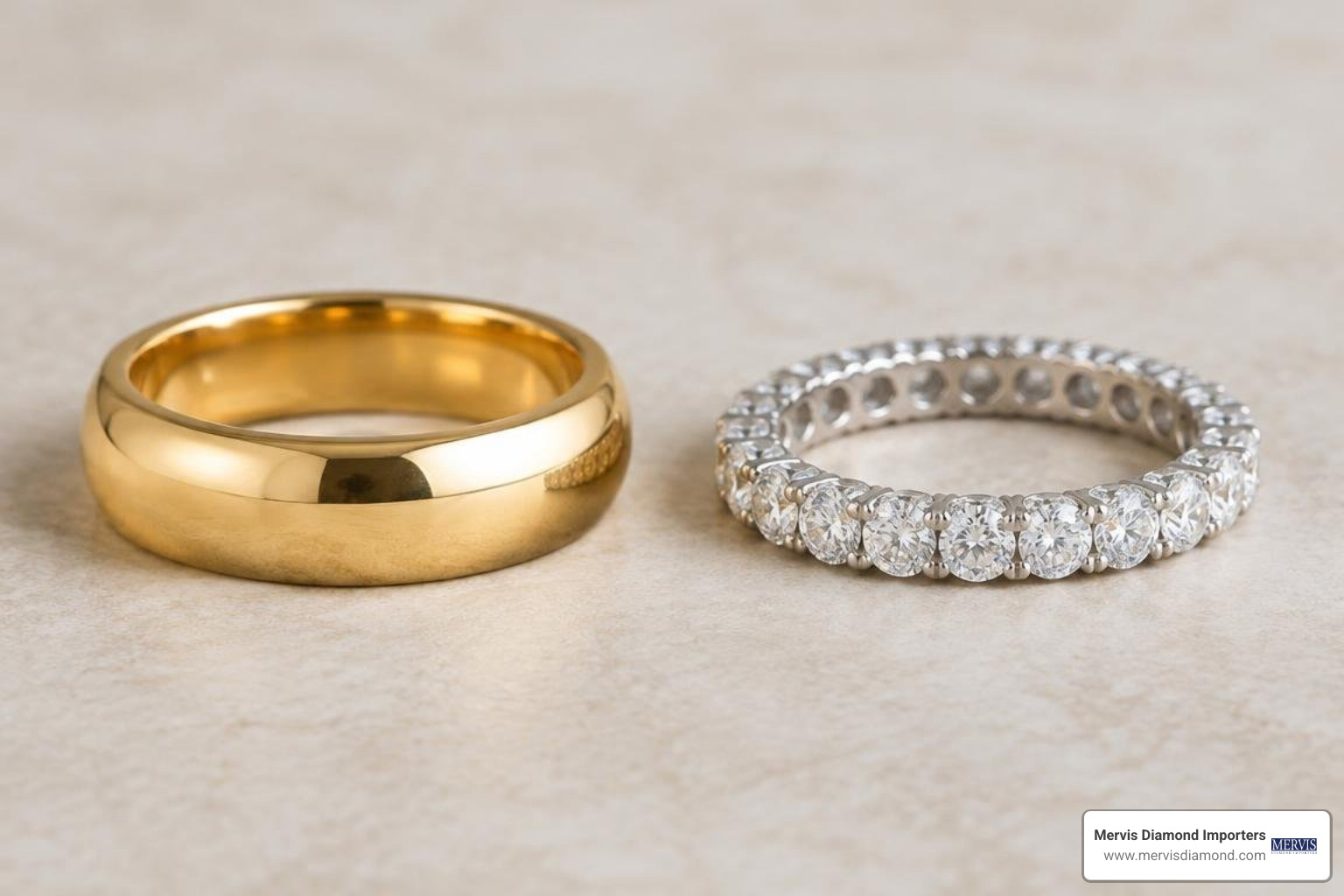
While classic traditions define clear lines between these pieces, modern couples frequently blend their purposes. Many brides select diamond eternity bands to serve as their official wedding bands during their ceremony, combining sparkling elegance with ceremony symbolism. Exploring current wedding ring styles demonstrates how personal taste often reshapes traditional conventions.
| Feature | Classic Wedding Ring | Diamond Eternity Ring |
|---|---|---|
| Primary Purpose | Formal commitment & marital union | Ongoing love & milestone celebration |
| Traditional Timing | Exchanged during wedding ceremony | Given on major anniversaries or life milestones |
| Gemstone Placement | Plain metal, single accent, or partial diamonds | Continuous 360° circle or half-coverage (face only) |
| Resizability | High (easy to resize up or down) | Low to none (full eternity cannot be resized) |
| Everyday Wearability | Exceptional comfort for active lifestyles | Requires mindful wear depending on stone setting |
Design Variations and Gemstone Settings
Designing an Eternity Ring vs Wedding Ring: Full vs. Half Eternity
The defining visual characteristic of an eternity band is its continuous line of uniform gemstones. However, how far those stones wrap around the finger fundamentally changes the ring's comfort, maintenance, and durability.
A full eternity ring features diamonds encircling the entire 360-degree circumference of the precious metal band. This unbroken loop delivers spectacular sparkle from every angle. Yet, wearing stones on the underside of the finger means diamonds constantly contact surfaces like desks, steering wheels, and door handles. As documented in the history of the eternity ring, full circles of stones can sometimes feel cumbersome between adjacent fingers.
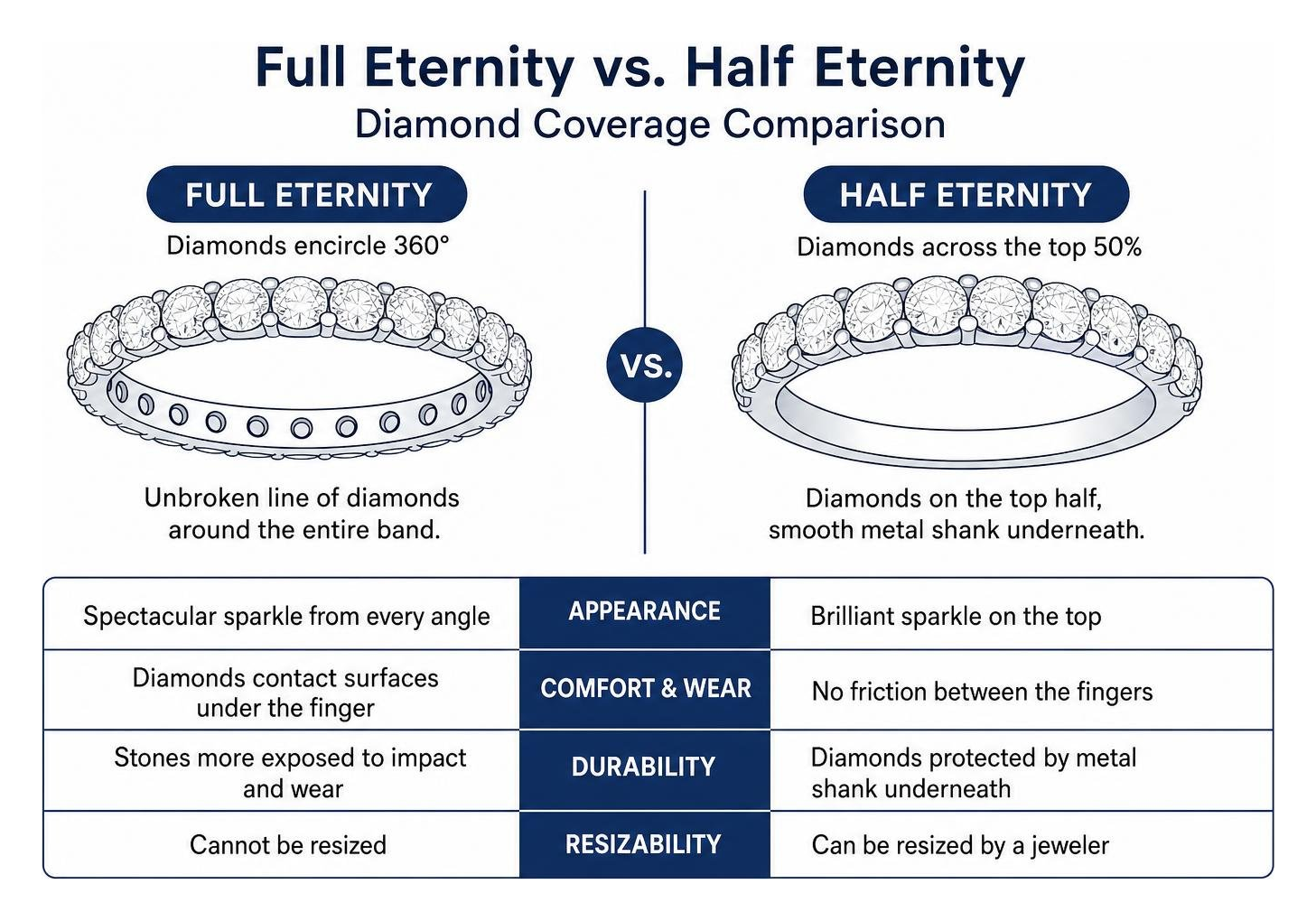
To solve these lifestyle challenges, the half-eternity ring places diamonds across the top 50 percent of the band while maintaining a smooth, solid precious metal shank underneath. This delivers several distinct advantages:
- Superior Comfort: Eliminates friction and bulk between the fingers.
- Enhanced Durability: Protects diamonds from direct impact against hard surfaces.
- Resizability: Allows a master jeweler to adjust the ring's size over time if your finger size fluctuates.
- Accessible Value: Achieves the brilliant aesthetic of a diamond band with approximately half the diamond carat weight.
Classic Metal Bands and Modern Diamond Accents
Classic wedding rings emphasize metalwork, ranging from traditional high-polish domed bands to contemporary flat, brushed, or hammered finishes. Platinum and yellow gold remain timeless choices due to their hypoallergenic nature, rich warmth, and structural resilience.
When diamonds are introduced into wedding bands and eternity rings, the setting style dictates both aesthetics and stone security:
- Shared Prong Settings: Minimalist metal allows maximum light to enter each diamond, producing intense brilliance.
- Channel Settings: Diamonds are nestled securely between two parallel walls of metal, creating a smooth, snag-free surface ideal for active lifestyles.
- Pavé and Micro-Pavé: Tiny diamonds are set closely together with micro-prongs, producing a seamless ribbon of diamond light.
- Bezel Settings: Each diamond is encircled by a rim of precious metal, delivering modern vintage flair and exceptional gemstone protection.
Selecting complementary setting styles ensures your wedding band and eternity ring sit flush against an engagement ring. You can explore seamless pairing techniques in our bridal ring set wearing guide.
Historical Origins and Relationship Symbolism
Ancient Traditions vs. 1960s Diamond Marketing Campaigns
The tradition of exchanging rings dates back millennia. Ancient Egyptians viewed the circle as a cosmic symbol of eternity—having no beginning and no end. They crafted early bands from woven reeds, bone, and iron, wearing them on the fourth finger of the left hand where they believed the vena amoris (the "vein of love") connected directly to the heart. Over centuries, these exchange rituals evolved across Roman, Renaissance, and Victorian traditions, cementing the solid precious metal wedding band as the universal emblem of lawful marriage.
Early precursors to eternity rings appeared during the 18th century as "keeper rings" or memorial bands, frequently set with paste gems, white topaz, or colored stones. However, the modern diamond eternity ring owes its global recognition to mid-20th-century history.
In the 1960s, a major diamond merchant negotiated an agreement to market uncut gem diamonds sourced from the Soviet Union's Siberian mines. Because these deposits yielded an abundance of smaller diamonds (frequently under 0.25 carats), the company launched a targeted marketing campaign introducing the diamond eternity ring. Marketed directly to husbands with evocative slogans celebrating enduring marriage, the campaign established a new tradition: honoring years of marital devotion with an unbroken band of brilliant small diamonds.
Symbolism of an Eternity Ring vs Wedding Ring Across Milestones
While both rings celebrate romantic devotion, their symbolic weight reflects different chapters of a shared life.
A classic wedding ring symbolizes a promise made at the beginning of a shared journey. It represents potential, sacred vows, and the formal start of a family unit.
An eternity ring represents promises kept. It honors the trials navigated, milestones achieved, and growth experienced after years of marriage. Popular milestone gifting moments include:
- The 10-Year Anniversary: Marking a decade of marital strength and companionship.
- The Birth or Adoption of a Child: Serving as a "push present" honoring new motherhood and family expansion.
- Significant Vow Renewals: Reaffirming vows at 20, 25, or 50 years with an elevated diamond band.
Couples looking to commemorate these cherished events can discover meaningful design ideas in our anniversary wedding bands guide.
How to Wear, Stack, and Care for Your Rings
Stacking Order with Engagement and Promise Rings
As fine jewelry collections grow from promise rings to bridal suites and milestone anniversary bands, establishing a cohesive stacking order keeps your rings comfortable and visually balanced.
The traditional bridal stacking custom places the wedding band on the finger first—closest to the heart—followed by the diamond engagement ring, and crowned with the diamond eternity ring. For detailed stacking techniques and alignment methods, consult our complete wedding ring worn guide.

Many modern wearers also choose to move their engagement ring to the right hand, allowing their wedding band and anniversary eternity ring to sit flush together on the left ring finger. Mixing precious metals—such as pairing a platinum engagement ring with a yellow gold eternity band—adds dynamic depth and individuality to your stack.
Comfort, Fit, and Long-Term Durability
Maintaining multiple precious rings requires attention to physical dimensions, lifestyle fit, and regular care:
- Band Width & Thickness: Stacking two or three wide bands can cause fingers to feel constricted. If you plan to wear an eternity ring alongside your wedding band, select slender profiles (1.5mm to 2.5mm) for effortless everyday comfort.
- Seasonal Swelling: Fingers expand in warm summer months and shrink in winter cold. Half-eternity bands handle these shifts comfortably without pinching.
- Professional Maintenance: Full and half-eternity rings feature dozens of tiny prongs. We recommend scheduling an inspection every six months to check prong tension, ensuring no stones have loosened during daily activities.
- Safe Cleaning: Clean diamond bands at home using warm water, mild dish soap, and a soft-bristled baby toothbrush. Avoid abrasive household chemicals or wearing diamond bands during heavy weightlifting and gardening.
Frequently Asked Questions
Can an eternity ring be used as a wedding ring?
Yes. Many modern brides choose a diamond eternity or half-eternity band as their official wedding ring during their ceremony. It provides continuous sparkle and pairs elegantly with solitaire engagement rings.
When is an eternity ring traditionally given?
Eternity rings are traditionally given to commemorate major marriage milestones—most commonly the 1st, 5th, 10th, or 25th wedding anniversary—or to celebrate the birth of a couple's first child.
Can you resize a full eternity band?
A full eternity band cannot be resized easily because diamonds cover the entire circumference. Sizing up or down requires rebuilding the metal basket structure or adding inner sizing beads. For guaranteed flexibility, half-eternity bands are recommended because their solid metal base allows standard resizing.
Conclusion
Choosing between an eternity ring and a classic wedding band comes down to timing, lifestyle, and how you want to celebrate your love story. While wedding rings represent the foundational vows made at the altar, eternity rings stand as sparkling testaments to the milestones, growth, and lasting devotion built in the years that follow.
At Mervis Diamond Importers, we take pride in helping couples across Washington DC, North Bethesda / Rockville MD, and Tysons VA find jewelry that reflects their individual journey. Whether you are searching for hand-selected natural diamonds, premier lab-grown diamonds, or custom-designed bands, our expert team provides pressure-free guidance every step of the way. To explore how to style your bridal suite effortlessly, explore our expert guide on how to wear your engagement and wedding rings, or schedule a private consultation at one of our local DMV showrooms today.