

Everything You Need to Know About Diamond Tennis Bracelets
What Is a Diamond Tennis Bracelet? A Quick Answer
A diamond tennis bracelet is a flexible, elegant bracelet featuring a continuous single row of individually set diamonds linked end to end. It is one of the most popular and timeless pieces in fine jewelry.
Quick facts at a glance:
| Feature | Details |
|---|---|
| Design | Single row of diamonds in a continuous line |
| Common diamond types | Natural or lab-grown |
| Typical carat weight | 1 ct to 10+ ct total weight |
| Popular metals | 14K/18K white gold, yellow gold, rose gold, platinum |
| Common settings | Prong, bezel, channel, pave |
| Average bracelet length | 7 inches (fits most wrists) |
| Price range | ~$1,470 to $59,850+ for natural diamonds; up to 60% less for lab-grown |
| Suitable for | Everyday wear and special occasions |
Few pieces of jewelry manage to feel both effortlessly casual and genuinely luxurious at the same time. The diamond tennis bracelet does exactly that.
It has graced the wrists of brides, athletes, and everyday jewelry lovers for decades. And with the global diamond jewelry market valued at around $85 billion, it's clear this isn't just a passing trend.
Whether you're buying your first fine jewelry piece, looking for a meaningful gift, or simply want to understand what separates a $1,500 bracelet from a $15,000 one — this guide covers everything you need to know. We'll walk through the history, diamond quality, settings, sizing, care, and how to get the best value without second-guessing your purchase.
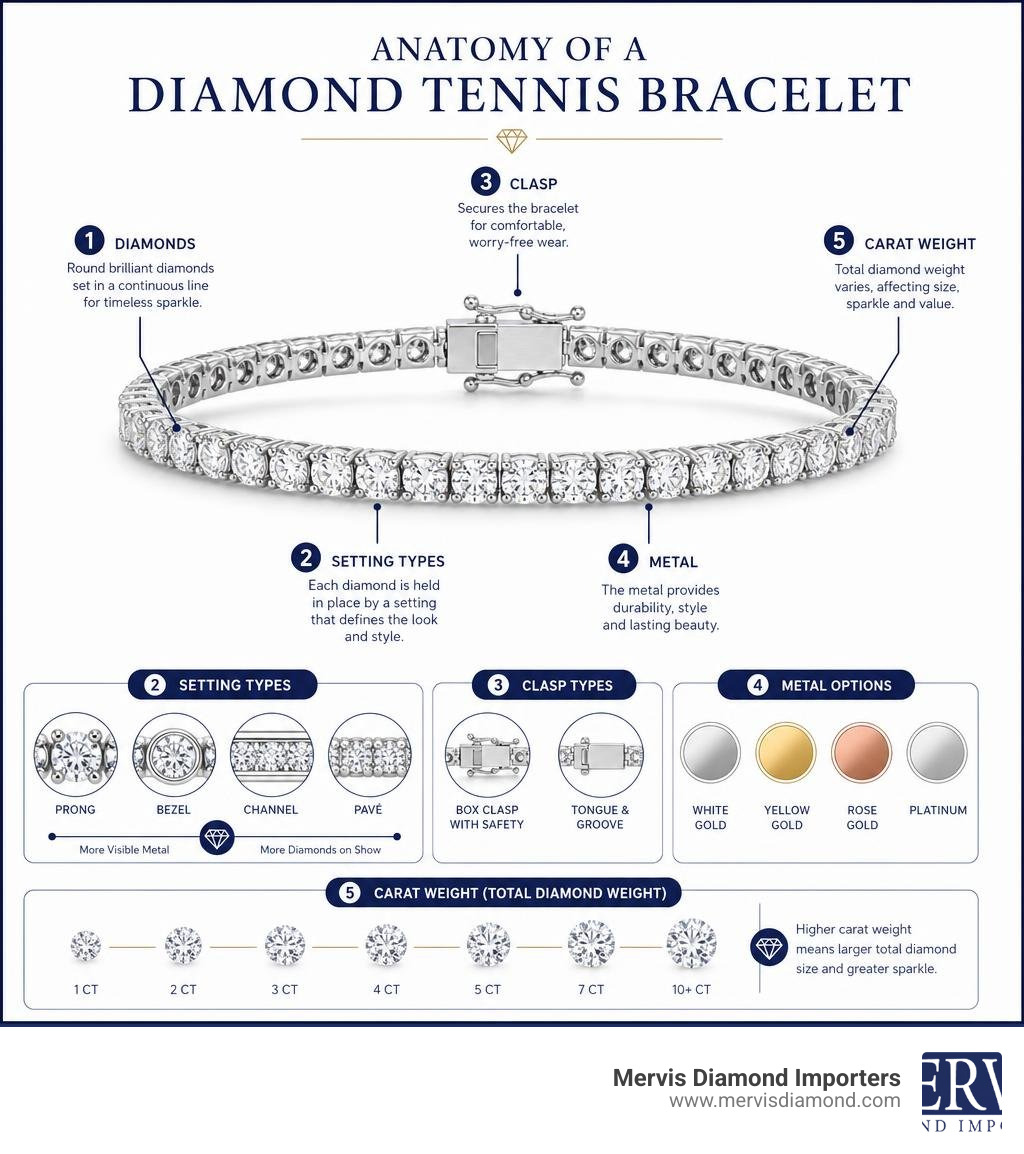
The History and Origin of the Diamond Tennis Bracelet
Before it became known as the "tennis bracelet," this style was simply referred to as an "eternity bracelet" or a "line diamond bracelet." It was a classic, elegant design, but it wasn't necessarily associated with athletic courts or everyday activewear.
That all changed during the 1987 US Open. Professional tennis star Chris Evert was playing a high-stakes match when her diamond line bracelet, designed by jeweler George Bedewi, suddenly broke. The clasp had failed, sending her precious diamonds scattering across the court. Evert immediately requested that officials pause the match so she could retrieve her diamonds.
During the post-match press conference, she referred to the missing jewelry as her "tennis bracelet." The name stuck instantly, capturing the public's imagination. Overnight, the jewelry world had a new term, and a star was born.
The incident revolutionized how we view fine jewelry. It proved that diamonds didn't need to be locked away in a safe, reserved only for formal galas. They could be worn during a rigorous athletic match, at the office, or while running errands. Today, this iconic piece remains a staple of modern fashion. If you want to dive deeper into this fascinating court-side mishap, you can read more about the Origin of the Tennis Bracelet.
Over the decades, design standards have evolved to prevent similar on-court disasters, introducing highly secure safety clasps. Yet, the timeless appeal remains entirely unchanged. If you have ever wondered whether these classic pieces are still in vogue, rest assured that they are as relevant as ever—explore our thoughts on Are Diamond Tennis Bracelets Out of Style to see how they continue to dominate modern fashion trends.
Natural vs. Lab-Grown Diamonds: Choosing Your Sparkle
When shopping for a diamond tennis bracelet in June 2026, one of the most important decisions you will make is choosing between natural and lab-grown diamonds. Both options offer breathtaking beauty, but they cater to different budgets, values, and preferences.
From a physical, chemical, and optical standpoint, natural and lab-grown diamonds are identical. Both are composed of pure carbon arranged in a crystalline structure, meaning a lab-grown diamond will sparkle with the exact same brilliance and fire as a natural stone. Even a professional gemologist cannot tell them apart without specialized laboratory equipment.
However, their origins and pricing structures are vastly different:
- Natural Diamonds: Formed deep within the Earth over billions of years under immense heat and pressure, natural diamonds are rare geological treasures. They hold a unique prestige and generally retain their value better over time.
- Lab-Grown Diamonds: Created in controlled laboratory environments using advanced technology that replicates the Earth's natural processes. Because the supply chain is shorter and highly efficient, they offer incredible cost savings.
To help you visualize the differences, here is a quick comparison:
| Feature | Natural Diamond Bracelet | Lab-Grown Diamond Bracelet |
|---|---|---|
| Origin | Mined from the Earth | Grown in a laboratory |
| Chemical Composition | Pure Carbon (C) | Pure Carbon (C) |
| Price Point | Premium ($1,470 to $59,850+) | Highly accessible (Up to 60% lower) |
| Value Retention | Historically strong | Lower resale value |
| Best For | Traditionalists, milestone investments | Maximizing carat size for your budget |
The price difference is substantial. Lab-grown options are often offered at prices up to 60% lower than their natural diamond equivalents. For example, a spectacular 10-carat total weight lab-grown diamond bracelet that might normally retail around $7,999 can be found for approximately $3,199.60. Similarly, a beautiful 7-carat total weight certified lab-grown diamond bracelet set in 10K or 14K white gold offers an incredibly accessible luxury option at around $3,999.98.
For comparison, a natural diamond tennis bracelet can range from $1,470 for a delicate 1.10-carat design to upwards of $59,850 for a massive 17.41-carat multi-shaped masterpiece. If you want to maximize your budget and get a larger, show-stopping look, explore our certified lab-grown options to find the perfect balance of scale and value.
Key Factors That Affect Appearance and Price
Several key factors dictate how much a diamond tennis bracelet will cost and how it will look on your wrist. Understanding these variables will help you make an informed decision.
Understanding Carat Weight in a Diamond Tennis Bracelet
When looking at tennis bracelets, you will see the term "total carat weight" (often abbreviated as CT. T.W. or ctw). This refers to the combined weight of all the diamonds in the bracelet, rather than the size of a single stone.
Because a tennis bracelet is made of dozens of smaller diamonds, the pricing structure is different than that of a solitaire diamond ring. A single 5-carat diamond ring is exceptionally rare and expensive, but a 5-carat total weight tennis bracelet is made of roughly 50 individual 0.10-carat diamonds, making it far more accessible.
The visual impact of carat weight is direct: a 2ctw to 3ctw bracelet offers a delicate, subtle shimmer perfect for daily layering, while a 10ctw+ bracelet delivers a bold, unmistakable statement.
Choosing the Right Diamond Shape for Your Style
While the round brilliant cut is the undisputed classic for tennis bracelets, modern jewelry design offers a variety of beautiful shapes to match your personal aesthetic:
- Round Brilliant: The traditional choice. It features 58 facets designed to maximize light reflection, offering unmatched sparkle.
- Princess Cut: Square-shaped diamonds set side-by-side. They create a sleek, modern, and continuous line of light with very little metal showing between the stones.
- Emerald Cut: Rectangular step-cut diamonds that emphasize clarity and sophistication over raw sparkle. A lab-grown 10.85-carat emerald cut tennis bracelet, for example, offers an incredibly sleek, architectural look.
- Oval and Pear Cuts: These elongated shapes offer a unique, contemporary twist on the traditional style, making the bracelet stand out from across the room.
Selecting the Perfect Metal Type
The metal you choose acts as the frame for your diamonds, influencing both the durability and the overall color profile of your bracelet.
- Platinum: The most durable and secure option. It is naturally hypoallergenic and has a heavy, luxurious weight. Because of its density, it holds diamonds incredibly securely, though it comes at a higher price point.
- White Gold (14K or 18K): The most popular choice for a seamless, icy look. 14K gold is roughly 58% pure gold and is highly durable for everyday wear. That white gold is plated with rhodium to maintain its bright white finish, which may need to be refreshed every six months to two years.
- Yellow Gold: A classic, warm choice that provides a stunning contrast against bright white diamonds. It is perfect for those who love a vintage or traditional look.
- Rose Gold: Offers a romantic, modern, and soft pink hue that looks beautiful on all skin tones.
Settings, Sizing, and Styling Your Bracelet
Once you have selected your diamonds and metal, the next steps involve choosing the setting style, finding the correct size, and learning how to wear your new piece.
Comparing Settings: Prong, Bezel, Channel, and Pave
The setting refers to how the diamonds are secured to the metal link structure. This choice greatly impacts both the style and durability of your bracelet.

- Prong Setting (3-Prong or 4-Prong): The classic option. It uses tiny metal claws to hold each diamond in place, allowing the maximum amount of light to enter the stones from all angles for ultimate brilliance.
- Bezel Setting: The diamonds are wrapped in individual metal cups. This is a highly protective setting that prevents the edges of the diamonds from chipping, creating a smooth, modern, and snag-free design.
- Channel Setting: The diamonds are nestled between two continuous walls of metal. This provides excellent protection and a very sleek, uninterrupted stream of sparkle.
- Pave Setting: Features clusters of tiny diamonds set closely together, creating a shimmering, textured surface of light.
Finding the Perfect Fit and Sizing Adjustments
A diamond tennis bracelet should drape comfortably on your wrist without being too tight or too loose. If it is too tight, it will pinch your skin and strain the links; if it is too loose, it can slide down your hand or snag on objects.
To find your size, wrap a soft measuring tape around your wrist just below the wrist bone, then add half an inch to an inch to that measurement. The average bracelet length for women is 7 inches, but they can easily be customized.
If you purchase a bracelet that is too large, a skilled jeweler can remove links to achieve the perfect fit. If you need assistance with professional sizing, custom adjustments, or clasp repairs, we encourage you to visit our local jewelry services. We proudly serve clients across our convenient locations in Tysons, VA, Rockville, MD, and Washington, DC.
How to Style a Diamond Tennis Bracelet for Everyday Wear
One of the greatest attributes of the diamond tennis bracelet is its sheer versatility. It transitions seamlessly from a morning workout to a high-profile board meeting, and finally to a black-tie gala.

Here are a few of our favorite ways to style this iconic piece:
- The Solo Statement: Wear a single 4ctw to 6ctw bracelet on your non-dominant wrist. It provides a clean, elegant, and sophisticated look that elevates even a simple white t-shirt and jeans.
- The Wrist Stack: Layer your tennis bracelet with a luxury watch or other metal bangles. Mix metals—such as pairing a white gold tennis bracelet with a yellow gold cuff—for a chic, contemporary aesthetic. If you want to master the art of layering, check out The Ultimate Stacking Guide.
- Bridal Perfection: A tennis bracelet is an unquestionable classic in bridal jewelry. It adds the perfect touch of delicate, sophisticated sparkle to a wedding gown without distracting from the rings.
- Summer Shimmer: Bring light, airy elegance to your warm-weather wardrobe by learning How to Incorporate Diamonds into Your Summer Style.
If you love the look of coordinated jewelry, you can also celebrate life's milestones by pairing your bracelet with stunning ring combinations—discover how in our guide to Celebrate All of Life's Milestones with Ring Stacks.
Frequently Asked Questions About Diamond Tennis Bracelets
We hear many questions from our clients in our Washington, DC, Maryland, and Virginia showrooms. Here are the answers to the most common queries.
Can you wear a tennis bracelet every day?
Yes, absolutely! Tennis bracelets are designed to be flexible and durable, making them highly suitable for daily wear. However, you should still exercise reasonable care.
We recommend removing your bracelet before swimming in chlorinated pools, lifting weights at the gym, or doing heavy household cleaning. Additionally, always ensure your bracelet features a secure clasp - such as a box clasp with a single-latch safety feature - to prevent it from accidentally falling off.
How do you clean and care for a tennis bracelet?
Over time, daily wear can cause soaps, lotions, and skin oils to build up behind the diamonds, dulling their natural sparkle. Fortunately, cleaning your bracelet at home is simple:
- Soak your bracelet in a bowl of warm water mixed with a few drops of mild dish soap for 10 to 15 minutes.
- Gently scrub the diamonds, especially underneath the settings, using a soft-bristled toothbrush.
- Rinse the bracelet thoroughly under warm running water (make sure the drain is closed!).
- Pat it dry with a lint-free cloth.
To keep your fine jewelry looking its absolute best, we recommend visiting us once a year for a professional inspection of the prongs and clasp. For more helpful maintenance advice, check out our expert care tips.
What certification should you look for when buying?
When purchasing a high-value piece of jewelry, peace of mind is paramount. Always look for diamonds that are certified by reputable, independent gemological laboratories, such as the Gemological Institute of America (GIA).
A GIA report or similar reputable grading documentation ensures that the diamonds have been thoroughly evaluated for their cut, color, clarity, and carat weight. This certification guarantees that you are getting exactly what you are paying for, protecting your investment for years to come.
Conclusion
A diamond tennis bracelet is far more than just a beautiful accessory—it is a timeless investment, a symbol of personal style, and a piece of jewelry history that you can wear every single day. Whether you prefer the classic prestige of natural diamonds or the incredible value of lab-grown stones, the key is to choose a piece crafted with exceptional care and high-quality materials.
At Mervis Diamond Importers, we specialize in offering hand-selected, premium natural and lab-grown diamonds paired with expert, pressure-free service. Our non-commissioned consultants are dedicated to helping you find a piece you will love forever.
If you are ready to find your perfect bracelet, we invite you to stop by one of our three convenient showrooms in Tysons, VA, Rockville, MD, or Washington, DC. Our team is here to guide you through every step of the process. To prepare for your visit, read more about the fascinating Origin of the Tennis Bracelet and start dreaming of your perfect sparkle today!