

Is Your Diamond Girdle Too Thick or Dangerously Thin?
Diamond Girdle Thickness Chart: What the Ratings Mean
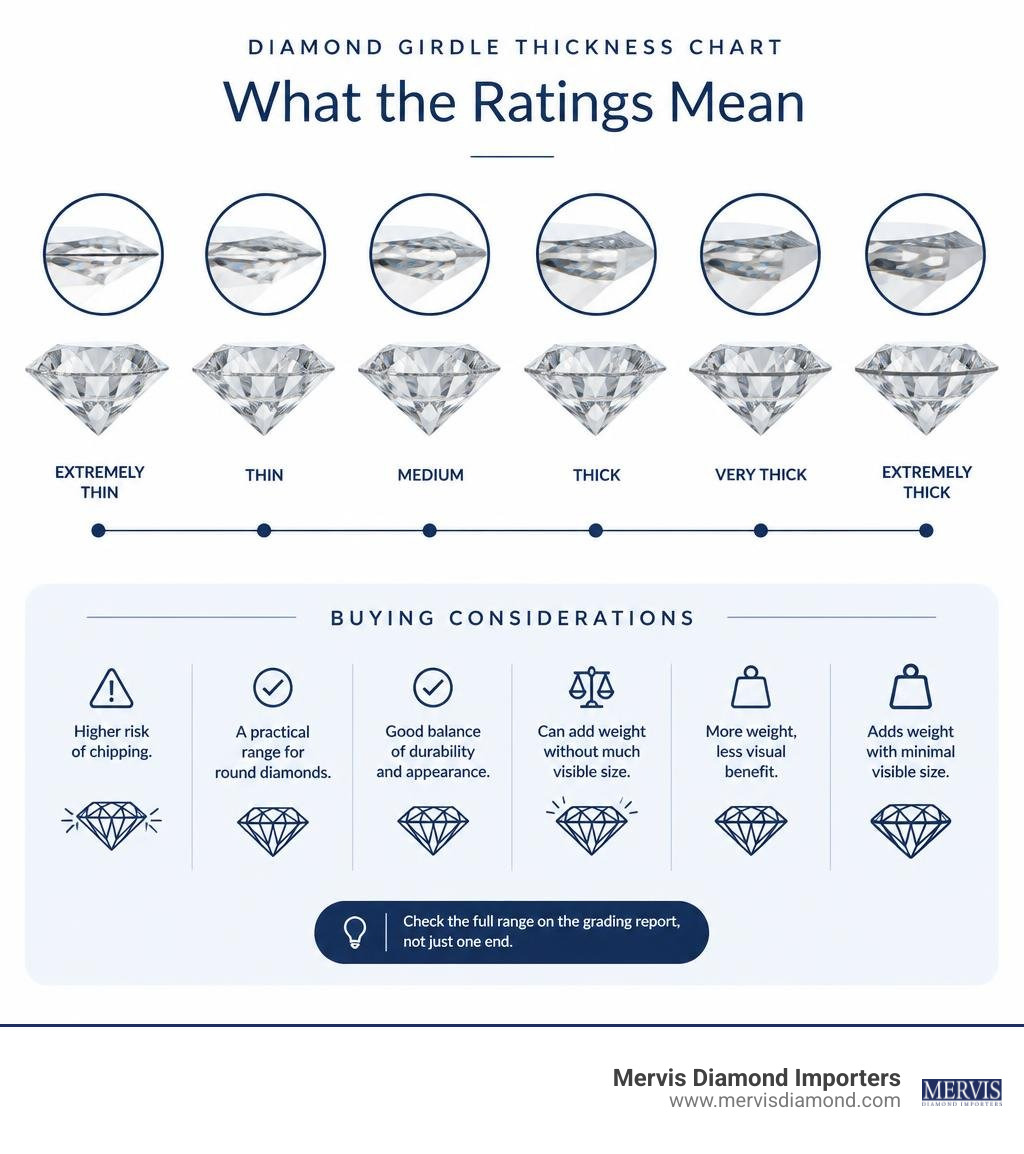
A diamond girdle thickness chart helps you judge the narrow edge where the top and bottom of a diamond meet. For a round diamond, Thin to Slightly Thick is a practical range to consider. Extremely Thin can mean a higher risk of chipping, while Very Thick or Extremely Thick can add weight without adding much visible size. Check the full range on the grading report, not just one end.
Girdle thickness also plays a part in the overall cut grade. The sections below show how to read the chart and what to check before choosing a ring. I'm Morris Mervis, and I'll walk you through it.
What Is a Diamond Girdle and Why Does Its Thickness Matter?
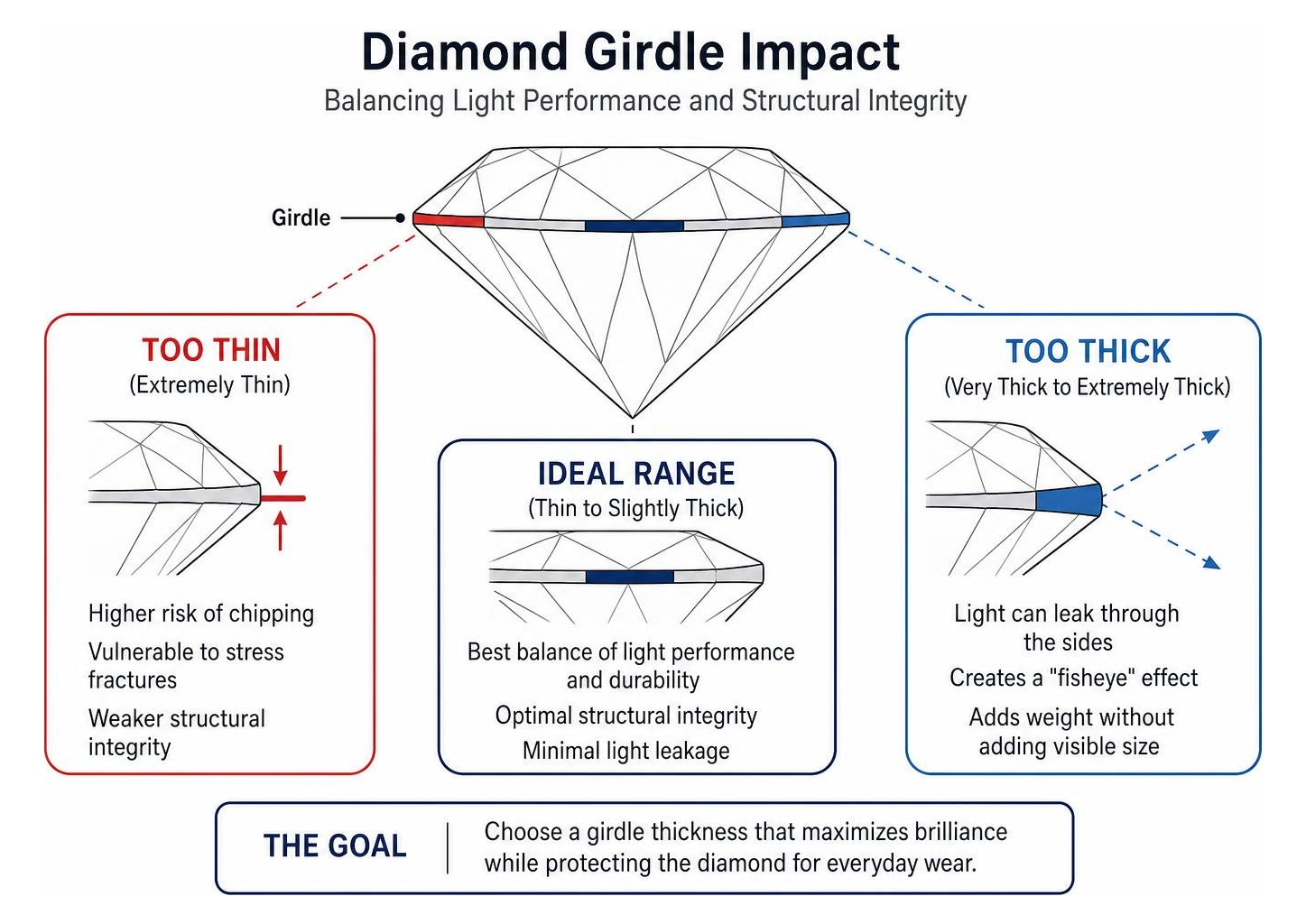
When looking at a diamond in profile, the girdle is the outer perimeter separating the upper crown from the lower pavilion. It serves as the physical setting edge where prongs grip the diamond or where a metal bezel wraps around the perimeter.
While it may look like a simple dividing line, the girdle is essential for structural integrity and optical performance. If it is cut too thin, the stone becomes vulnerable to stress fractures during setting and daily wear. If cut too thick, light can leak through the sides, creating a dark, lifeless ring around the stone known as a "fisheye" effect or dulling edge brilliance.
Understanding this balance is a crucial element of our comprehensive 4Cs diamond evaluation guide.
Anatomy of the Girdle: Valleys vs. Hills
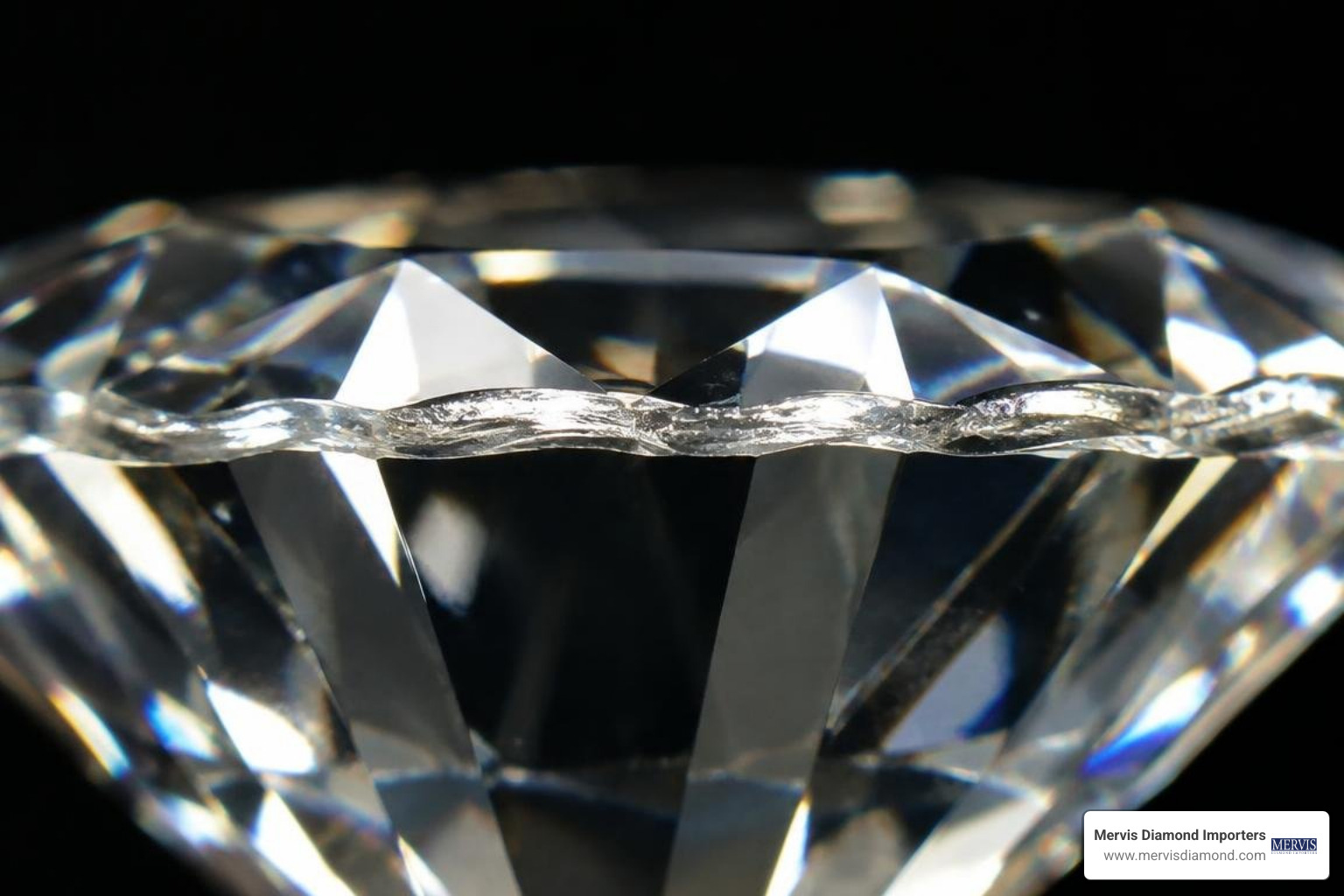
The girdle of a standard round brilliant diamond is not a flat, uniform ribbon. Instead, it features a scalloped edge made up of 16 "valleys" (the thinnest spots) and 16 "hills" (the thickest points).
These peaks and dips are created during final brillianteering, when the diamond cutter places 16 upper girdle facets and 16 lower girdle facets around the stone's circumference:
- Valleys: Formed where the upper and lower girdle facets meet directly along the junction. These represent the narrowest, most fragile points on the perimeter.
- Hills: Formed where the kite facets (bezel facets) on the crown meet the main pavilion facets. These create the thickest vertical cross-sections.
Because structural failure almost always begins at the narrowest spot, gemological laboratories focus their thickness assessments on these 16 valley positions.
Durability, Settings, and Light Performance
The girdle functions as the diamond's bumper. When a setter sets a stone into a ring, the prongs must apply firm, focused pressure directly against this edge. A stone with sufficient girdle thickness absorbs that tension effortlessly. An overly thin edge, however, can crack or cleave under pressure.
Girdle thickness also impacts light path dynamics. When light enters through the table and crown facets, it must refract downward to the pavilion angles and bounce back to your eyes. An overly thick girdle acts as an unpolished or improperly angled barrier that allows light rays to escape out the sides rather than reflecting toward the top.
Balancing these factors helps shoppers identify the right balance of durability and brilliance when evaluating the best cut for engagement rings.
The Master Diamond Girdle Thickness Chart and Percentage Ranges
Gemological laboratories categorize diamond girdles using standardized percentage ranges and corresponding verbal descriptions, establishing clear parameters under the ISO 24016 diamond grading standards.
Below is the definitive reference table comparing verbal ratings, valley-to-hill percentage ranges, visual characteristics, durability considerations, and maximum attainable cut grades.
| Verbal Rating | Percentage Range (Valley % / Hill %) | Visual Profile | Durability Risk | Max Cut Grade Eligibility |
|---|---|---|---|---|
| Extremely Thin (ETN) | < 1.2% valley | Knife-edge sharp; crown and pavilion almost touch | High risk of chipping and setting damage | Fair to Poor |
| Very Thin (VTN) | 1.2% – 2.0% valley | Delicate, razor-fine hairline edge | Moderate risk under prong pressure | Very Good to Good |
| Thin (TN) | 2.0% – 3.0% valley | Fine, clean boundary edge | Minimal risk; safe for standard settings | Excellent |
| Medium (MED) | 3.0% – 4.0% valley | Perfectly balanced, defined boundary | Negligible risk; ideal structural durability | Excellent |
| Slightly Thick (STK) | 4.0% – 4.5% hill | Clearly visible, sturdy edge | Zero risk; safe for all setting types | Excellent |
| Thick (THK) | 4.5% – 6.0% hill | Chunky band around perimeter | Zero durability risk; minor hidden weight | Very Good to Good |
| Very Thick (VTK) | 6.0% – 8.0% hill | Heavy, prominent grey or faceted band | Zero durability risk; significant dead weight | Good to Fair |
| Extremely Thick (ETK) | > 8.0% hill | Wide, barrel-like band around the stone | Zero durability risk; severe face-up size penalty | Fair to Poor |
Reading the Diamond Girdle Thickness Chart for GIA Cut Grades
Under the GIA Cut Grading System booklet, girdle thickness serves as a "limiting parameter." This means an extreme girdle measurement caps the final cut grade, even if the diamond has an ideal 57% table, a 61.5% total depth, and flawless 34.5-degree crown angles:
- Excellent Cut Grade: Requires the girdle to fall strictly between Thin and Slightly Thick (averaging between 2.5% and 4.2%).
- Very Good Cut Grade: Allows the range to expand slightly from Very Thin to Thick.
- Good Cut Grade: Accommodates diamonds with girdles reaching Very Thick.
- Fair to Poor Cut Grades: Assigned automatically to stones with Extremely Thin (knife-edges) or Extremely Thick girdles due to severe durability or proportion flaws.
Measurement Formulas and Verbal Descriptions
Non-contact optical scanners calculate the exact thickness percentage by dividing the girdle thickness in millimeters by the average diameter in millimeters, then multiplying by 100. For example, if a 1.00-carat round brilliant has an average diameter of 6.40 mm and a girdle thickness measured at 0.20 mm, the calculation is 0.20 divided by 6.40, times 100, which equals 3.125%—a Medium rating.
Because digital non-contact measuring devices have minor calibration tolerances and can be influenced by internal inclusions near the surface, professional gemologists verify every measurement under 10x magnification to confirm the verbal description.
The Dangers of Extreme Girdles: Knife Edges vs. Dead Weight
When cutters polish rough diamonds, they face a choice: maximize light performance or maximize retained carat weight. Choosing carat yield over optical balance often leads to extreme girdles that either compromise the stone's physical integrity or create dead weight.
Thin Girdles: Chipping Risks and Mounting Vulnerability
An Extremely Thin girdle is often referred to in the trade as a "knife-edge." In this scenario, the crown facets meet the pavilion facets with almost no flat surface in between.
This presents several long-term risks:
- Mounting Damage: The mechanical pressure required to tighten prongs over a knife-edge girdle can cause the diamond to fracture during setting.
- Cleaving Along Grain Lines: Diamonds are the hardest known natural mineral, but they have directional cleavage planes. A direct impact on a knife-edge girdle can shear a chunk off the stone.
- Daily Wear Vulnerability: A ring bumped against a hard granite countertop or metal door handle can easily chip an exposed, razor-thin girdle.
Thick Girdles: The Weight Ratio Trap and Stolen Carat Spread
On the opposite end of the spectrum, an Extremely Thick girdle acts as a hiding place for "dead weight." Diamond rough is priced per carat, which tempts some cutters to leave extra bulk around the girdle simply to keep a finished diamond above lucrative weight thresholds (such as 1.00, 1.50, or 2.00 carats).
A detailed Rapaport analysis on diamond Weight Ratio highlights the financial penalty of this practice. The Weight Ratio compares the actual weight of a diamond to the reference weight of an ideally cut stone with the same diameter.
When a diamond has a thick or very thick girdle:
- The Face-Up Size Suffers: A 1.00-carat round diamond with an ideal girdle measures roughly 6.5 mm in diameter. A 1.00-carat diamond with a Very Thick girdle might measure only 6.1 mm across—giving it the visual spread of an ordinary 0.85-carat diamond.
- You Pay for Invisible Carats: You pay the premium for a full 1.00-carat stone, but the extra weight is hidden in a thick band around the center.
- The Cut Grade Drops: Even if the diamond's table and polish are flawless, a Weight Ratio exceeding 1.08 to 1.09 will downgrade the stone from Excellent to Very Good or Good.
Advanced Proportion Factors: Painting, Digging Out, and Depth
A diamond cutter can intentionally tilt and rotate individual facet junctions along the perimeter. These adjustments are known as painting and digging out.
How Painting and Digging Out Alter Girdle Symmetry
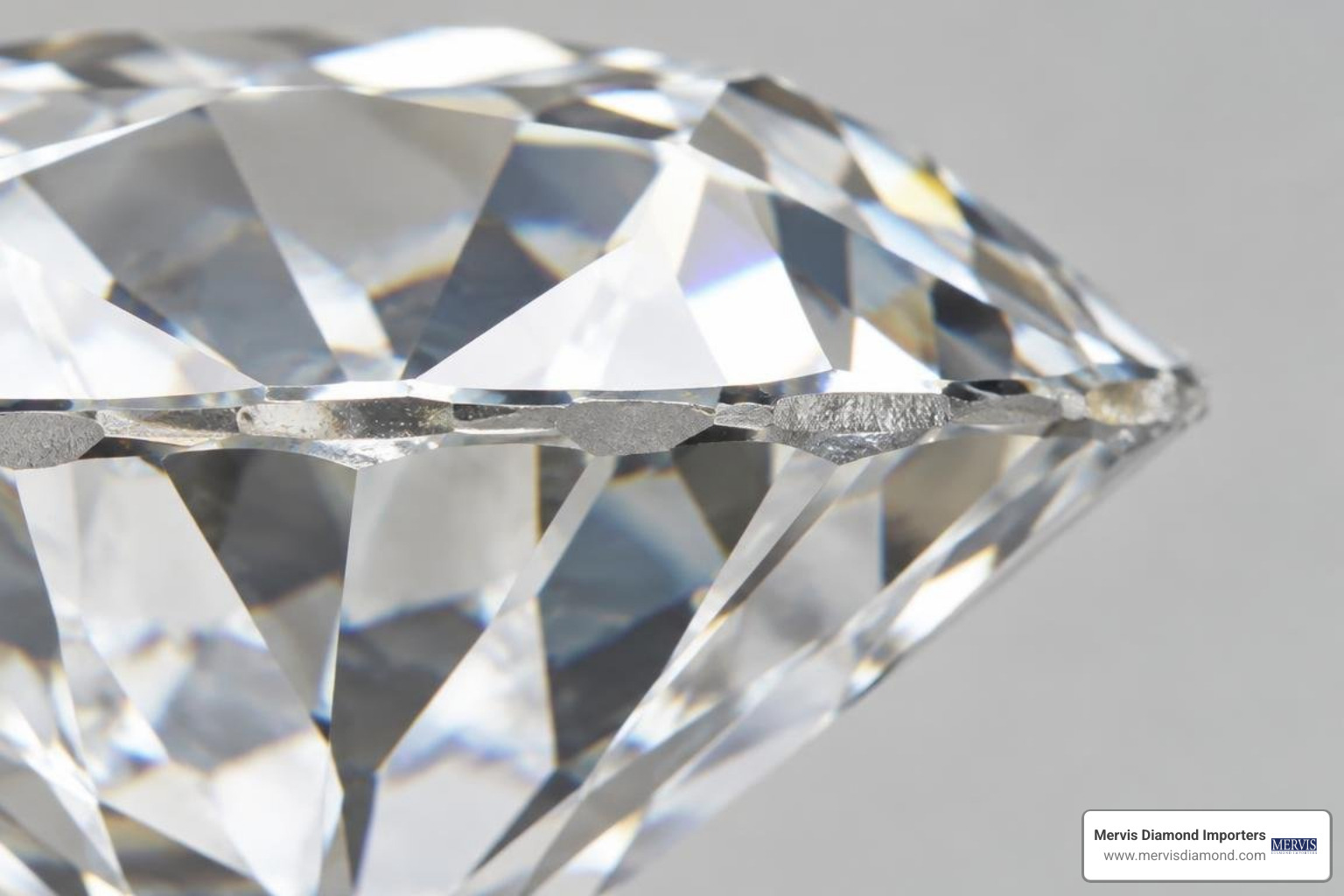
- Painting: The cutter angles the upper or lower girdle facets toward the adjacent main facets. This thickens the girdle valleys, shifting the boundary outward and retaining more weight from the rough crystal. While it adds carat weight, heavy painting alters light refraction, reducing high-contrast scintillation and creating a dull appearance.
- Digging Out: The cutter angles the girdle facets away from the main facets, deepening the valleys and thinning the girdle edges. This creates large differences between the hills and valleys, introducing thin zones that are more prone to chipping.
Both techniques can disrupt optical symmetry. If either technique is used excessively, the diamond's cut grade will be downgraded.
Total Depth Percentage vs. Girdle Thickness
Total depth percentage measures the diamond from the table down to the culet, expressed as a proportion of its diameter. To calculate it, divide the total depth in millimeters by the average diameter in millimeters, then multiply by 100.
For a round brilliant, the historical benchmark for ideal total depth is roughly 59.0% to 62.5%. However, a thick girdle can distort this measurement:
- A diamond might display an acceptable total depth of 62.2%, suggesting good proportions on paper.
- If 6.5% of that depth comes from a Very Thick girdle, the crown and pavilion must be cut shallower to compensate.
- This shallow combination reduces the stone's ability to bounce light back out the top, leading to light leakage and a duller look.
How to Evaluate Girdle Thickness on a Grading Report
Grading certificates from laboratories like the GIA report girdle thickness in two places: within the proportion diagram profile and under the grading parameters table.
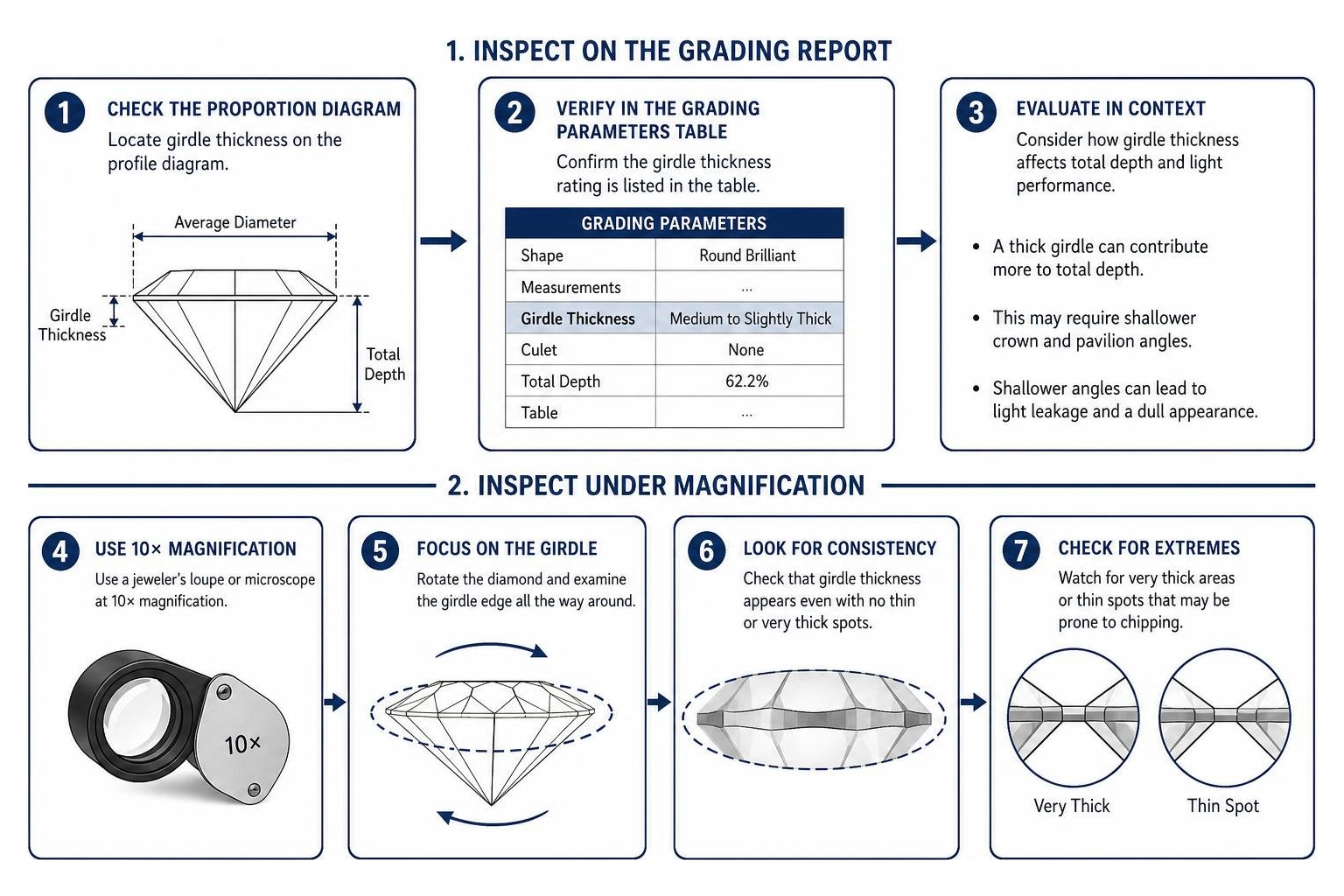
When reviewing reports for loose diamonds and engagement settings, look for the following details:
How to Use a Diamond Girdle Thickness Chart When Buying Online
When buying online or reviewing digital grading reports, use these best-practice guidelines:
- Target the Sweet Spot: Look for a listed range between Thin to Medium, Medium to Slightly Thick, or Thin to Slightly Thick.
- Review the Full Range: Reports list both the thinnest valley and thickest hill (e.g., Very Thin to Thick). Avoid stones with broad variations, as they often point to poor symmetry or aggressive painting and digging out.
- Verify the Millimeter Spread: Cross-reference the carat weight with the average millimeter diameter. If a 1.50-carat round diamond measures less than 7.30 mm across, check the girdle thickness—the diamond may be hiding unnecessary weight around its perimeter.
Interpreting Min-Max Ranges and Clarity Characteristics
Minor physical characteristics along the girdle can also influence the reported thickness range:
- Naturals and Indented Naturals: Small remnants of the original rough diamond crystal left on the girdle edge. If an indented natural dips inward, the lab records the thinnest remaining section, which may drop the listed minimum to Very Thin.
- Extra Facets: Additional facets placed along the edge to polish out a surface flaw can narrow the girdle locally.
- Bearded Girdles: Minute, hairline fractures extending into the stone caused by excessive friction during the rounding process. A heavily bearded girdle weakens the edge and can lower both the clarity and cut grades.
Frequently Asked Questions About Diamond Girdles
What is the ideal girdle thickness for a round brilliant diamond?
The ideal girdle thickness for a standard round brilliant diamond is Medium, or a narrow range between Thin and Slightly Thick (roughly 2.5% to 4.2%). This range offers the ideal balance: it is thick enough to resist chipping and hold up under prong pressure, yet thin enough to maximize the diamond's face-up size and light performance.
Can a diamond with a Very Thick girdle still get an Excellent cut grade?
No. The GIA Cut Grading System caps diamonds with a Very Thick or Extremely Thick girdle at a Very Good, Good, or Fair cut grade. A thick girdle adds excess weight without increasing the stone's diameter, which raises the Weight Ratio and automatically drops the final cut score.
Does a thin girdle make a diamond look bigger?
Yes, a thinner girdle allows a greater portion of the diamond's total carat weight to be distributed across its surface width. This gives the diamond a wider diameter and larger visual spread for its weight. However, selecting an Extremely Thin girdle is not recommended, as the slight increase in size comes with a high risk of chipping over time.
Conclusion
A diamond's girdle plays an important role in both its beauty and everyday durability. Choosing a stone within the ideal Thin to Slightly Thick range protects your investment from chipping while ensuring you aren't paying for wasted, hidden carat weight.
At Mervis Diamond Importers, our master gemologists hand-select every natural and lab-grown stone in our inventory, verifying that every facet, angle, and girdle is balanced for durability and brilliance. Whether you visit our showrooms in Tysons, VA, Rockville, MD, or Washington, DC, we provide clear, pressure-free guidance to help you make an informed choice.
Explore our expert guide to understanding the 4Cs or visit one of our DMV showrooms to find the perfect diamond for your setting.