

How to Master the Diamond Cut Quality Scale Before You Buy
The Diamond Cut Quality Scale Explained: Your First Step to a Brilliant Stone
The diamond cut quality scale is the single most important tool you have when buying a diamond. Before you spend thousands of dollars, you need to understand what it means — and how to use it.
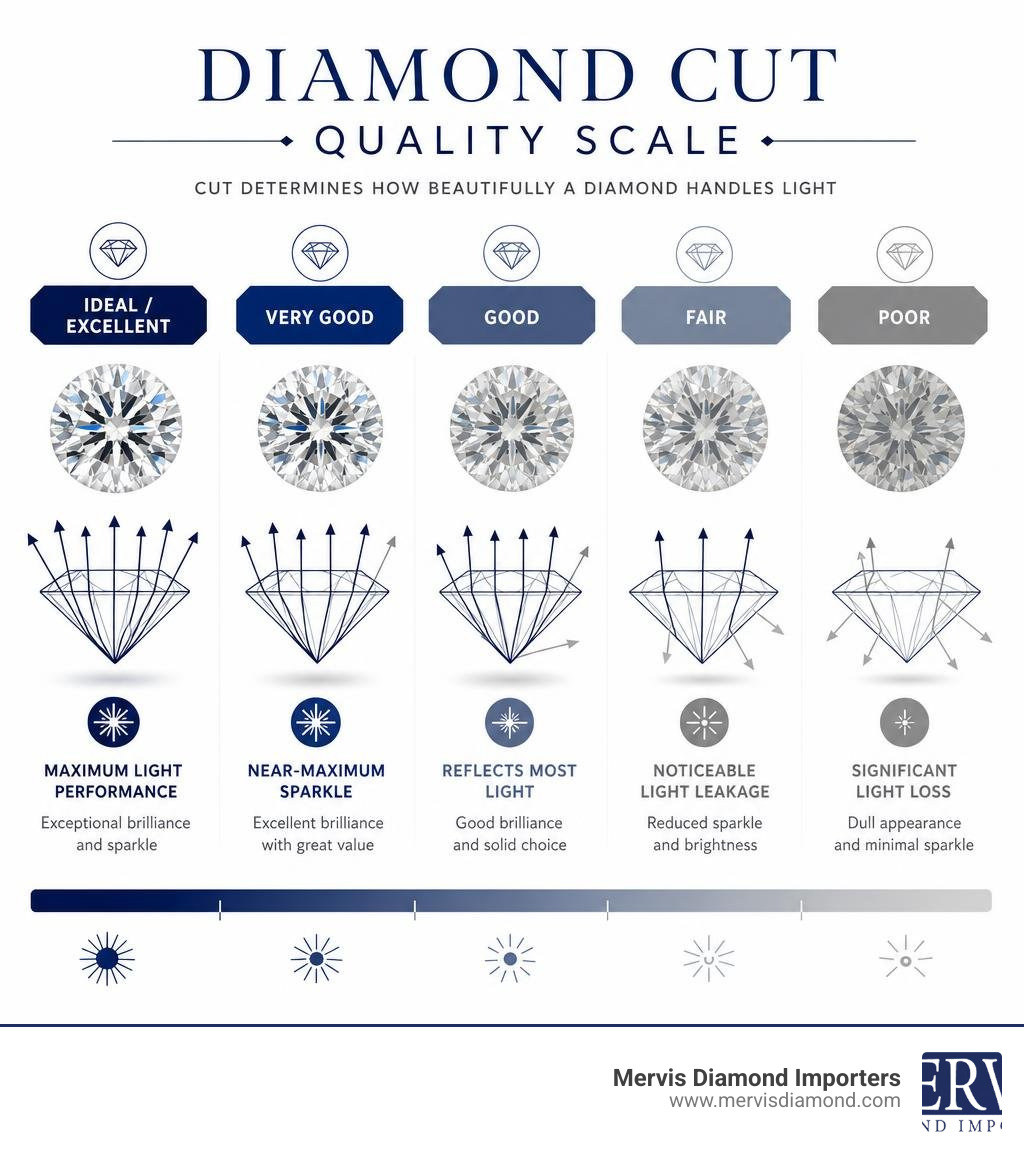
Here is a quick overview of the standard cut grades:
| Cut Grade | What It Means | % of Market |
|---|---|---|
| Ideal / Excellent | Maximum light performance; top brilliance | Top 3% |
| Very Good | Near-maximum sparkle; excellent value | Top 15% |
| Good | Reflects most light; solid budget choice | Top 25% |
| Fair | Noticeable light leakage; reduced sparkle | Top 35% |
| Poor | Significant light loss; dull appearance | Bottom tier |
Note: "Super Ideal" (Hearts & Arrows) sits above Excellent — fewer than 1% of all diamonds reach this standard.
Most buyers focus on carat weight or clarity first. That's a mistake. A flawless diamond with a poor cut can look completely dull. A well-cut diamond in a lower clarity grade can look absolutely stunning.
Cut is the one factor where the craftsmanship of the diamond cutter — not just nature — determines how beautiful your stone looks. Every other factor (color, clarity, carat) describes what the diamond is. Cut determines what it does with light.
This guide walks you through every level of the scale, what drives the grades, and exactly how to use this knowledge to buy with confidence.
Why Cut is the Most Crucial of the 4Cs
When we sit down with clients at our showrooms in Tysons, Rockville, and Washington DC, we always start with a simple truth: cut is king. While carat weight determines size and clarity determines purity, it is the cut that brings a diamond to life.
As we detail in our guide on The 4Cs When Purchasing Diamond Engagement Rings, the way a diamond is cut dictates its entire visual impact. If you get the cut right, the diamond will look larger, brighter, and incredibly lively. If the cut is poor, even a perfect D-color, flawless stone will look like a piece of common glass.
Simply put, Diamond Cut is the Most C because of how it manages light reflection. When light strikes a diamond, we want it to travel down through the crown, reflect off the pavilion walls, and bounce right back up through the top table facet to your eye. A poorly cut stone allows light to leak out of the sides or bottom, leaving the diamond looking dark and lifeless.
Cut vs Shape: Understanding the Difference
It is incredibly common to confuse diamond cut with diamond shape, but they are entirely different concepts.
- Diamond Shape refers to the outward physical form of the stone. Whether you prefer a classic round, a modern princess, or an elegant oval, you are choosing a shape. You can read more about finding your perfect look in our guide to Selecting the Right Diamond Shape.
- Diamond Cut refers to the technical arrangement of facets, the symmetry, the polish, and the precise proportions of the stone. It is the blueprint that dictates how those shapes interact with light.
To understand how cut types influence appearance, we categorize them into three main styles:
- Brilliant Cuts: These feature triangular and kite-shaped facets designed to maximize sparkle. The standard round brilliant, ovals, and marquise shapes fall into this category.
- Step Cuts: These feature long, parallel facets that resemble steps. Think of emerald and Asscher cuts. Instead of a firework show of sparkle, step cuts offer a hall-of-mirrors effect, highlighting the diamond's clarity and structural elegance.
- Mixed Cuts: These combine the crown of a step cut with the pavilion of a brilliant cut (or vice versa), such as radiant and princess cuts. They offer a beautiful balance of clean lines and intense sparkle.
The Science of Sparkle: Brilliance, Fire, and Scintillation
To appreciate the diamond cut quality scale, we have to look at the physics of what actually happens when light enters a diamond.
When light hits the surface of a diamond, it slows down to nearly half its normal speed (which is roughly 186,000 miles per second!) due to the incredible density of the carbon structure. This dramatic slowdown causes the light to bend—a process called refraction.
As we explain in our post on What Makes a Diamond Sparkle, the ultimate visual beauty of a diamond is broken down into three distinct elements:
- Brilliance: This is the foundation of a diamond's beauty. It is the total amount of white light reflected back to your eyes from both the interior and exterior surfaces of the stone.
- Fire: Also known as dispersion, fire is the splitting of white light into a rainbow of spectral colors. This is what gives a diamond its magical, fiery flashes of red, orange, blue, and violet.
- Scintillation: This is the dynamic play of light and shadow when the diamond, the light source, or the observer moves. It is composed of "sparkle" (the flashes of light) and "pattern" (the contrast of light and dark areas inside the stone).
When evaluating Which Diamond Cut Sparkles the Most, the round brilliant cut always takes the crown due to its mathematically optimized 57 or 58 facets. However, achieving this high-level performance requires strict adherence to the upper tiers of the grading scale.
Navigating the Standard Diamond Cut Quality Scale
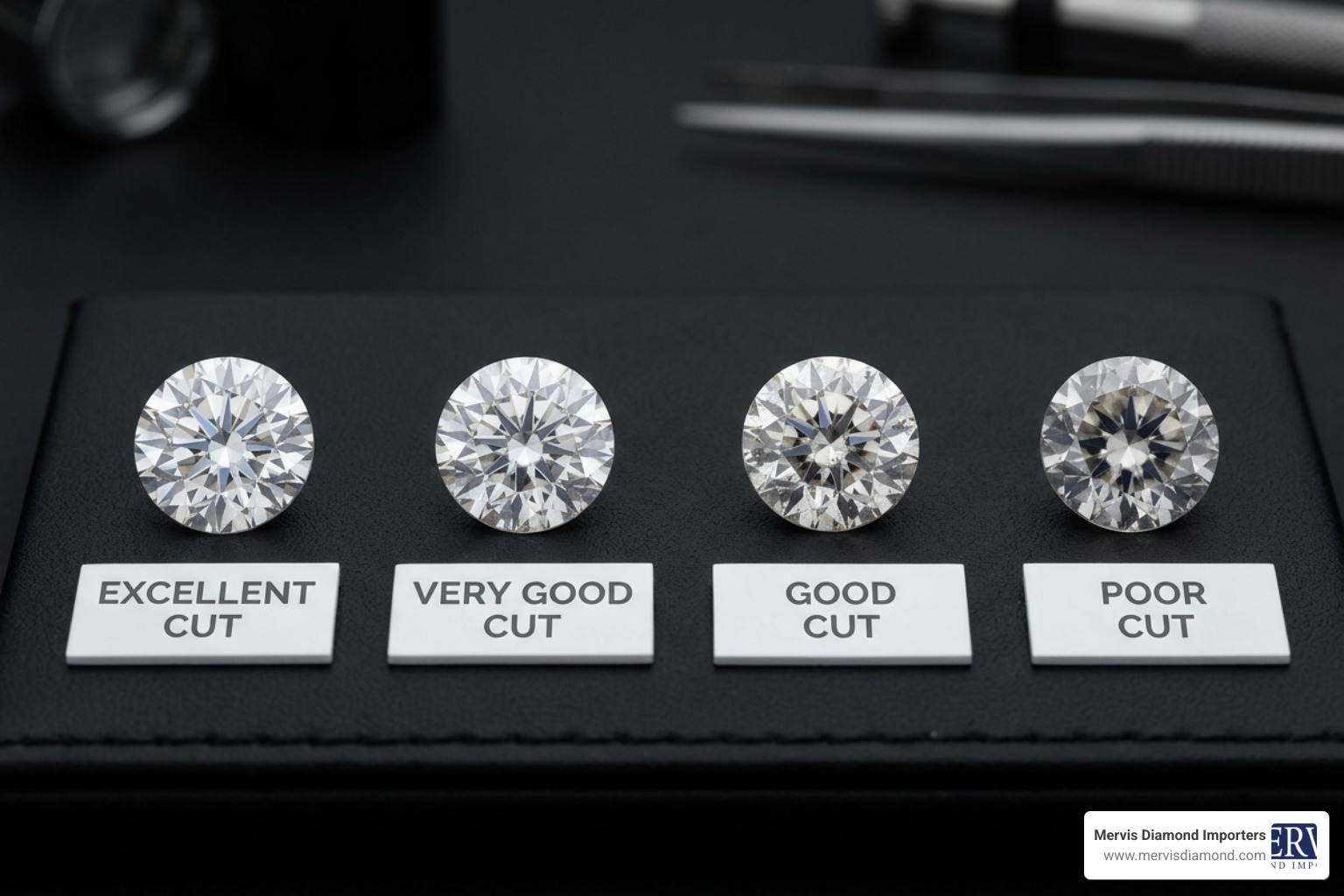
Understanding the standard diamond cut quality scale is essential for evaluating diamond cut grades in person or online. Let's break down what each of these grades actually looks like to the naked eye.
- Ideal / Excellent: The absolute pinnacle of light performance. These diamonds reflect almost all light that enters them, creating an incredibly bright face-up appearance with balanced brilliance, fire, and scintillation. They represent roughly the top 3% of all diamonds.
- Very Good: These diamonds represent the top 15% of cut quality. They reflect the vast majority of light, and to most non-experts, they look almost identical to an Excellent cut. They offer a fantastic way to optimize your budget.
- Good: Representing the top 25% of diamonds, these stones capture and reflect a solid amount of light but may have slightly altered proportions that cause minor light leakage.
- Fair: Making up a portion of the 35% of the market consisting of fair or poor cuts, these diamonds allow a noticeable amount of light to escape through the sides or bottom. They will appear significantly less lively.
- Poor: These diamonds lose the majority of light through the sides and bottom. They often look dark, dull, and glassy, even under direct jewelry store lighting.
The GIA Diamond Cut Quality Scale
The Gemological Institute of America (GIA) established the industry-standard grading scale for standard round brilliant diamonds in the D-to-Z color range. To understand how GIA evaluates a diamond, you can explore the Diamond Cut | Understanding The Cut Scale | GIA 4Cs .
The GIA system is deductive. It evaluates seven key components and assigns a final grade based on the lowest-performing metric. These components are divided into:
- Face-Up Appearance: Brightness, fire, and scintillation.
- Design: Weight ratio (how heavy the diamond is relative to its face-up size) and durability (such as an extremely thin girdle that could chip easily).
- Craftsmanship: Polish and symmetry.
Because it is deductive, if a diamond has exceptional brightness and fire but poor symmetry, its overall cut grade will be dragged down to reflect that limitation.
Comparing GIA and AGS Cut Grading Systems
While GIA is the most widely recognized grading laboratory, the American Gem Society (AGS) developed a highly respected, mathematically rigorous system of its own.
Instead of using words, the AGS scale uses a numerical system from 0 to 10:
- AGS 0 (Ideal): Equivalent to GIA's Excellent grade.
- AGS 1 to 2 (Excellent / Very Good): High-quality light performance.
- AGS 3 to 10 (Good to Poor): Increasing levels of light leakage and proportion issues.
While GIA relies on a combination of visual models and proportion tables, AGS historically pioneered a direct, ray-tracing light performance technology to measure exactly how light travels through the stone. Both scales are highly trusted, but a GIA "Excellent" or an AGS "0" are the golden standards you should look for on a grading report.
Beyond Excellent: Super Ideal and Hearts & Arrows Cuts
For buyers who want nothing less than absolute perfection, there is a tier that sits above standard Excellent cuts. These are often referred to as "Super Ideal" or "Hearts & Arrows" diamonds.
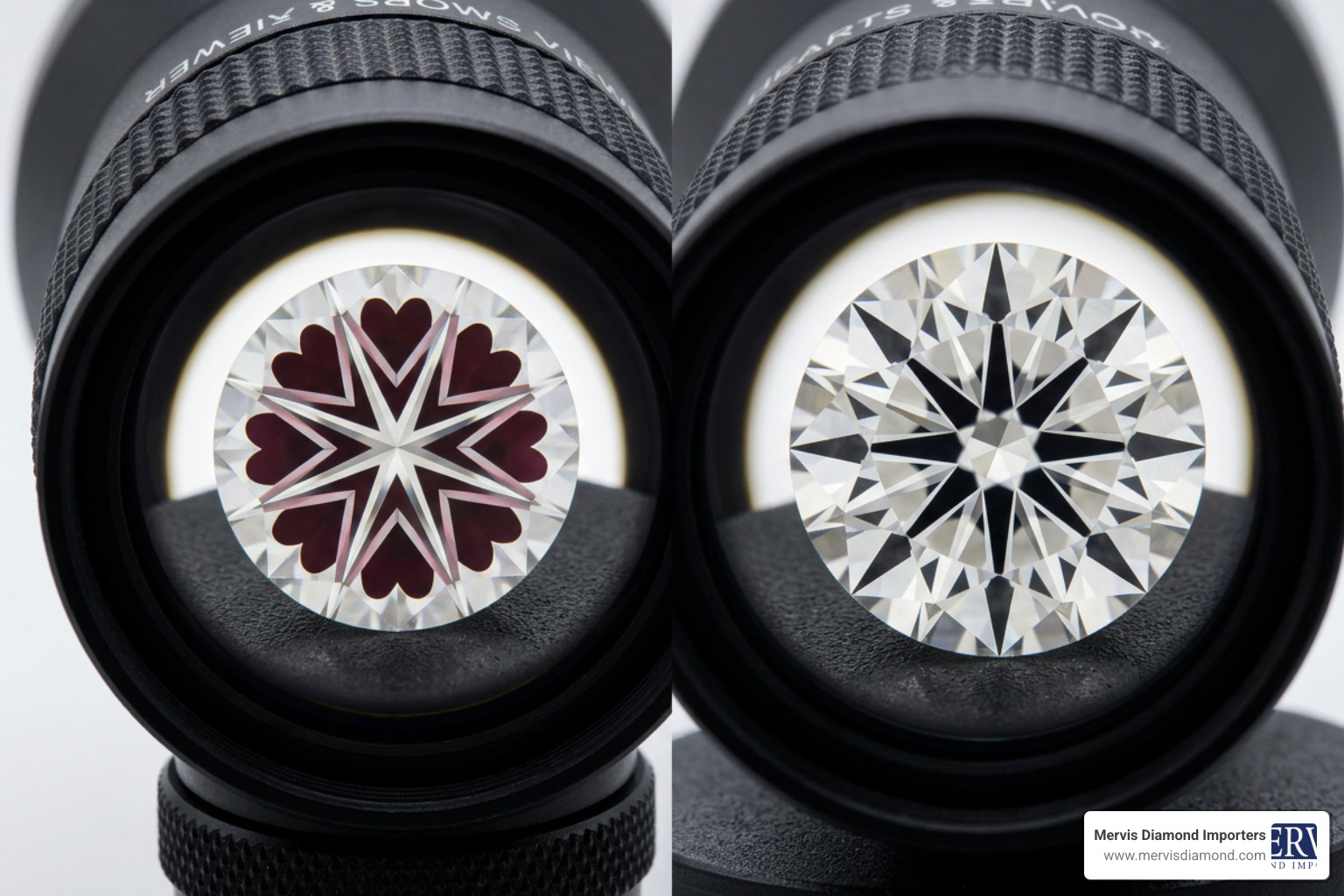
A Hearts & Arrows pattern is a visual phenomenon that only appears in round brilliant diamonds cut to incredibly precise physical proportions and perfect three-dimensional symmetry. When viewed through a special optical scope, you will see:
- An array of eight uniform hearts when looking at the diamond face-down from the pavilion side.
- An array of eight uniform arrows when looking at the diamond face-up from the crown side.
This ultra-precise facet alignment represents less than 1% of all diamonds produced worldwide. It ensures that light is reflected with maximum efficiency, producing a blinding display of sparkle even in low-light environments.
Anatomy and Proportions: What Determines Cut Quality?
To understand how a grading laboratory assigns a cut grade, we must look at the physical anatomy of the diamond.
The key sections of a diamond's structure include:
- Table: The flat, horizontal facet at the very top of the stone.
- Crown: The upper portion of the diamond, extending from the girdle to the table.
- Girdle: The narrow outer band that forms the widest perimeter of the stone.
- Pavilion: The lower, cone-shaped portion of the diamond.
- Culet: The tiny facet or point at the very bottom of the pavilion.
Key Proportions of the Diamond Cut Quality Scale
The magic of a diamond's sparkle lies in the relationship between its angles and percentages. Even a fraction of a degree can make a massive difference.
For standard round brilliant diamonds, the sweet spot of proportions for an Excellent cut grade generally falls within these tight ranges:
- Table Percentage: 52% to 62% of the diamond's overall diameter.
- Total Depth Percentage: 57.5% to 63%.
- Crown Angle: 31.5° to 36.5°.
- Pavilion Angle: 40.6° to 41.8°.
- Girdle Thickness: Thin to Slightly Thick.
- Culet Size: None to Small.
If you are looking for highly technical guidance on how these proportions interact, you can reference the GIA Cut Estimation Tables or explore the IGI Cut Grading Guidelines.
These resources show how parameters like star facet length and lower half facet length interact. For example, if a diamond has a slightly steeper crown angle, it must be paired with a shallower pavilion angle to maintain an Excellent cut grade. If both angles are too steep, the diamond will suffer from "nailhead" darkness in the center; if both are too shallow, it will suffer from a "fish-eye" effect.
Polish, Symmetry, and Light Performance Tools
Beyond the basic angles, two aspects of craftsmanship heavily influence the final grade:
- Polish: This refers to the smoothness of the diamond's exterior facets. A high polish grade (Excellent or Very Good) ensures that light passes through the surface without being scattered or dulled by microscopic surface scratches or polishing wheel marks.
- Symmetry: This measures how precisely the facets align with one another. Misaligned facets, an off-center table, or a wavy girdle will skew the path of light, causing it to exit through the sides of the stone rather than returning to your eye.
To help consumers verify these qualities, laboratories and high-end jewelers utilize specialized tools. The GemEx BrillianceScope uses spectrophotometer technology to analyze a diamond’s actual light performance under multiple lighting angles, measuring its exact levels of white light (brilliance), colored light (fire), and scintillation. You can read more about how these parameters are analyzed in the GIA's guide on Diamond Quality Factors.
Frequently Asked Questions about Diamond Cut
Can lab-grown diamonds be graded on the diamond cut quality scale?
Yes, absolutely! Lab-grown diamonds share the exact same chemical, physical, and optical properties as natural diamonds. Because they are made of pure carbon, they are cut and polished using the exact same tools and techniques.
Major grading institutions like the IGI and GIA apply the exact same diamond cut quality scale to lab-grown diamonds as they do to natural ones. Interestingly, because lab-grown rough is often grown in highly controlled environments with fewer natural structural distortions, cutters can frequently achieve Ideal and Excellent cuts with less raw material waste.
When shopping for lab-grown diamonds, you should hold them to the same high standards for cut quality as you would a natural stone. If you want to dive deeper into how other quality factors interact, you can check out this comprehensive diamond clarity guide or view a standardized diamond clarity chart.
Which diamond cut looks the biggest and holds its value?
This is one of the most common questions we hear at Mervis Diamond Importers. While carat weight measures physical mass, the way a diamond is cut determines its perceived size.
If a diamond is cut too deep, a large portion of its weight is hidden in the pavilion (the bottom), making the stone look much smaller from the top than its carat weight suggests. Conversely, a shallow-cut diamond might look wide, but it will suffer from major light leakage and look incredibly dull.
According to our research on What Diamond Shape Looks the Biggest, elongated shapes like Oval, Marquise, and Pear cuts have a larger surface area than round diamonds of the same carat weight, making them appear visually larger.
When it comes to value retention and demand, the round brilliant is historically What is the Most Expensive Diamond Cut. This is because cutting a round brilliant requires sacrificing up to 50% to 60% of the original rough diamond crystal. The high demand for its unmatched sparkle, combined with this significant material loss during cutting, keeps its market value exceptionally high.
How does cut quality affect a diamond's price?
Cut quality is one of the smartest places to optimize your budget, but it is also the last place you should cut corners. Here is how cut quality directly impacts the price tag:
- The "Excellent" Premium: An Excellent or Ideal cut diamond commands a premium of 10% to 15% (or more) over a Good or Very Good cut. This is because achieving these proportions requires elite craftsmanship and sacrificing more rough diamond weight.
- The Size Illusion: Because a high-quality cut maximizes the face-up appearance, an Excellent cut 0.90-carat diamond will often look just as large—and significantly brighter—than a poorly cut 1.00-carat diamond. This allows you to buy a slightly lower carat weight, saving you money while getting a more beautiful ring.
- Hiding Color and Clarity: Excellent cuts excel at reflecting light. This intense light return makes it much harder to see slight yellow tints or minor natural inclusions. By choosing an Excellent cut, you can safely drop down to a G or H color, and a VS2 or SI1 clarity grade, saving thousands of dollars without sacrificing visual beauty.
Conclusion
Mastering the diamond cut quality scale is the ultimate secret weapon for any diamond buyer. It is the bridge between a stone that simply sits on a ring and one that commands attention from across the room.
At Mervis Diamond Importers, we have spent generations hand-selecting only the finest natural and lab-grown diamonds. We believe in providing expert, pressure-free guidance to help you find a diamond that matches both your dream design and your budget. Whether you visit us at our showrooms in Tysons, VA, Rockville, MD, or Washington, DC, our team is here to show you the difference a masterful cut makes in person.
Ready to take the next step in your diamond journey? Explore our master guide on Understanding Four Cs or book a personalized consultation with us today!