

Which C Matters Most in the Diamond 4 C's Order of Importance
Why the Diamond 4 C's Order of Importance Changes Everything You Buy
Understanding the diamond 4 C's order of importance can be the difference between a stunning ring and one that looks dull despite a high price tag. Most buyers walk into a jewelry store focused on size — but size alone won't make a diamond beautiful.
Here's the quick answer if you need it now:
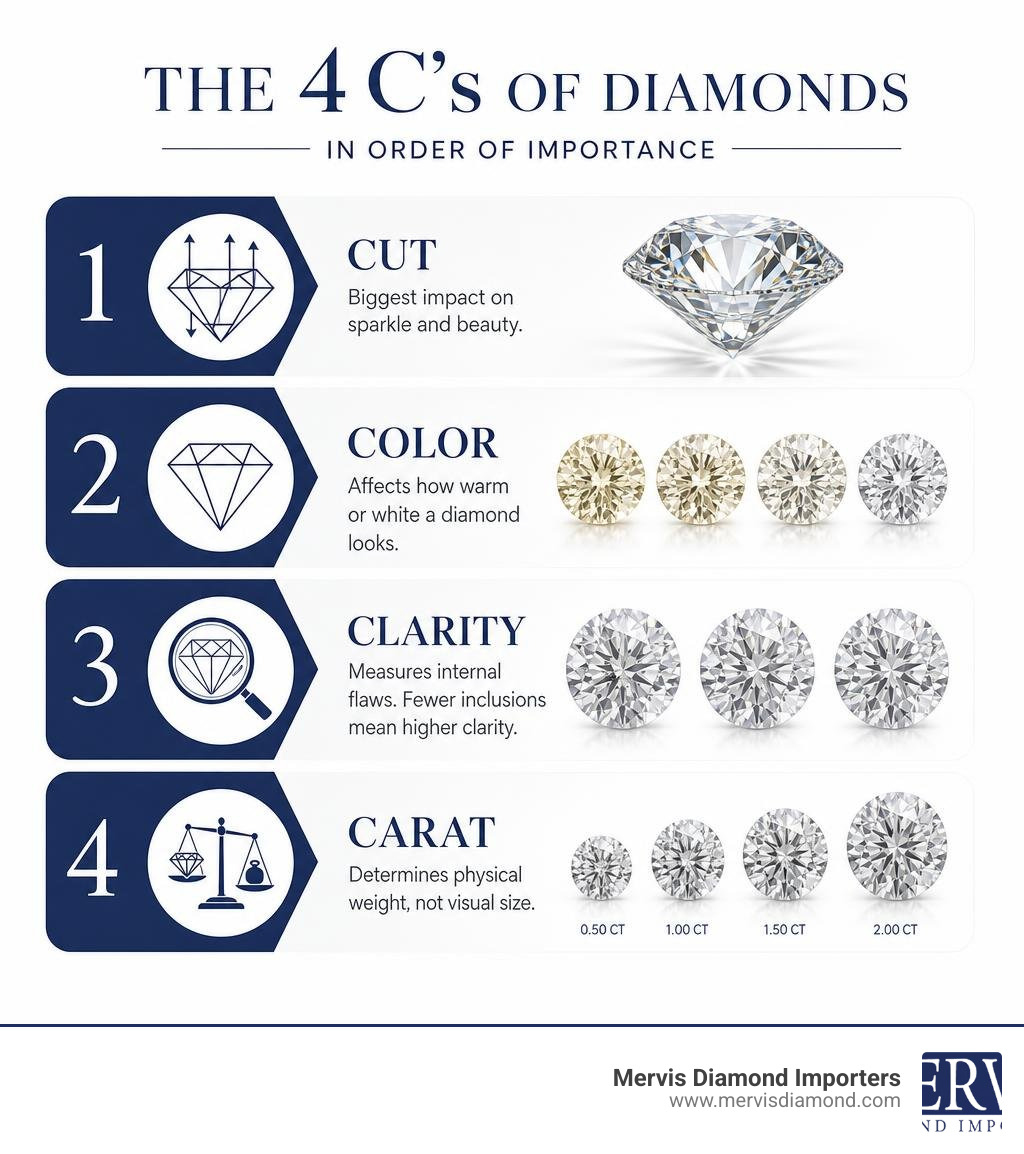
The 4 C's of diamonds ranked by importance:
- Cut — Has the biggest impact on sparkle and beauty. Never compromise here.
- Color — Affects how warm or white a diamond looks. G–H grades offer the best value.
- Clarity — Measures internal flaws. Eye-clean VS2 or SI1 is the sweet spot for most buyers.
- Carat Weight — Determines physical weight, not visual size. Go just below round-number thresholds to save money.
This ranking is the consensus view across the diamond industry — and it exists for a good reason. A Flawless, D-color diamond with a poor cut will look worse in real life than a VS2, H-color stone with an Excellent cut. That's not a matter of opinion. It's how light physics works.
The challenge is that most buyers don't know this going in. Carat weight is the easiest number to compare, so it gets the most attention. Color and clarity grades look impressive on a certificate. But cut — the factor that actually determines whether a diamond blazes or sits flat — often gets overlooked.
This guide walks you through each C, explains what actually matters to the naked eye, and shows you how to balance all four so your budget goes where it counts most.
What Are the 4 C's of Diamonds?
Before we rank them, let’s quickly define what we are actually ranking.
Back in the 1940s and 1950s, a visionary gemologist named Robert M. Shipley, who founded the Gemological Institute of America (GIA), realized the diamond industry had a massive trust problem. Jewelers used all kinds of confusing, subjective terms to describe quality. One merchant's "super fine blue-white" was another's "slightly off-color."
To prevent merchant bias and establish a universal standard, GIA developed the modern Diamond Grading System based on the 4 C's: Cut, Color, Clarity, and Carat weight.
Today, this system is the international standard used by every reputable lab in the world to evaluate a diamond's quality, rarity, and value. For an in-depth primer on these four pillars, you can read our comprehensive breakdown of the 4 Cs to a Diamond or explore the historical background in The Four Cs of Buying Diamonds—and the Fifth C Defined.
Understanding these characteristics is essential because they establish a diamond's rarity. The rarer a diamond's combination of features, the higher its market value. However, rarity does not always translate directly to visual beauty. Some characteristics are incredibly expensive because they are rare in nature, but they look virtually identical to more common grades when viewed with the naked eye. That is why understanding the diamond 4 C's order of importance is the ultimate key to smart shopping.
The Diamond 4 C's Order of Importance: The Definitive Ranking
When you shop for a diamond, you are working within a budget. Unless that budget is infinite, you will have to make trade-offs. To get a larger stone, you might need to accept a lower color or clarity grade. To get a perfectly colorless stone, you might have to compromise on size.
But there is one C you should never compromise on: Cut.
To help you visualize how to allocate your budget, we have put together a quick-reference table outlining the visual impact, price influence, and flexibility of each C. "Flexibility" refers to how much room you have to lower the grade to save money without sacrificing the diamond's actual beauty to the naked eye.
| The C | Visual Impact | Price Influence | Buyer Flexibility (Where to Compromise) | Recommended Value "Sweet Spot" |
|---|---|---|---|---|
| 1. Cut | Extreme (Determines sparkle, fire, and perceived size) | Moderate to High | None. Always buy Excellent/Ideal. | GIA Excellent / AGS Ideal |
| 2. Color | High (Determines warmth vs. whiteness) | Very High | High. You can easily drop to G-J. | G or H (I or J for yellow gold settings) |
| 3. Clarity | Medium (Flaws are mostly invisible without a loupe) | High | Very High. Eye-clean is all that matters. | VS2 or SI1 (ensure it is eye-clean) |
| 4. Carat | High (Perceived physical size) | Extreme (Exponential price jumps) | Moderate. Buy just below major thresholds. | 0.90ct instead of 1.00ct |
By prioritizing Cut first, you ensure your diamond has maximum sparkle. Next, we look at Color to ensure the diamond faces up white. Clarity comes third because most inclusions are microscopic. Carat weight comes last because a smaller, sparkling diamond will always look more impressive and larger than a dull, poorly cut, heavy stone.
Deep Dive into the 4 C's: How They Affect Beauty and Value
To truly understand why we rank the 4 C's this way, we need to look at how each one behaves in the real world. A diamond's beauty is defined by its light performance — how it interacts with light to produce brilliance, fire, and scintillation. You can learn more about how these optical properties are evaluated by checking out the 4Cs of Diamonds | Jewelers of America.
Let's take a deep, practical dive into each of the 4 C's to see how they impact both what you see and what you pay.
Cut: The King of Sparkle and the Most Critical Factor
We cannot stress this enough: Cut is the most important of the 4 C's.
While the other three C's are determined entirely by nature, Cut is the direct result of human artistry and scientific precision. It refers to how well a diamond's facets have been proportioned, angled, and polished.
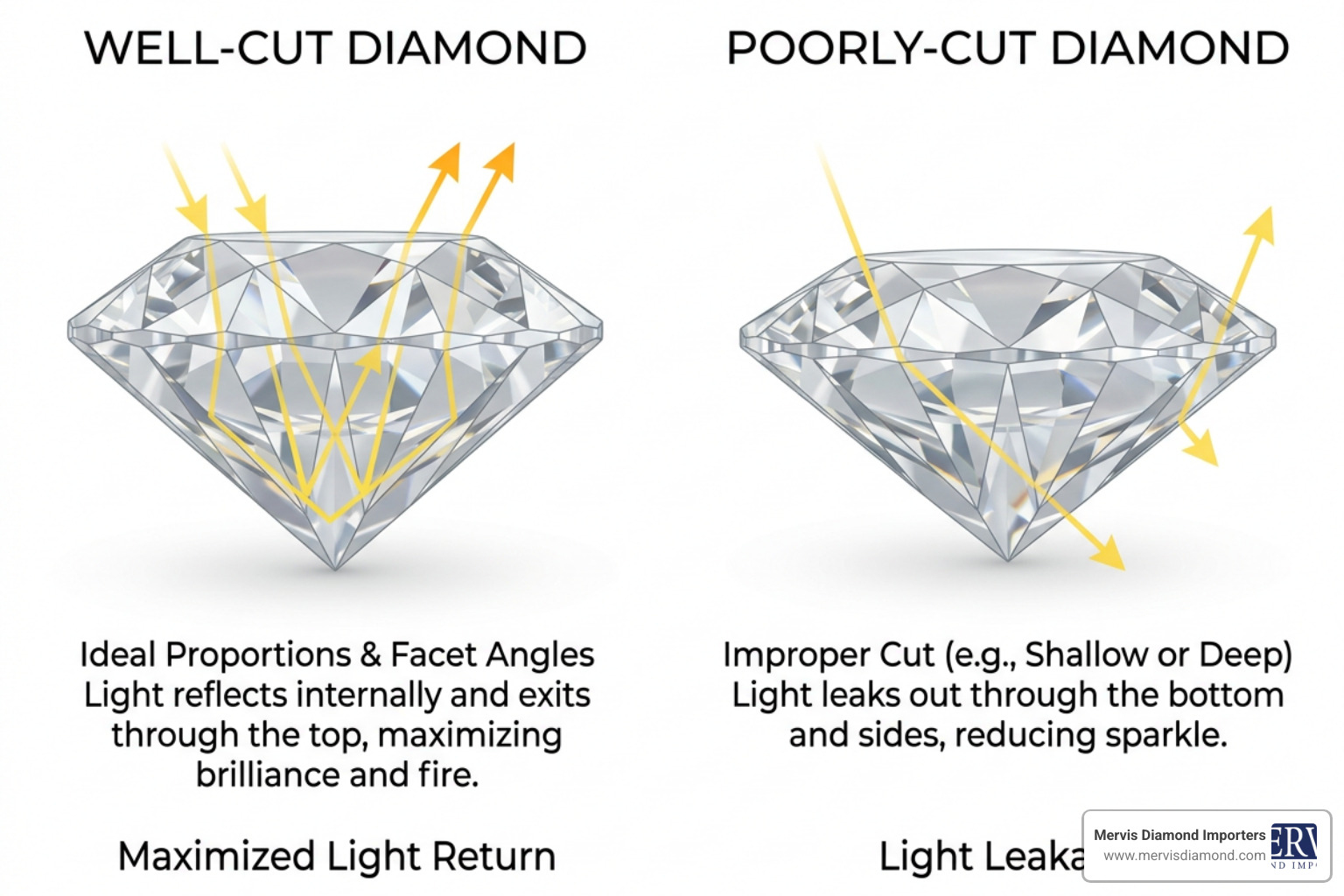
When a diamond is cut with excellent proportions, light enters through the crown (the top), reflects off the pavilion facets (the bottom) from side to side, and bounces straight back out through the top to the eye of the viewer. This creates three spectacular optical effects:
- Brilliance: The bright, white light reflected from the diamond.
- Fire: The flashes of vivid, rainbow colors.
- Scintillation: The sparkle and pattern of light and dark areas created when the diamond or the light source moves.
If a diamond is cut too shallow, light leaks out of the bottom. If it is cut too deep, light leaks out of the sides. In both cases, the diamond loses up to 50% or more of its potential brilliance, leaving you with a dark, lifeless stone.
The GIA grades cut on a five-point scale for standard round brilliant diamonds: Excellent, Very Good, Good, Fair, and Poor. For a detailed look at how these cut grades are determined and how they affect the diamond's overall light return, read The 4Cs Unveiled: A Plain Guide to Understanding Diamond Quality | Reuven Veksler.
At Mervis, we always advise our clients in Tysons, Rockville, and Washington DC to prioritize an Excellent cut grade. A well-cut diamond actually looks larger than a poorly cut diamond of the same carat weight because it maximizes light return across its entire surface, right out to the edges.
Color: Finding the Value Sweet Spot
The GIA color grading scale for white diamonds runs alphabetically from D (completely colorless) to Z (light yellow or brown).
- D-F (Colorless): Incredibly rare and highly prized. These diamonds are like pure water. Because of their rarity, they command a massive price premium — often 10% to 30% more between adjacent grades at the top of the scale.
- G-J (Near-Colorless): These diamonds contain trace amounts of warmth, but to the naked, untrained eye, they look completely white when facing up.
- K-M (Faint): A noticeable warm yellow or brownish tint begins to appear, especially in larger stones.
Here is a major insider secret: once a diamond is mounted in a ring setting, the color of the metal will fundamentally change how the diamond's color is perceived.
If you are setting your diamond in a white metal like platinum or white gold, we recommend staying in the G to H color range to ensure the stone looks icy white. However, if you choose a yellow gold or rose gold setting, you have a lot more flexibility. The warm yellow prongs will reflect through the stone, making even a colorless D-grade diamond look slightly warm. Therefore, you can easily drop to an I or J color grade (and save thousands of dollars) because the metal setting naturally masks any faint warmth in the diamond.
Clarity: Understanding Eye-Clean Diamonds
As diamonds form deep within the earth under extreme heat and pressure, they develop natural internal characteristics called "inclusions" and surface irregularities called "blemishes." Clarity is the measure of these characteristics.
The GIA clarity scale ranges from Flawless (FL) to Included (I3). For a visual representation of how these grades compare, you can reference our Diamond Clarity Chart Best to Worst.
Only about 1% of all gem-quality diamonds are graded Flawless or Internally Flawless. Because of this extreme rarity, chasing a flawless grade on paper will cost you a fortune. But here is the reality: most inclusions in the VS1, VS2, and SI1 ranges are completely invisible to the naked eye.
In the diamond world, we use the term "eye-clean" to describe a diamond that has no inclusions visible to the naked eye when viewed from a normal distance of about 10 to 12 inches (25-30 cm) under normal lighting.
Unless you plan on walking around with a 10x jeweler's loupe pressed to your eye, paying a premium for a VVS or Flawless diamond means you are paying for a technical difference that you can only appreciate on a piece of paper. We always recommend focusing on finding an eye-clean VS2 or SI1 diamond. This allows you to redirect those savings into a higher carat weight or a superior cut.
Carat Weight: Size vs. Weight in the Diamond 4 C's Order of Importance
Carat is the most misunderstood of the 4 C's. Many people assume that carat refers to the physical size of the diamond, but it actually measures weight.
One metric carat is equal to exactly 200 milligrams (about the weight of a standard paperclip).
Because carat is a measure of weight, two diamonds with the exact same carat weight can look completely different in size. For instance, a well-cut 1.00-carat round brilliant typically measures about 6.5mm in diameter. However, if a diamond is cut too deep (carrying extra weight in its "belly" where you can't see it once set), it might only measure 6.1mm in diameter, making it look like a 0.85-carat stone.
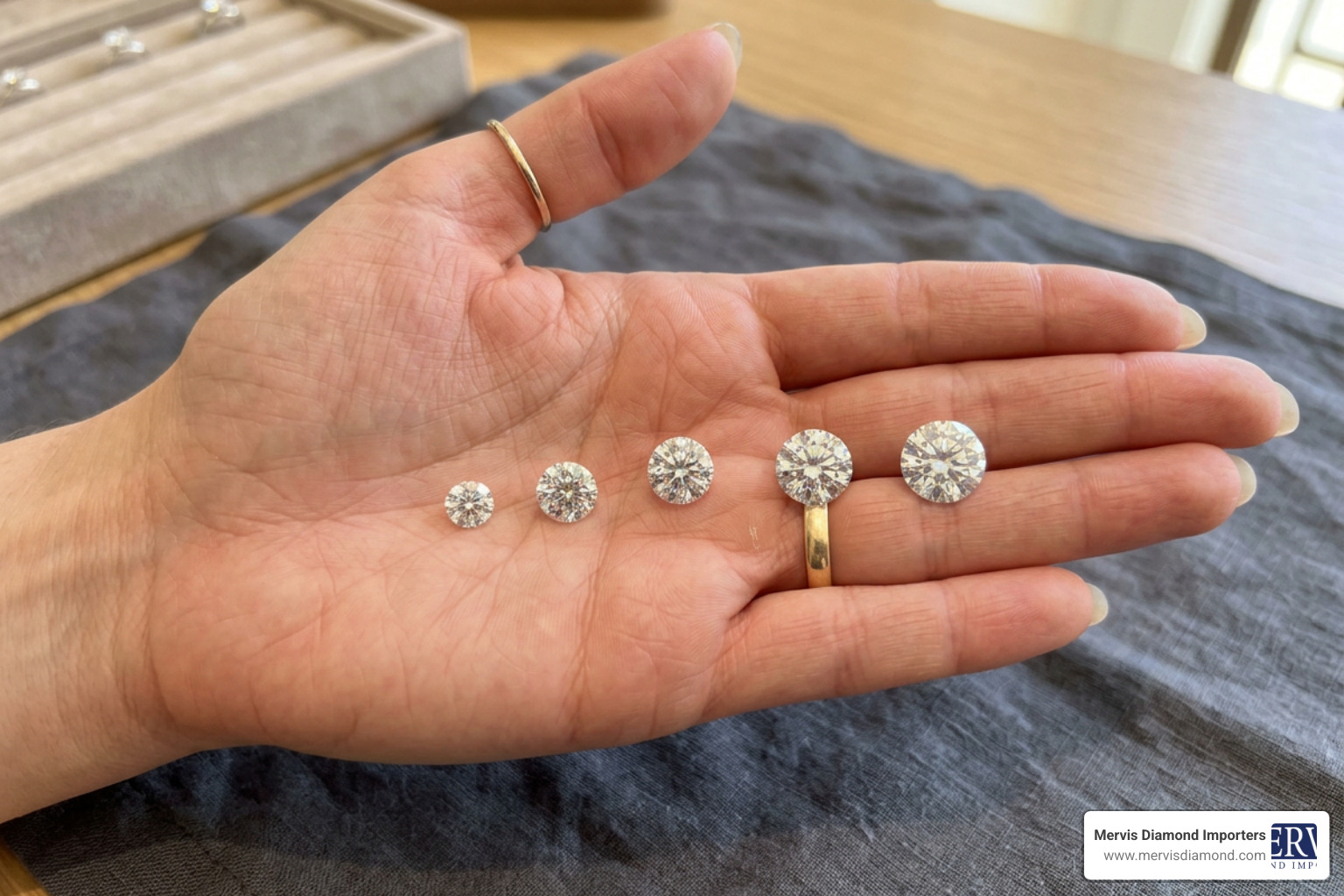
Furthermore, diamond prices do not increase linearly with carat weight. Instead, they jump exponentially at "magic thresholds" or round numbers (like 0.50ct, 0.70ct, 0.90ct, 1.00ct, 1.50ct, and 2.00ct).
This is because of rarity; large rough diamonds are much harder to find in nature than small ones. If you buy a diamond that weighs exactly 1.00 carat, you will pay a significant premium. But if you look for a diamond that weighs 0.90 to 0.95 carats, you can save 10% to 20% on the price. Once mounted, a 0.90-carat diamond and a 1.00-carat diamond are virtually indistinguishable in size to the naked eye, but the price difference is very real.
How the 4 C's Interact and Practical Budget Tips
Now that you know the details of each C, it is important to understand that they do not exist in isolation. They are highly interdependent.
For example, carat weight directly influences how you should select your color and clarity grades. Larger diamonds have larger facets (especially step-cut shapes like Emerald or Asscher cuts, which act like a hall of mirrors). This means that inclusions and color warmth are much easier to see in a 2.00-carat diamond than in a 0.50-carat diamond. If you are buying a larger stone, you may need to step up to a slightly higher color and clarity grade to keep it looking clean and white.
Additionally, always evaluate diamonds under different lighting conditions. Jewelry store spotlights are designed to make even poorly cut stones sparkle. Ask your consultant to show you the diamond under diffused lighting or in natural daylight near a window. This is where a truly Excellent cut diamond will show its true superiority.
Balancing the Diamond 4 C's Order of Importance for Your Budget
If you want to maximize your budget and walk away with a stunning ring, here is our expert game plan for balancing the diamond 4 C's order of importance:
- Lock in the Cut: Start by filtering only for Excellent (GIA) or Ideal (AGS) cut grades. This is non-negotiable if you want maximum sparkle.
- Find the Clarity Sweet Spot: Look for VS2 or SI1 clarity grades. Ask your jeweler to verify that the stone is "eye-clean." Avoid diamonds with dark inclusions right in the center of the table facet.
- Choose the Right Color: Target G or H color grades for white gold or platinum settings, and I or J for yellow or rose gold settings.
- Maximize the Carat Weight: With the savings you secured by choosing eye-clean clarity and near-colorless grades, buy the largest carat weight that fits your remaining budget — ideally looking for those "just under" magic weights (like 0.90ct or 1.90ct) to maximize value.
Frequently Asked Questions About Diamond Grading
FAQ 1: What is the difference between diamond cut and diamond shape?
This is one of the most common points of confusion for first-time buyers.
- Diamond Shape refers to the physical outline and geometric form of the stone (e.g., Round, Oval, Cushion, Princess, Emerald, Pear, Marquise).
- Diamond Cut refers to the quality of the craftsmanship — specifically, how well the facets have been aligned and polished to reflect light.
While a round brilliant diamond has a standardized GIA cut grading scale (Excellent to Poor), fancy shapes (like Ovals or Pears) do not have official GIA cut grades on their certificates. For fancy shapes, gemologists evaluate cut quality based on polish, symmetry, and visual light performance.
FAQ 2: Is there a "5th C" of diamonds?
Yes! Many experts consider Certification to be the unofficial "5th C."
A diamond certificate (or grading report) is your blueprint. It is an independent, objective evaluation of the diamond's 4 C's. You should always buy a diamond certified by a highly respected, independent laboratory like the GIA (Gemological Institute of America).
Additionally, we believe that Conflict-Free sourcing is an essential modern "5th C." Every diamond we hand-select at Mervis is certified under the international Kimberley Process, ensuring that your stone is ethically sourced and completely conflict-free.
FAQ 3: How do lab-grown diamonds compare in the 4 C's?
Lab-grown diamonds are optically, physically, and chemically identical to natural diamonds. They are made of 100% pure carbon and are graded on the exact same 4 C's scales by major labs like the GIA and IGI.
Because they are grown in controlled laboratory environments rather than mined, they are a highly budget-friendly alternative. Choosing a lab-grown diamond allows you to secure a significantly larger carat weight with top-tier cut, color, and clarity grades for a fraction of the cost of a natural stone.
Conclusion
At the end of the day, buying a diamond is as much an art as it is a science. While grading reports and charts are incredibly helpful tools, the most important factor is how the diamond looks to you in real life.
At Mervis Diamond Importers, we specialize in helping you navigate the diamond 4 C's order of importance with zero pressure. Our non-commissioned experts in Tysons, Rockville, and Washington DC hand-select only the most beautiful, high-performing natural and lab-grown diamonds, ensuring you get the absolute best visual sparkle for your budget.
Ready to see the difference an Excellent cut makes in person? Learn more by reading our guide on Understanding the Four Cs or book an appointment at one of our local showrooms today to find your perfect stone.