

Rank the Sparkle: Decoding the 4 Cs of Diamonds Order of Importance
What Are the 4 Cs of Diamond Quality?
When you begin shopping for a diamond, you will quickly encounter the universal grading system established by the Gemological Institute of America (GIA). The GIA International Diamond Grading System evaluates a diamond's quality based on four distinct attributes: Cut, Color, Clarity, and Carat Weight. Together, these four factors determine a stone's optical properties, visual presence, and market value. You can explore the full history and technical definitions in GIA's guide on Understanding the 4Cs of Diamond Quality and read our overview of the 4 Cs to a Diamond.
Cut: Sparkle, Fire, and Scintillation
Diamond cut refers to how skillfully a diamond's facets are proportioned, aligned, and polished. It is often confused with shape (such as round, oval, or emerald), but cut is purely about light performance. A standard round brilliant diamond features 58 facets (or 57 if there is no culet)—32 on the crown, 1 on the table, 24 on the pavilion, and 1 culet.
When light hits a well-cut diamond, it travels through the stone, bounces off the internal pavilion facets, and reflects back out through the top table facet directly to your eyes. This light return produces three distinct visual effects:
- Brilliance: The brightness created by all the white light reflections inside and outside the diamond.
- Fire (Dispersion): The flashes of rainbow colors into which white light breaks when passing through the facets.
- Scintillation: The dynamic pattern of light and dark flashes produced when the diamond, light source, or observer moves.
A diamond cut too shallow or too deep leaks light through its bottom or sides, resulting in a dark, lifeless appearance regardless of its other grades. To dive deeper into how facets craft brilliance, read our article on What Makes a Diamond Sparkle? and view the Diamond Cut Quality Scale.
Color: The D-to-Z Grading Scale
The GIA Color Grading Scale measures the absence of color in white diamonds. The scale spans 23 letter grades, ranging from D (completely colorless) down to Z (light yellow, brown, or gray), grouped into five subcategories:
- Colorless (D–F): Rare, icy white with no visible trace of color.
- Near Colorless (G–J): Appears colorless when viewed face-up, with minute warm tones detectable under lab conditions.
- Faint (K–M): Noticeable slight warm tint to the naked eye.
- Very Light (N–R): Easily visible yellowish or brownish tint.
- Light (S–Z): Prominent yellow or brown color, though distinct from true "fancy colored" diamonds.
Subtle differences between adjacent color grades are often impossible to see with the naked eye once mounted in a ring setting. For advice on pairing settings and studs, check our guide on What Is Good Color and Clarity for Diamond Earrings?
Clarity: Inclusions, Blemishes, and Transparency
Diamond clarity measures the purity and presence of tiny natural imperfections. Internal characteristics are called inclusions (such as crystals, clouds, or feathers), while surface imperfections are blemishes (such as scratches or nicks). The GIA Clarity Scale features 11 grades evaluated under 10x jeweler magnification:
- Flawless (FL) / Internally Flawless (IF): No inclusions visible under 10x magnification.
- Very, Very Slightly Included (VVS1, VVS2): Inclusions so minute that they are difficult for trained gemologists to see under 10x.
- Very Slightly Included (VS1, VS2): Minor inclusions detected with effort under 10x magnification, but virtually always "eye-clean."
- Slightly Included (SI1, SI2): Noticeable inclusions under 10x magnification that may occasionally be visible to the naked eye depending on diamond shape and location.
- Included (I1, I2, I3): Inclusions obvious under magnification and visible to the naked eye, impacting transparency and brilliance.
For more details on evaluating eye-clean stones, check out What Diamond Clarity Is Best? and reference our complete Diamond Clarity Chart Best to Worst.
Carat Weight: Size, Rarity, and Price Multipliers
Carat measures a diamond's weight rather than its physical size. One metric carat equals 200 milligrams (0.2 grams), and there are roughly 142 carats in an ounce. In the diamond trade, a carat is divided into 100 "points." For example, a 50-point diamond weighs 0.50 carats. The term originates from ancient carob seeds used as weight counterbalances on scales due to their uniform weight.
Because large, gem-quality rough diamonds are far rarer in nature than smaller ones, diamond pricing scales exponentially rather than linearly. A single 2.00-carat diamond costs significantly more than two 1.00-carat diamonds of equal quality. However, visual dimensions do not always increase at the exact same rate as carat weight. To familiarize yourself with essential gemstone terminology, review our list of Must-Know Diamond Terms.
Decoding the Standard 4 Cs of Diamonds Order of Importance
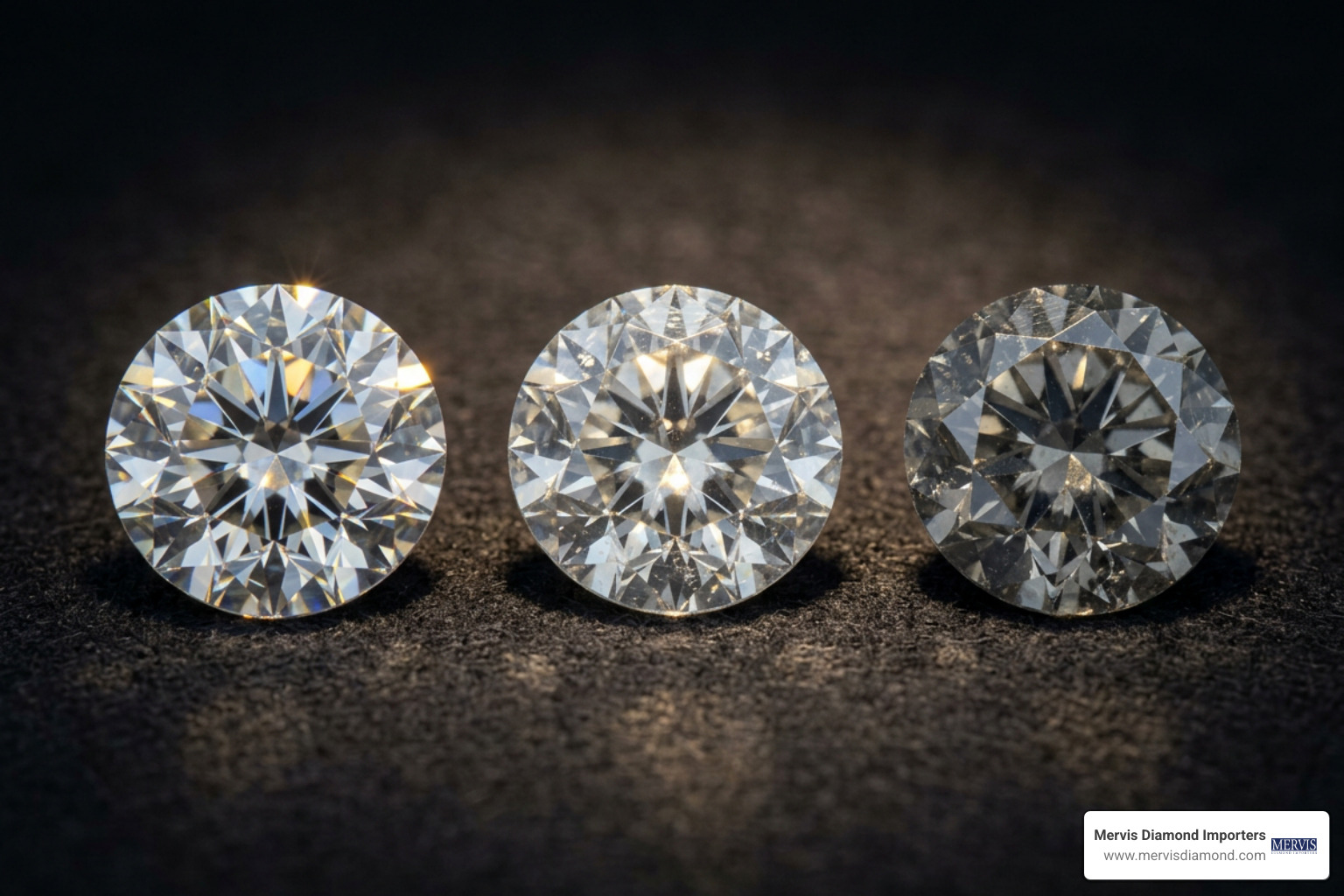
When balancing a real-world budget, establishing a baseline hierarchy for the 4 cs of diamonds order of importance helps you avoid overpaying for technical grades that don't translate to visual beauty. For general diamond education on this topic, review The Four Cs of Buying Diamonds and our dedicated post on Diamond 4 Cs Order of Importance.
Here is how diamond experts generally rank the 4 Cs for maximum visual impact and overall value:
Why Cut Leads the 4 Cs of Diamonds Order of Importance
Diamond Cut universally holds the top spot as the most critical factor. Cut determines whether your diamond will fire and sparkle across a dimly lit restaurant or look milky and dull under sunlight.
An exceptional cut can actually work miracles for lower clarity and color grades. The intense light bounce and scintillation of an Ideal or Excellent cut creates flashes that mask minor internal inclusions and disguise subtle warm body color. Conversely, if you purchase a 2-carat, Flawless, D-color diamond with a Poor cut, it will reflect light poorly and look like glass. That is why gemologists agree that Diamond Cut Is the Most C.
How Personal Preferences Shift the 4 Cs of Diamonds Order of Importance
While Cut is the baseline leader, personal aesthetic preferences and target diamond shapes often reshape this hierarchy:
- Prioritizing Size (Carat Weight): If having a large diamond on your finger is your primary goal, you might deliberately accept a lower clarity grade (such as SI1) or a near-colorless grade (such as H or I) to maximize carat weight within your budget.
- Step-Cut Diamonds (Emerald & Asscher): These fancy shapes feature wide, open, table-like facets instead of brilliant facet patterns. Because they do not create high scintillation to hide imperfections, clarity jumps ahead of color in importance. You generally need a VS2 or higher to guarantee eye-cleanliness.
- Setting Metal Integration: If you plan to set your diamond in yellow gold or rose gold, color drops lower on your list of priorities. Warm setting metals naturally reflect into the diamond, making an I or J color stone look deliberately warm and complementary.
To explore how setting selection alters these priorities, see The 4Cs When Purchasing Diamond Engagement Rings.
Strategic Trade-Offs: How to Balance the 4 Cs for Maximum Value
Finding the best value diamond means knowing where to spend your money and where to save without sacrificing visual appeal. Learn more in our guides on finding the Best Value Diamond and discovering How to Buy a Loose Diamond.
| Buyer Strategy / Goal | Recommended Cut | Recommended Color | Recommended Clarity | Target Carat Savings |
|---|---|---|---|---|
| Maximum Sparkle & Value | Excellent / Ideal | G - H (Near Colorless) | VS2 - SI1 (Eye-Clean) | Buy slightly below whole numbers (e.g., 0.90ct or 1.40ct) |
| Maximum Size on a Budget | Excellent / Very Good | H - I | SI1 - SI2 (Inspected in person) | Choose elongated fancy shapes (Oval, Pear, Marquise) |
| Step Cuts (Emerald / Asscher) | Excellent | F - G | VS1 - VS2 | Focus budget heavily on Clarity over Carat Weight |
| Warm Gold Setting Priority | Excellent | I - J | VS2 - SI1 | Save up to 30% on Color; invest savings in Carat Weight |
Maximizing Visual Size Without Skyrocketing Carat Weight
If you want a diamond that looks massive without blowing past your budget, smart purchasing tactics can give you the visual dimension you desire:
- Buy Below Whole-Carat Thresholds: Diamond prices jump significantly at major weight benchmarks like 1.00, 1.50, and 2.00 carats. A 0.90–0.95 carat diamond offers virtually the exact same visual footprint as a 1.00-carat stone but can save you 15% to 30%.
- Choose Elongated Fancy Shapes: Oval, Marquise, and Pear cuts cover more physical surface area on the finger than round diamonds of identical weight, creating the visual impression of a larger stone.
- Opt for Smart Ring Settings: Placing a center diamond inside a delicate halo setting or pairing it with a thin band enhances the stone's physical profile.
Finding the Clarity and Color Sweet Spots
The true "sweet spot" for value lies in selecting grades that appear identical to high-end luxury tiers without the steep price tags:
- The Clarity Sweet Spot (VS2 to SI1): Nobody inspects engagement rings with a 10x jeweler's loupe in daily life. An eye-clean SI1 or VS2 diamond looks identical to a Flawless stone to the naked eye while freeing up funds for a larger carat or superior cut.
- The Color Sweet Spot (G to H): In the G to H range, diamonds appear icy white face-up when mounted in white gold or platinum, saving you substantial money compared to rare D, E, or F colorless grades.
- Cleanliness Matters: A dirty diamond will look dull regardless of its technical grades. Dust and body oils accumulate quickly on the back facets of a diamond, blocking light return. Regular cleaning maintains the brilliance of your stone over time.
For an in-depth breakdown on making smart diamond trade-offs, review Four Things You Need to Know Before Buying a Diamond.
The Fifth C: Why Conflict-Free Sourcing Matters in 2026

In 2026, modern diamond buyers care deeply about how their diamonds are sourced. This priority has introduced a "Fifth C": Conflict-Free.
A conflict-free diamond ensures that the gemstone was ethically mined under certified labor practices, free from human rights abuses, child labor, or military conflict funding. Global rough diamond production stood at approximately 111 million carats in 2020, down from a peak of 177 million carats in 2005. This shift toward responsible sourcing has made traceable origin documentation and adherence to international protocols an essential standard for modern diamond retailers.
When shopping for diamonds, always verify that your jeweler strictly adheres to the Kimberley Process Certification Scheme and partners with conflict-free supply chains. Whether you choose natural or lab-grown diamonds, knowing your gem was sourced ethically provides peace of mind alongside physical beauty.
Frequently Asked Questions About Diamond Quality
Which of the 4 Cs has the biggest impact on diamond price?
Carat weight has the most direct impact on pricing due to exponential price jumps at key weight benchmarks. However, Cut quality requires strict precision during cutting, which can increase manufacturing cost. While Carat drives raw cost, Cut determines real-world beauty.
Is an eye-clean SI1 diamond a better value than a VVS1 diamond?
Yes, for most buyers, an eye-clean SI1 diamond offers far superior value compared to a VVS1 stone. Because inclusions in an SI1 diamond are often invisible to the naked eye, the visual presentation is virtually identical, allowing you to reallocate savings into a larger carat weight or superior cut.
How does setting metal choice affect diamond color perception?
Yellow gold and rose gold settings reflect warm tones into the center stone, making a J, K, or L color diamond appear intentional and harmonious. Conversely, white metals like platinum or white gold accentuate color contrast, making near-colorless G or H stones look crisp and bright.
Conclusion: Crafting Your Ideal Diamond Priority Checklist

There is no single "correct" sequence for the 4 cs of diamonds order of importance—only the sequence that fits your unique vision, budget, and personal taste. For most buyers, prioritizing Cut first guarantees maximum sparkle, followed by finding the eye-clean and near-colorless sweet spots in Clarity and Color, and finally maximizing Carat Weight.
At Mervis Diamond Importers, we believe buying a diamond should be an enjoyable, pressure-free experience. Whether you visit our showrooms in Tysons, VA, Rockville, MD, or Washington, DC, our expert gemologists hand-select high-quality natural and lab-grown diamonds to help you create your ideal engagement ring.
Ready to examine loose diamonds side-by-side in real-world lighting? Visit our comprehensive guide on Understanding the Four Cs or schedule an appointment with our team today!