

A Realistic Price Breakdown for Lab Grown Diamonds by Quality
What Lab-Grown Diamonds Cost in 2026
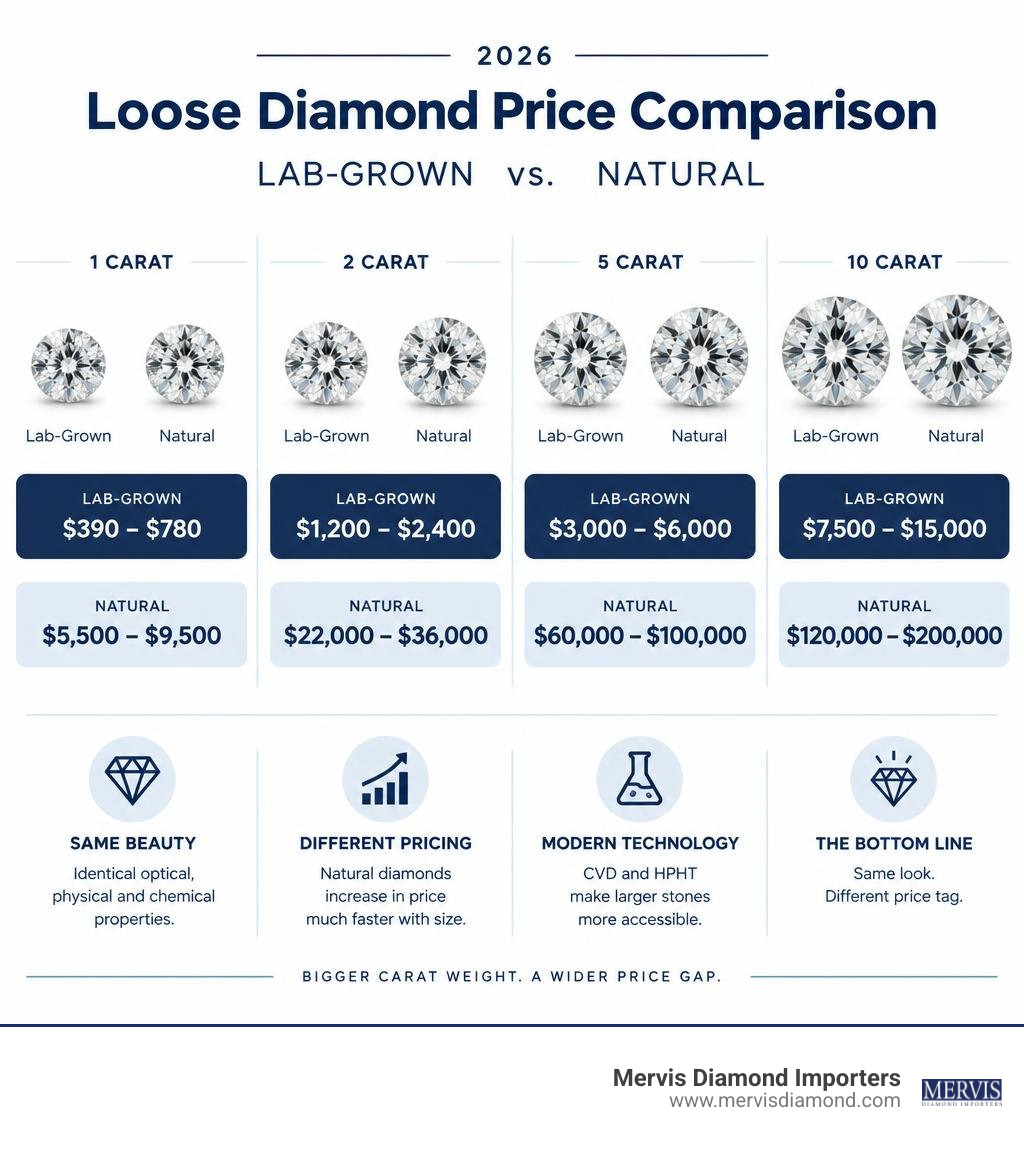
A 1-carat lab-grown round diamond costs about $390-$780 in 2026, compared with $5,500-$9,500 for a natural round diamond of similar quality. At 2 carats, expect roughly $1,200-$2,400 for lab-grown versus $22,000-$36,000 for natural. These are loose-stone price ranges; a ring setting adds to the final cost.
Price depends on more than size. Cut, shape, color, clarity, and the grading report all matter. This guide will help you compare stones that look great without paying for grades you may not notice. I'm Morris Mervis, and I'll walk you through where the money goes.
Understanding the True Cost of Lab Grown Diamonds by Carat Weight (2026 Index)
When evaluating the market today, the overall cost of lab grown diamonds reflects an unprecedented shift in gemstone manufacturing efficiency. In our showrooms across Washington DC, Rockville MD, and Tysons VA, clients often ask how laboratory stones compare mathematically to mined stones. While both share identical optical, physical, and chemical structures, their pricing models diverge dramatically as carat weight scales up.
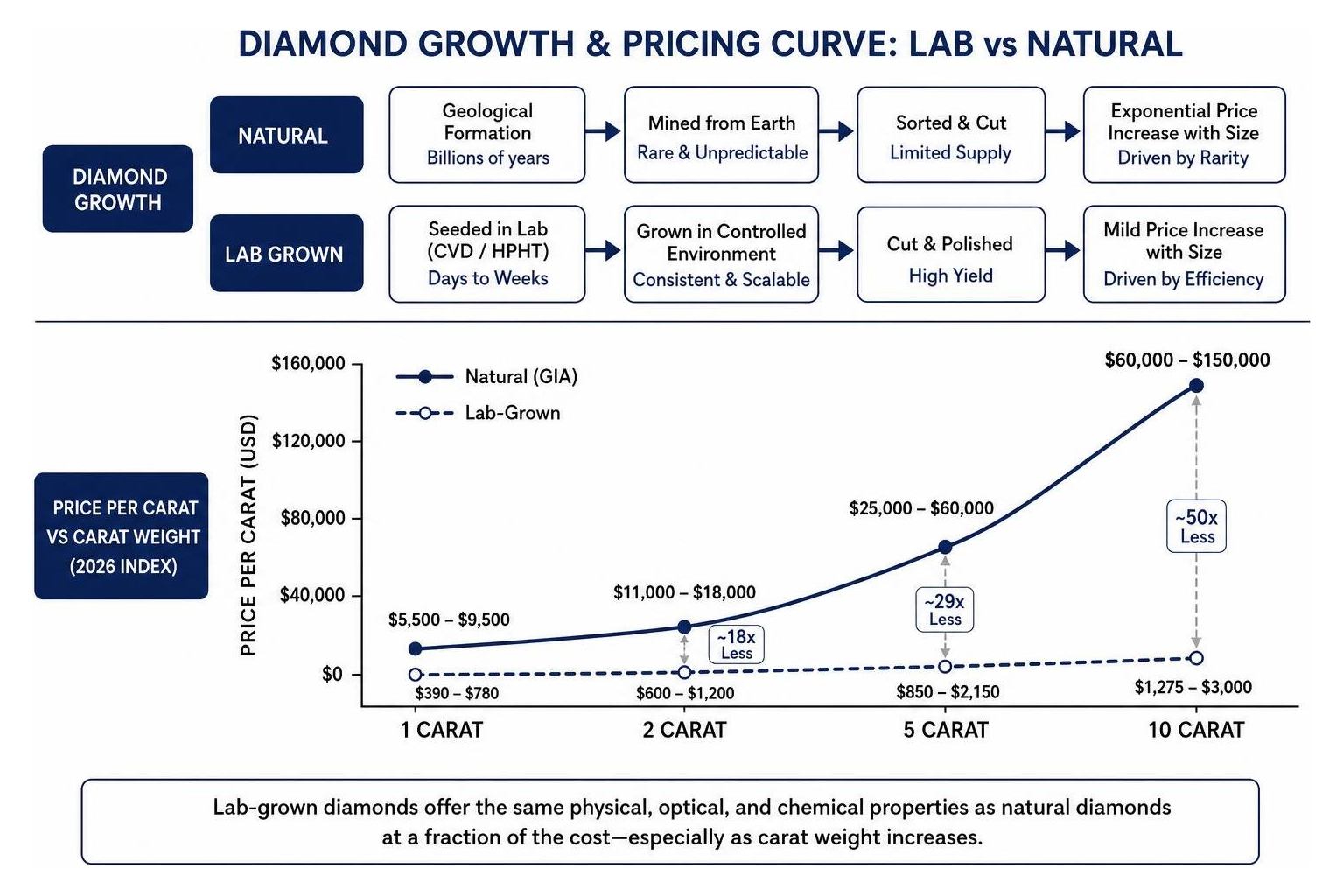
Natural diamond prices increase exponentially with size because recovering large, gem-quality rough from the earth is exceptionally rare. In contrast, laboratory-grown diamonds experience far milder price increases per carat. Advancements in Chemical Vapor Deposition (CVD) and High Pressure High Temperature (HPHT) synthesis allow growers to produce multi-carat gems with greater consistency, keeping retail pricing accessible even at higher carat tiers.
The following index, aligned with current industry data from the 2026 Diamond Price Per Carat Index, highlights the baseline price per carat and average total retail ranges across major size thresholds for round brilliant diamonds in 2026:
| Carat Weight | 2026 Lab-Grown Price / Carat | Total Lab-Grown Cost (Loose) | 2026 Natural GIA Price / Carat | Total Natural Cost (Loose) | Total Savings |
|---|---|---|---|---|---|
| 1.00 ct | $390 – $780 | $390 – $780 | $5,500 – $9,500 | $5,500 – $9,500 | $5,000 – $8,500 |
| 2.00 ct | $600 – $1,200 | $1,200 – $2,400 | $11,000 – $18,000 | $22,000 – $36,000 | $20,000 – $33,000 |
| 5.00 ct | $850 – $2,150 | $4,250 – $10,750 | $25,000 – $60,000 | $125,000 – $300,000 | $120,000 – $295,000 |
| 10.00 ct | $1,275 – $3,000 | $12,750 – $30,000 | $60,000 – $150,000 | $600,000 – $1,500,000 | $600,000 – $1,470,000 |
1-Carat to 2-Carat Price Dynamics
For most engagement ring shoppers, the 1-carat to 2-carat segment represents the core buying territory. At the 1-carat mark, a premium laboratory-grown round brilliant trades between $390 and $780 per carat, making it roughly 14 times cheaper than an equivalent natural diamond. Moving to a 2-carat stone, the lab-grown rate averages $600 to $1,200 per carat, which is approximately 18 times less than a natural stone.
When you look at intermediate sizes such as 3 carats, understanding the 3 carat lab grown diamond cost reveals that buyers can easily secure substantial presence on the hand without taking on the steep exponential markup typical of mined inventory.
Large Carats: 5-Carat to 10-Carat Price Breakdown and Scarcity Gap
At the 5-carat and 10-carat milestones, the pricing gap widens into life-changing figures. A 5-carat laboratory-created diamond runs roughly 29 times cheaper than a natural counterpart, saving between $120,000 and $295,000. At 10 carats, the laboratory diamond is approximately 50 times less expensive, translating to savings upwards of $600,000 to $1.47 million.
Natural diamonds at this tier are mineralogical wonders whose prices are driven by pure scarcity, private treaty negotiations, and auction house activity. Lab diamonds do see modest per-carat price increases above 5 carats, not due to geological rarity, but because maintaining plasma stability in a reactor over extended growth periods requires greater energy, specialized seed plates, and stricter yields. However, because each stone is a genuine diamond with the exact crystal lattice of carbon atoms, you achieve identical physical radiance at a fraction of the capital outlay.
How the 4Cs and Certification Shape Diamond Pricing
Even within laboratory stones, quality variation plays a direct role in where a specific stone falls within its price band. The standard 4Cs—Cut, Color, Clarity, and Carat Weight—remain the universal benchmark for setting value and visual brilliance.
How Cut and Fancy Shapes Alter the Cost of Lab Grown Diamonds
Cut quality is paramount. An excellently cut diamond maximizes light return, fire, and scintillation. However, shape choice introduces significant pricing differences. Fancy shapes—such as ovals, emerald cuts, radiants, pears, and cushions—routinely trade at 15% to 30% lower per carat than round brilliants of matching color and clarity.
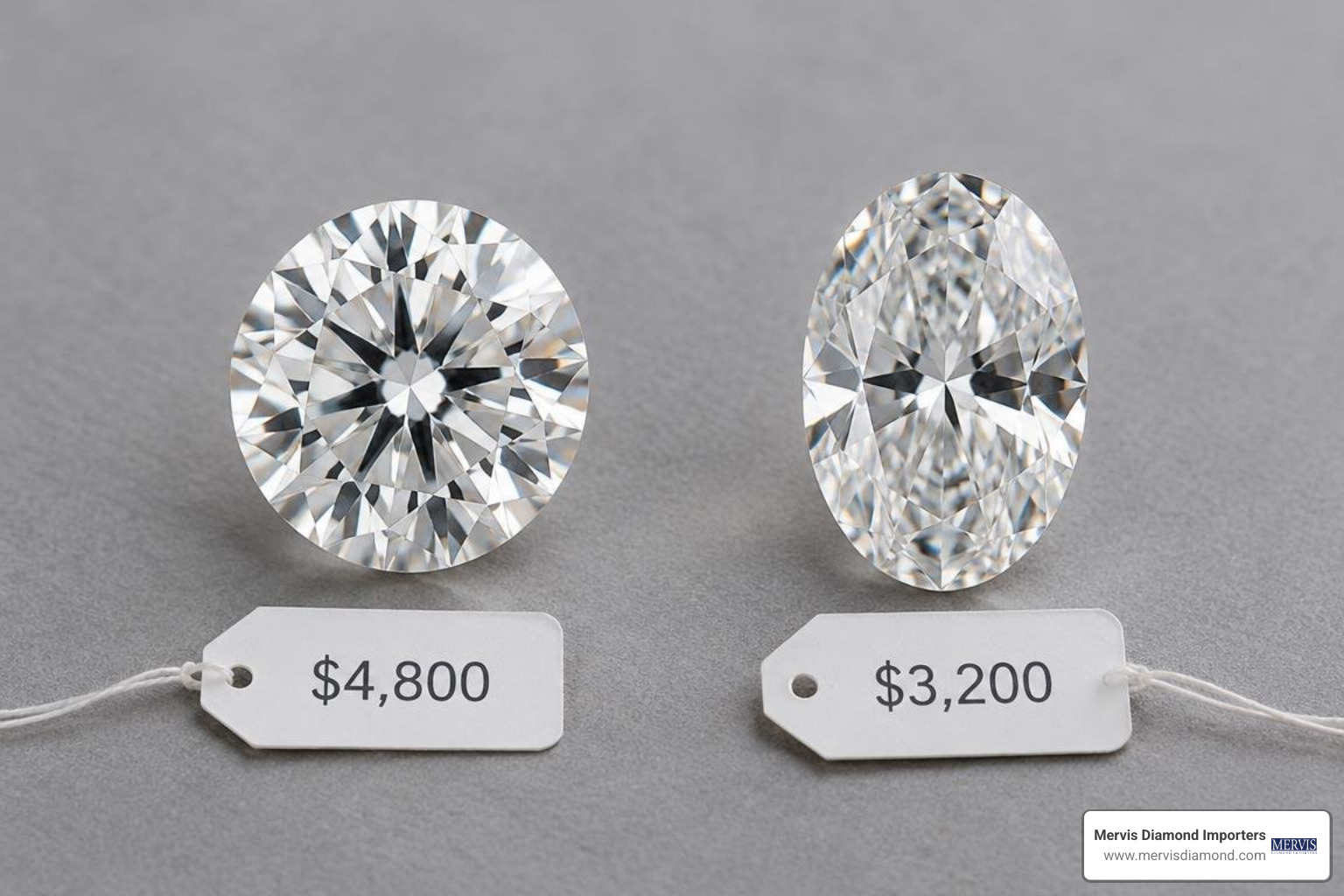
This price differential stems from cutting yield. Round brilliant diamonds require removing roughly 50% to 60% of the rough crystal to achieve ideal mathematical proportions. Fancy shapes retain much more of the original rough crystal during polishing.
For instance, an elongated step cut like this lab grown emerald cut diamond report or a brilliant shape like this lab grown oval diamond report maximizes weight retention, translating directly into lower consumer costs per carat.
Sweet-Spot Recommendations: Balancing Quality and the Cost of Lab Grown Diamonds
Because laboratory diamonds are priced accessibly, many shoppers default to selecting flawless D-color and VVS-clarity stones. While options such as this lab grown round diamond report or this lab grown radiant diamond report deliver immaculate purity, understanding the visual "sweet spots" allows you to balance quality and budget seamlessly:
- 1 Carat to 1.5 Carats: F–G color and VS1–VS2 clarity. In this size range, inclusions are microscopic, and color tinting is imperceptible in face-up view.
- 2 Carats to 3 Carats: E–F color and VS1 clarity. As table facet sizes increase, step cuts and brilliant cuts benefit from VS1 clarity to guarantee complete eye-cleanliness.
- 4 Carats and Above: D–E color and VVS2–VS1 clarity. Larger stones act like clear windows; maintaining exceptional clarity ensures no internal crystal graining or strain lines show under ambient light.
Grading Lab Certification: IGI vs. GIA Impact
Independent certification is just as essential for lab-grown stones as it is for natural diamonds. The International Gemological Institute (IGI) is the recognized standard in the lab-grown market, certifying the majority of fine lab stones. The Gemological Institute of America (GIA) also grades laboratory diamonds, often commanding a 5% to 15% pricing premium.
While GIA-graded lab stones offer familiarity for traditional shoppers, an IGI certificate provides rigorous evaluation of cut proportions, polish, symmetry, and post-growth treatments. Whether you need appraisal documentation for insurance or are researching how lab grown diamonds are appraised, a recognized certificate from IGI or GIA validates your diamond's exact specifications.
Market Factors: Magic Weights, Resale Value, and Long-Term Trends
Unlike natural diamonds, laboratory-grown stones do not experience severe "magic weight" price jumps. In mined stones, hitting an exact 1.00, 2.00, or 3.00-carat benchmark causes an immediate 20% to 35% pricing surge due to consumer demand for round numbers and extreme rough scarcity. In the laboratory market, a 1.95-carat stone and a 2.02-carat stone are priced almost linearly based on their exact gram-weight cost.
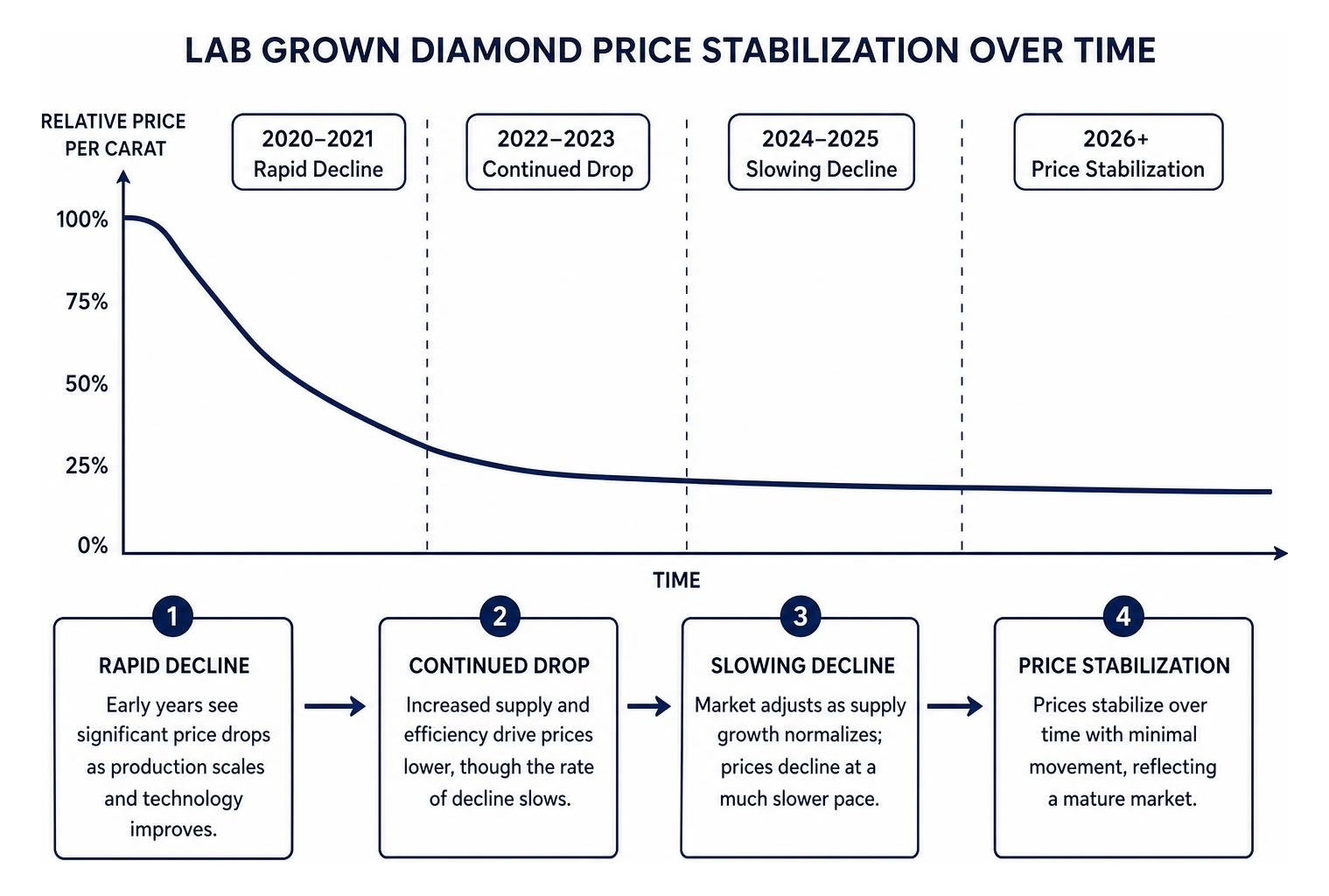
When planning your purchase, keep long-term value expectations realistic. Lab-grown diamonds continue to see year-over-year price compression as production technology scales. A stone purchased at the high end of a pricing band today may trade for less on the secondary market in subsequent years.
Because resale liquidity for lab diamonds remains limited compared to natural diamonds, laboratory stones should be purchased for their personal beauty, design freedom, and upfront savings rather than as financial investment vehicles. Choosing the best lab grown diamond source ensures you receive direct pricing, top-tier cut curation, and transparent guidance.
Setting and Jewelry Applications: Maximizing Your Budget
Because laboratory diamonds significantly lower center-stone acquisition costs, our clients in Maryland, Virginia, and Washington DC frequently use their savings to create bespoke, heirloom-grade settings or explore distinctive fine jewelry styles.
- Engagement Rings: You can pair a substantial center stone with handcrafted platinum, pavé bands, or hidden halos. Explore custom mountings and designer settings through our collection of lab grown diamond engagement rings.
- Diamond Studs: Lab diamonds provide exceptional value for daily luxury. You can explore lab grown stud earrings to achieve classic 2-carat to 4-carat total weight studs at accessible price points.
- Contemporary Fashion Rings: Unique geometric designs, such as a bezel set east-west pear ring, showcase modern diamond aesthetics while keeping total fine jewelry investments practical.
Frequently Asked Questions About Diamond Pricing
How much cheaper is a lab-grown diamond compared to a natural diamond at 2 carats?
A 2-carat laboratory-grown diamond is roughly 18 times cheaper than an equivalent natural diamond. In 2026, a high-quality 2-carat lab stone averages $1,200 to $2,400 loose, whereas a comparable natural stone ranges from $22,000 to $36,000, creating an average direct savings of $20,000 to $33,000.
Does buying just under 1 carat save money on lab-grown diamonds?
In natural diamonds, buying an "under-size" stone like a 0.90–0.95 carat yields massive savings because you avoid the 1.00-carat scarcity jump. In lab-grown diamonds, the price per carat scales linearly without dramatic threshold spikes. While a 0.90-carat lab diamond costs slightly less because it weighs less, you will not experience an artificial 25% price drop simply by stepping just below 1.00 carat.
Why do fancy shape lab-grown diamonds cost less than round brilliants?
Fancy shapes—such as ovals, emeralds, radiants, and pears—cost 15% to 30% less per carat than round brilliants due to cutting yield. Diamond cutters preserve more rough material when shaping fancy cuts from laboratory crystal blocks, whereas round brilliants require polishing away more than half of the initial rough to achieve ideal symmetry.
Conclusion
The 2026 diamond market gives fine jewelry buyers unprecedented control over their budgets and personal styles. Whether you prioritize mined rarity or modern laboratory craftsmanship, matching cut precision with balanced color and clarity grades ensures maximum beauty and value.
At Mervis Diamond Importers, our family has guided diamond buyers across the Washington DC region for generations. We invite you to visit our showrooms in Tysons, VA, Rockville, MD, or downtown Washington, DC to view stones side-by-side in person, or discover the latest trending lab grown diamonds in Washington DC to find your ideal ring today.