

Why We Are Obsessed with the Baguette Diamond Solitaire Ring
The Baguette Diamond Solitaire Ring: Understated Elegance That Never Goes Out of Style
A baguette diamond solitaire ring is one of the most striking — and underrated — choices in fine jewelry today. Here's what you need to know at a glance:
- Shape: Rectangular step-cut diamond with clean, parallel lines
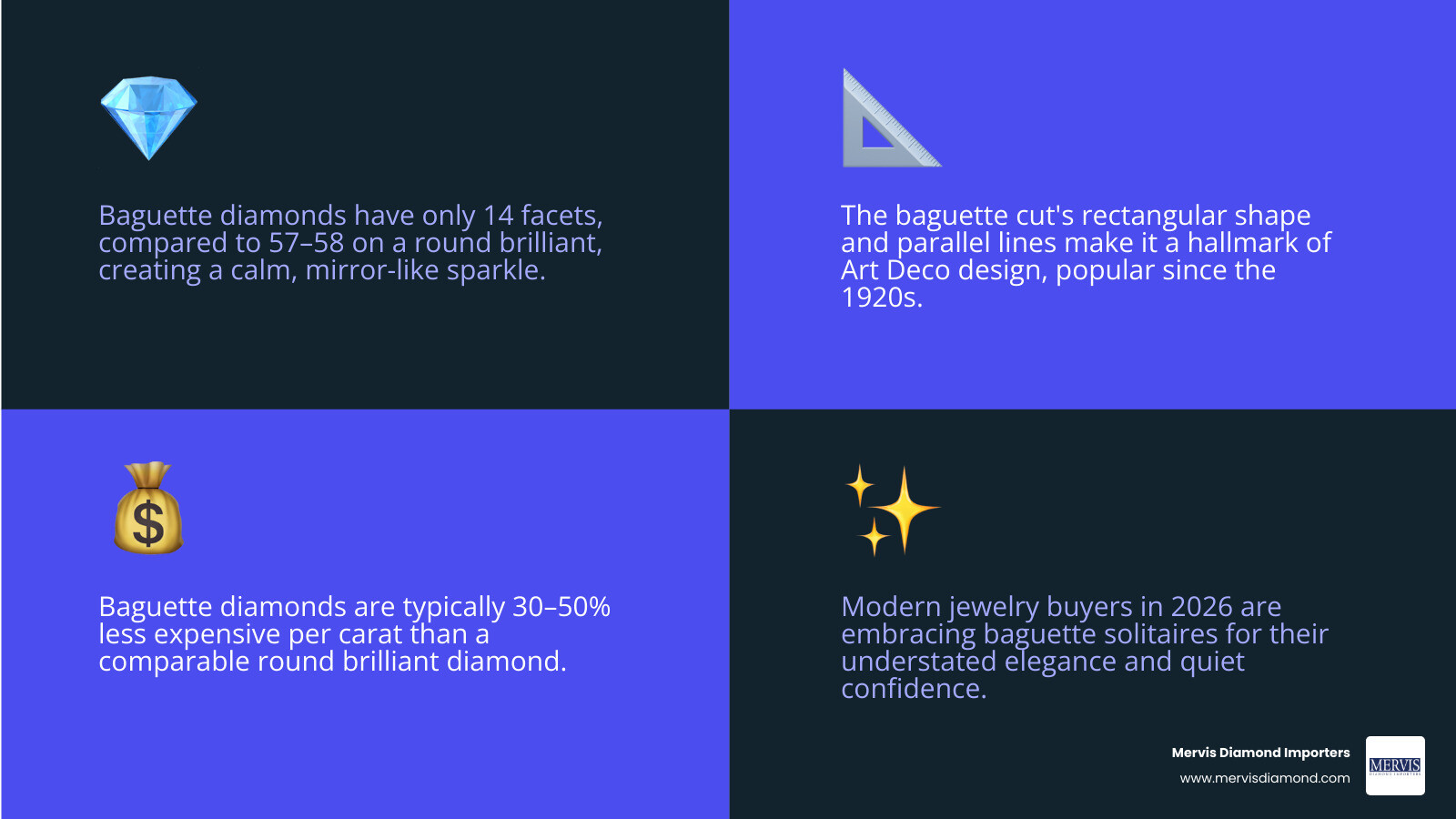
- Facets: 14 facets (vs. 57–58 in a round brilliant), producing a calm, mirror-like sparkle
- Style: Geometric, minimalist, and rooted in Art Deco design
- Price: Typically 30–50% less per carat than a comparable round brilliant diamond
- Best for: Someone who wants bold structure over flashy brilliance
The baguette cut has been turning heads since the 1920s Art Deco era — and in 2026, it's back in a big way. Modern jewelry buyers are moving away from maximalist styles toward clean lines and intentional design. The baguette solitaire sits right at that intersection of vintage heritage and contemporary cool.
It's not the loudest stone in the room. It doesn't need to be. Its appeal is quiet confidence — the kind that comes from knowing exactly what you want.
I'm Morris Mervis, and after decades of helping customers find diamonds that truly fit their lives, I can tell you that few cuts reward a discerning eye quite like the baguette.
What is a Baguette Diamond Solitaire Ring?
To truly appreciate the baguette diamond solitaire ring, we first have to understand what makes this particular cut so special. The word "baguette" comes from the French word for a long, thin loaf of bread (yes, really!), which perfectly describes its elongated, rectangular silhouette.
Unlike the highly popular round brilliant diamond, which is engineered to bounce light in every direction, a baguette diamond belongs to the "step-cut" family. While a round brilliant features 57 or 58 tiny, triangular facets, a classic baguette cut typically features just 14 facets arranged in parallel steps.
When you set this unique gem as a solitaire, you are making a deliberate style choice. While many people think "solitaire" means a single, isolated stone on a plain band, the term actually refers to a design where one central diamond dominates the ring's aesthetic. If you want to dive deeper into how this works, check out our guide on how Solitaire Doesn't Mean Single Stone.
Historically, baguettes have been relegated to the background, but when you let a single, magnificent baguette take center stage, the result is breathtaking. To understand the fundamental structure of this cut, you can read our resource on What is a Baguette Diamond.
The Unique Anatomy of a Baguette Cut
The charm of a step-cut diamond lies in its geometry. Because the facets run parallel to the girdle, they create a mesmerizing "hall-of-mirrors" effect. Instead of the chaotic, fiery scintillation of a brilliant cut, a baguette diamond offers flashes of pure, bright light alternating with dark, reflective shadows.
This behavior is entirely dependent on the stone's physical structure. For a detailed breakdown of how different cuts interact with light, read our article on What Makes a Diamond Sparkle. The clean, straight lines of a baguette emphasize the diamond's natural clarity and architectural symmetry, making it an excellent match for those who appreciate structural beauty over sheer glitter.
Solitaire vs. Accent Stones
For decades, baguette diamonds were primarily used as accent stones. If you look at vintage or even contemporary engagement rings, about 1 in 5 solitaire rings feature baguette accents flanking a round, oval, or princess-cut center stone. They are incredibly popular in three-stone settings, where they act as elegant visual ramps leading the eye toward the center gem.
However, in 2026, we are seeing a massive shift. Modern couples are skipping the accent role entirely and choosing a baguette diamond solitaire ring as the main event. By elevating the baguette to the center stone, you get a look that is incredibly sleek, rare, and deeply personal.
Why the Baguette Diamond Solitaire Ring is the Ultimate Modern Statement
There is something undeniably architectural about a baguette diamond. It feels less like a traditional piece of jewelry and more like a miniature piece of modern sculpture.
This style is deeply rooted in the Art Deco movement of the 1920s and 1930s, an era defined by geometric patterns, bold lines, and a break from the ornate, flowery designs of the Edwardian period. By choosing a baguette solitaire, you are wearing a piece of design history. At the same time, its minimalist profile fits perfectly into the clean, uncluttered aesthetics of 2026. For a complete look at how this vintage favorite has evolved, explore our Baguette Diamond Complete Guide 2026.
Designing Your Custom Baguette Diamond Solitaire Ring
One of the best things about a baguette diamond solitaire ring is its versatility in custom design. Because of its linear shape, you can orient the stone in two entirely different ways:
- Vertical (Classic) Setting: Setting the baguette north-south along the finger has an incredible lengthening effect, making the finger look long and slender.
- East-West (Horizontal) Setting: Turning the baguette 90 degrees so it runs east-west across the band creates an ultra-modern, edgy look that immediately stands out from the crowd.
Your choice of mounting also completely changes the vibe of the ring. A prong setting allows maximum light to enter the sides of the stone, while a bezel setting wraps the diamond in a solid collar of precious metal, accentuating its geometric shape and offering superior protection. To help you decide which look is right for you, we recommend reading How to Choose a Diamond Ring Setting as well as A Comprehensive Guide to Engagement Ring Settings.
When it comes to metals, platinum and white gold offer a seamless, icy look that blends beautifully with the white flashes of a step-cut diamond. On the other hand, yellow gold provides a gorgeous, warm contrast that highlights the stone's crisp boundaries.
Comparing Baguettes to Emerald and Cushion Cuts
If you love the look of a step-cut diamond, you might also be considering an emerald cut. While they look similar at a glance, they have key differences.
| Feature | Baguette Cut | Emerald Cut | Cushion Cut |
|---|---|---|---|
| Shape | Narrow, elongated rectangle | Wider rectangle with cropped corners | Square or rectangle with rounded corners |
| Facet Style | Step-cut (parallel facets) | Step-cut (parallel facets) | Brilliant-cut or modified step-cut |
| Brilliance | Understated, mirror-like flashes | Deep, hall-of-mirrors effect | High fire and scintillation |
| Durability | Vulnerable sharp corners | Protected cropped corners | Highly durable rounded edges |
An emerald cut is essentially a wider baguette with cropped corners. This cropping makes the emerald cut slightly more durable at the edges. A cushion cut, on the other hand, is a brilliant cut with rounded corners, offering a completely different type of sparkle. To learn more about cushion cuts, read our breakdown of the Best Cut for Cushion Diamond. For an official industry perspective on cut quality and classifications, you can also refer to GIA's Guide on Diamond Cuts.
Selecting the Perfect Stone: The 4Cs for Step Cuts
When buying a round brilliant diamond, the stone's intense sparkle can easily hide minor inclusions or a slight yellow tint. Step-cut diamonds like the baguette do not have that luxury. Because of their large, open facets, looking into a baguette diamond is like looking through a clean window.
This means you must approach the 4Cs (Cut, Clarity, Color, and Carat) a little differently. You can brush up on the basics with our guide to Understanding Four Cs. It's also helpful to understand what you are comparing your natural or lab-grown stone against, which you can learn about in our article explaining What is a Diamond Simulant.
How to Choose the Perfect Baguette Diamond Solitaire Ring
To get the absolute best value and beauty out of your baguette solitaire, keep these expert tips in mind:
- Prioritize Clarity: Because there is no heavy sparkle to mask flaws, we highly recommend choosing a clarity grade of VS1 or higher. An "eye-clean" stone is absolutely vital here.
- Watch the Color: Step cuts tend to retain color more than brilliant cuts. If you are setting your diamond in platinum or white gold, try to stay within the colorless to near-colorless range (D through G). If you prefer yellow gold, you can comfortably drop to an H or I.
- Embrace the Carat Savings: Here is the good news! Because baguette diamonds are less in demand than round brilliants and utilize more of the rough diamond crystal during cutting, they are often 30% to 50% less expensive per carat than round brilliant diamonds of the same quality. This allows you to get a much larger stone for your budget.
- Decide on Natural vs. Lab-Grown: At Mervis Diamond Importers, we hand-select both natural and lab-grown diamonds. Whichever path you choose, we ensure your baguette has the perfect proportions and symmetry to maximize its unique light return.
Frequently Asked Questions About Baguette Solitaires
Are baguette diamonds durable enough for daily wear?
Because baguette diamonds have sharp, 90-degree corners, they can be more vulnerable to chipping if they suffer a hard impact. However, you can easily mitigate this risk by choosing a protective setting. A bezel setting or a semi-bezel that caps the delicate corners with precious metal will keep your stone safe for decades of daily wear.
How do I clean and maintain a baguette diamond ring?
Because of their flat, open surfaces, baguette diamonds show dirt, oil, and fingerprints much faster than brilliant-cut diamonds. A thin layer of hand lotion can quickly dull their mirror-like shine.
To keep your ring looking its best, wash it weekly in warm water mixed with a few drops of mild dish soap. Use a soft-bristled toothbrush to gently clean underneath the stone where dirt likes to hide. For peace of mind, we always recommend bringing your ring to one of our showrooms in Tysons, Rockville, or Washington DC for a complimentary professional inspection and deep clean.
Can I pair a baguette solitaire with a wedding band?
Absolutely! A baguette diamond solitaire ring pairs beautifully with a wide variety of wedding bands. For a cohesive, geometric look, you can pair it with a band featuring small, channel-set baguette diamonds. If you love a bit of contrast, a round brilliant pavé band creates a gorgeous texture play. For a fun, modern everyday look, you can even coordinate your ring with stylish Baguette Diamond Huggies.
Conclusion
The baguette diamond solitaire ring is a masterclass in clean design, historic charm, and modern minimalism. It is a style designed for those who appreciate the quiet brilliance of a step-cut diamond and want a ring that feels entirely unique.
At Mervis Diamond Importers, we are proud to offer an exquisite, hand-selected inventory of both natural and lab-grown baguette diamonds. Our non-commissioned, expert consultants are here to guide you through our pressure-free selection process across our convenient locations in Maryland, Virginia, and the District of Columbia.
Whether you are visiting us in Tysons, VA, Rockville, MD, or Washington, DC, we are ready to help you design the perfect ring. To take your first step, explore our foundational guide on What is a Baguette Diamond or schedule a personalized consultation with us today!