

Don't Get Rocked: The Real Average Cost of Lab Grown Diamonds
Lab Grown Diamond Prices Have Dropped Dramatically — Here's What to Expect in 2026
The average cost of lab grown diamonds has fallen sharply over the past few years, making them one of the most talked-about shifts in the jewelry market right now.
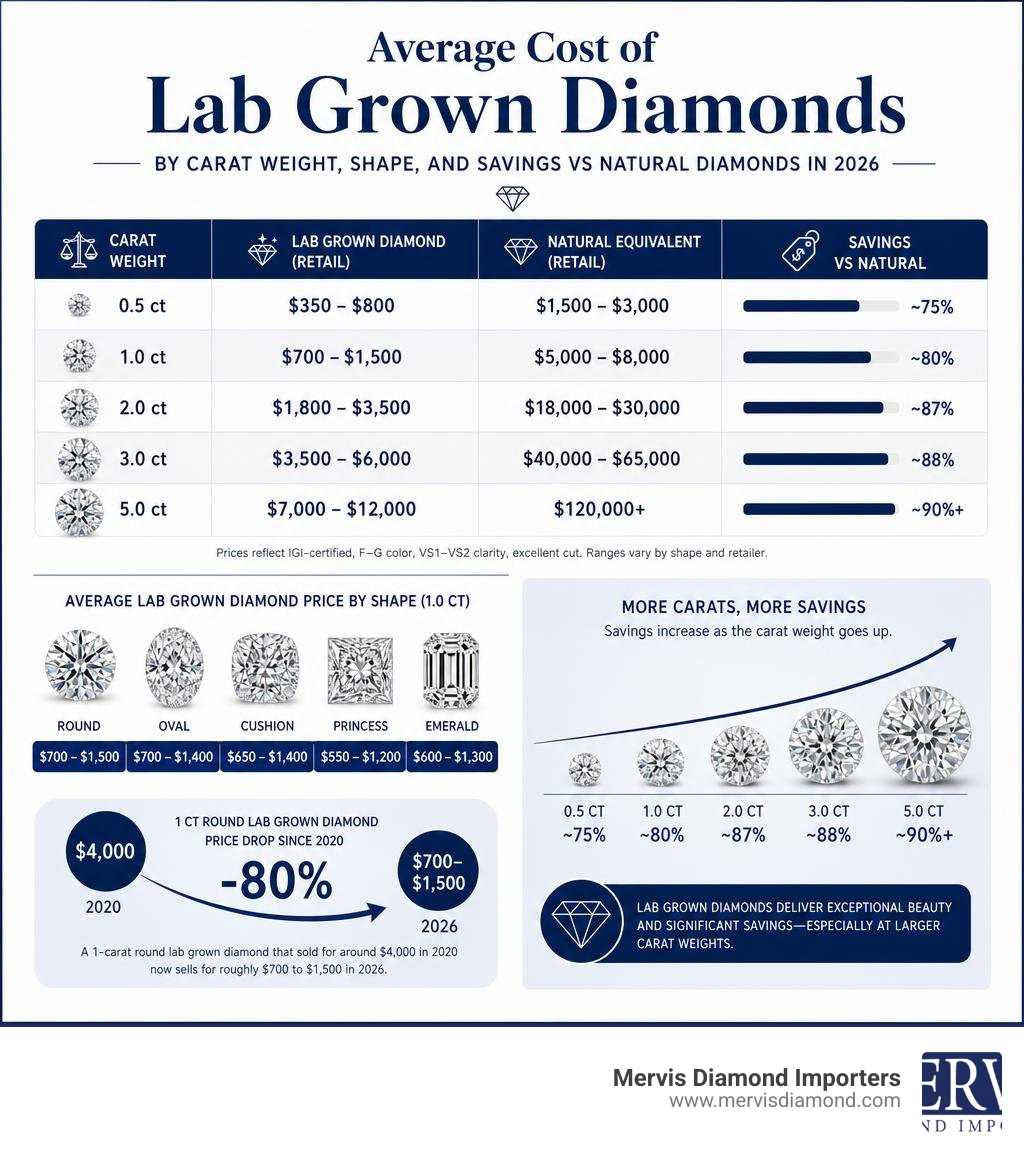
Here's a quick snapshot of what lab grown diamonds cost at retail in 2026:
| Carat Weight | Lab Grown (Retail) | Natural Equivalent | Savings |
|---|---|---|---|
| 0.5 ct | $350 – $800 | $1,500 – $3,000 | ~75% |
| 1.0 ct | $700 – $1,500 | $5,000 – $8,000 | ~80% |
| 2.0 ct | $1,800 – $3,500 | $18,000 – $30,000 | ~87% |
| 3.0 ct | $3,500 – $6,000 | $40,000 – $65,000 | ~88% |
| 5.0 ct | $7,000 – $12,000 | $120,000+ | ~90%+ |
Prices reflect IGI-certified, F–G color, VS1–VS2 clarity, excellent cut. Ranges vary by shape and retailer.
To put that in perspective: a 1-carat round lab grown diamond that sold for around $4,000 in 2020 now sells for roughly $700 to $1,500. That's an 80% price drop in under six years.
And the savings grow bigger as the stone gets larger. A 2-carat natural round diamond with strong color and clarity grades can run $13,000 to $14,000. The lab grown equivalent? Around $1,000 to $3,500.
This isn't a sale. It's a structural market shift — driven by a massive expansion in global production capacity, more efficient manufacturing technology, and increased competition among producers.
For buyers who want a beautiful, conflict-free diamond without overpaying, that's very good news. But pricing can still vary widely depending on carat weight, cut quality, shape, certification, and where you buy. This guide breaks all of that down clearly.
What is the Average Cost of Lab Grown Diamonds in 2026?
When you step into our showrooms in Tysons, VA, Rockville, MD, or Washington, DC, one of the first questions we hear is: "What is the actual bottom line for a lab grown diamond today?"
In July 2026, the market has settled into a highly accessible, stable pricing structure after years of rapid declines. The average cost of lab grown diamonds now ranges from $800 to $2,500 per carat for high-quality, hand-selected loose stones. However, because lab grown diamond production scales incredibly well, the price per carat behaves very differently than it does with natural diamonds.

To help you visualize the current landscape, here is a detailed breakdown of retail pricing across the most popular carat weights and shapes in 2026:
| Carat Weight & Shape | Average Price (Lab Grown) | Average Price (Natural Equivalent) | Savings Percentage |
|---|---|---|---|
| 1.0 Carat Round | $759 | $5,500 | 86% |
| 1.0 Carat Oval | $827 | $5,000 | 83% |
| 1.0 Carat Princess | $500 | $2,500 | 80% |
| 2.0 Carat Round | $1,312 | $14,000 | 90% |
| 2.0 Carat Oval | $1,970 | $12,500 | 84% |
| 3.0 Carat Round | $1,846 | $45,000 | 95% |
| 4.0 Carat Emerald | $3,200 | $75,000 | 95% |
At the wholesale level, prices are even lower, with some 1-carat lab diamonds trading around $680. However, as a retail buyer, you should expect to pay a fair markup that covers professional gemological inspection, mounting, and long-term service guarantees.
While you can search online and find massive databases of loose stones, the real value lies in choosing a stone that has been physically vetted. Many ultra-cheap stones bought online carry visual defects like graining or a gray-brown undertone that doesn't show up on a grading report.
Understanding the Average Cost of Lab Grown Diamonds by Carat Weight
To understand how the average cost of lab grown diamonds scales, we have to look closely at each major carat weight milestone. In the natural diamond world, the price per carat spikes exponentially as you go from 1 to 2 to 3 carats because larger rough crystals are incredibly rare in nature. With lab-grown stones, that geological scarcity does not exist, meaning the price curve is much flatter.
- 1 Carat Stones: A high-quality 1 Ct Man Made Diamond is the absolute sweet spot for entry-level budgets. You can easily find a gorgeous, eye-clean stone for $700 to $1,500. For a classic princess cut, a natural stone would cost roughly $2,500, versus about $500 for a same-quality lab-grown equivalent.
- 2 Carat Stones: This has quickly become the new standard for engagement rings in the Washington, DC metro area. According to our 2 Carat Man Made Diamond Complete Guide, a 2-carat loose lab diamond averages between $1,800 and $3,500. This is a massive contrast to natural 2-carat diamonds, which command $15,000 to $25,000. This size offers an incredible balance of visual impact and value for local couples looking to maximize their budget.
- 3 Carat Stones: If you want a show-stopping look, a 3-carat stone is highly accessible. Our 3 Carat Man Made Diamond Ring Guide shows that a loose 3-carat lab stone averages $3,500 to $6,000, whereas a natural equivalent would easily cost $30,000 to $60,000.
- 4 Carat Stones and Beyond: For those who want ultimate luxury, our Ultimate 4 Carat Man Made Diamond Guide highlights that 4-carat D-color, VVS-clarity emerald or radiant cuts can be secured for $4,500 to $8,000. In the natural world, a 4-carat diamond of this quality is a museum-worthy piece costing upwards of $80,000.
Key Factors Influencing the Average Cost of Lab Grown Diamonds
Just like natural diamonds, lab grown diamonds are graded on the classic 4Cs: Cut, Color, Clarity, and Carat Weight. However, because these stones are grown in a controlled environment, the way these factors influence the final price tag is slightly different.
1. Cut Quality (The Sparkle Factor)
Cut is the single most important factor determining a diamond's beauty and its price. We always advise our clients in Tysons and Rockville to allocate the largest portion of their budget here. An Excellent or Ideal cut maximizes light return, hiding minor color tints and microscopic inclusions.
2. Color and Clarity
Because technology allows us to grow diamonds with incredible precision, the majority of lab diamonds on the market sit in the desirable colorless (D-F) and near-colorless (G-H) ranges, with VVS to VS clarity. You do not need to pay a massive premium for a Flawless (FL) or VVS1 stone. An "eye-clean" VS2 diamond will look identical to the naked eye and save you 20% to 30%.
3. Shape and Silhouette
Round brilliant cuts are the most expensive because they require the most rough diamond loss during the cutting and polishing process. Fancy shapes like Ovals, Pears, Marquises, and Cushions typically cost 15% to 30% less than a round diamond of the same carat weight.
4. The Growth Method: CVD vs. HPHT
How the diamond is grown plays a major role in its wholesale and retail pricing. To learn more about the science behind this, you can check out our article on What Is a CVD Diamond. CVD (Chemical Vapor Deposition) is generally 5% to 10% cheaper to produce than HPHT (High Pressure High Temperature) and is excellent for larger, colorless stones.
Lab Grown vs. Natural Diamonds: The Massive Price Gap
The price gap between lab grown and natural diamonds has grown from a modest 20% discount a decade ago to a staggering 80% to 90% savings in 2026.

When comparing Mined vs Lab Grown Diamonds, the physical, chemical, and optical properties are 100% identical. Both are pure carbon crystalline structures with a Mohs hardness of 10. Yet, their price points tell two completely different stories.
For a real-world comparison, look at this report from Lab-grown versus natural diamonds: what to know before you buy . The news segment highlights that a natural 2-carat round-cut diamond with high-quality color and clarity ratings costs about $13,000 to $14,000, whereas the equivalent lab-grown diamond sells for about $1,000 to $2,000.
This massive cost savings has completely rewritten the rules of engagement ring shopping. Couples in Northern Virginia and Maryland are routinely choosing lab grown diamonds so they can redirect $10,000+ of savings toward a home down payment, a luxury honeymoon, or paying off student loans.
The Resale Reality and Value Retention
If you are choosing between natural and lab grown, you must understand the financial trade-offs. This is what we call the "resale reality."
Natural diamonds have a mature, secondary market. While you will rarely recoup 100% of what you paid retail, a high-quality natural diamond typically retains 25% to 50% of its original value over time.
Lab grown diamonds, on the other hand, have virtually no long-term resale value. Because they can be manufactured on demand, wholesalers and secondary platforms will only offer a fraction of the original price — typically 10% to 30% of the retail cost. For an honest, deep-dive into this topic, read our article: Do Lab Grown Diamonds Have Resale Value.
However, we encourage our clients to look at the actual math rather than just percentages:
- The Natural Scenario: You buy a natural diamond for $15,000. If you sell it years later at a 50% loss, you recoup $7,500. Your net financial loss is $7,500.
- The Lab Grown Scenario: You buy the identical-looking lab diamond for $2,000. If you sell it later for absolute zero, your net financial loss is only $2,000.
By choosing lab grown, you keep an extra $13,000 in your bank account on day one. If you invest that saved capital into an index fund, it will yield far better financial returns than any diamond ever could.
Why Have Lab Diamond Prices Dropped So Significantly?
The dramatic drop in lab grown diamond prices over the last six years is a classic study in supply, demand, and industrial scaling.
Between 2020 and 2023, global manufacturing capacity for lab grown diamonds expanded by over 300%. Much of this growth was driven by massive CVD operations in India and China. With supply flooding the market, wholesale prices fell roughly 80% over six years. The actual manufacturing cost to grow a 1-carat diamond dropped from $300–$400 in 2022 to under $100 today.
However, in 2026, we have finally hit a price floor. The cost of cutting, polishing, certifying, and shipping a diamond safely across the globe sits around $100 to $150 per carat. Because of this structural floor, industry analysts expect prices to stabilize at these historically low levels rather than continuing their steep downward trajectory.
CVD vs. HPHT Production Costs
The two primary methods used to grow diamonds in a lab are Chemical Vapor Deposition (CVD) and High Pressure High Temperature (HPHT).

- CVD (Chemical Vapor Deposition): This process uses a slice of a diamond seed placed in a vacuum chamber filled with carbon-rich gas. Microwave energy ignites a plasma, causing carbon atoms to precipitate onto the seed. CVD is highly efficient, taking about 2 to 4 weeks, and is generally 5% to 10% cheaper to scale.
- HPHT (High Pressure High Temperature): This method mimics the earth's natural process by subjecting carbon to intense pressure (60,000 atmospheres) and heat (1,500°C). HPHT machines are more expensive to run and maintain, but they often produce incredibly saturated, beautiful crystals.
While CVD is the more common and cost-effective method for larger colorless gems, both methods yield stones that are chemically identical to those mined from the earth.
How to Get the Best Value When Buying a Lab Diamond Ring
If you want to maximize your budget and walk away with a breathtaking ring, you need to shop smart.
Here is our expert shortlist of buying tips for navigating the 2026 lab diamond market:
- Prioritize Cut Above All Else: A diamond's sparkle comes entirely from its cut. Do not compromise here. Always choose an "Ideal" or "Excellent" cut grade.
- Aim for the "Value Sweet Spot" in Color and Clarity: Don't pay a premium for D color or FL clarity. A G or H color stone with VS2 clarity will look completely colorless and flawless to the naked eye.
- Buy Just Under "Magic Numbers": Diamond prices jump at whole carat weights (e.g., 1.0ct, 2.0ct). Buying a 0.92-carat or a 1.90-carat stone can save you 10% to 15% while looking visually identical.
- Work with a Trusted Local Jeweler: Avoid online-only databases where you cannot physically see the stone. A local expert can help you inspect the diamond under a loupe to ensure there are no oily or milky visual defects.
Certification and Insurance Considerations
Even though lab diamonds are highly affordable, protecting your purchase is still incredibly important.
First, never buy an uncertified lab grown diamond. Always insist on a grading report from a reputable laboratory like the International Gemological Institute (IGI) or the Gemological Institute of America (GIA). These reports verify that the stone is indeed a real diamond and document its exact 4Cs. If you are wondering how these stones perform under inspection, read our guide: Do Lab Diamonds Pass a Diamond Tester.
Second, protect your investment. Even if you only spent $2,000 on a gorgeous 2-carat ring, losing it or having it damaged still represents a financial loss. For details on coverage options, check out our guide on Can You Insure a Lab Grown Diamond.
Frequently Asked Questions about Lab Diamond Pricing
Are lab grown diamonds a good value for buyers in 2026?
Yes, absolutely. For the vast majority of couples in 2026, lab grown diamonds offer unprecedented value. They are chemically, physically, and optically identical to mined diamonds, meaning they will never cloud, scratch, or lose their sparkle. They allow you to get a significantly larger, higher-quality center stone for a fraction of the price of a natural diamond.
Why does the price per carat fall as lab diamonds get larger?
In the natural diamond market, large stones are exponentially more expensive because finding a massive, high-clarity rough diamond in the earth is incredibly rare. In a laboratory setting, growing a 3-carat diamond takes only slightly more time and energy than growing a 1-carat diamond. Because production scales linearly rather than exponentially, the price per carat actually decreases or flattens as the stone gets larger.
How much does a finished lab grown diamond engagement ring cost?
A finished ring consists of two components: the loose center stone and the metal setting. While a high-quality 1.5-carat lab diamond might only cost $1,200, a custom 18K gold or platinum setting with accent diamonds can add $1,000 to $3,000 to the total. On average, our clients in the Washington, DC area spend between $3,000 and $5,500 for a fully completed, high-end lab grown engagement ring.
Conclusion
At Mervis Diamond Importers, we believe that buying an engagement ring should be an exciting, pressure-free milestone. Whether you choose a classic natural diamond or a modern lab-grown alternative, our mission is to provide you with hand-selected, exceptionally cut stones that offer the absolute best visual beauty for your budget.
If you are located in Tysons, VA, Rockville, MD, or Washington, DC, we invite you to book a private consultation with one of our non-commissioned diamond specialists. We will lay out multiple stones side-by-side under a loupe so you can see the real-world sparkle for yourself.
Ready to explore what's possible? Read our guide on Trending Lab Grown Diamonds Washington DC or visit one of our showrooms today to find your perfect match.