

3 Carat Oval Diamond Ring Price Breakdown for Smart Buyers
A Smart Starting Point for 3ct Oval Diamond Ring Prices
A 3ct oval diamond ring price can range widely. For a natural diamond, expect roughly $20,000 to $60,000 or more before considering a detailed custom setting. A comparable lab-grown oval diamond is often 50% to 70% less, though its long-term resale market differs from a natural stone.
The best value is not always the lowest price. Focus on:
- Cut and light performance: A well-cut oval can look bright and reduce the noticeable dark "bow-tie" across its center.
- Color and clarity: Near-colorless, eye-clean diamonds often offer a strong balance of beauty and cost.
- Certification: Choose an independently graded diamond and verify its report number.
- Setting choice: Platinum, gold, pavé, halo, and custom work all add to the finished ring price.
Oval diamonds also commonly cost 10% to 15% less per carat than round brilliant diamonds of similar quality, while their elongated shape can create impressive finger coverage. In 2026, that mix of visual size and relative value continues to make the 3-carat oval a popular choice for buyers who want a substantial center stone without paying round-diamond premiums.
I am Morris Mervis, and this guide will help you compare quality, certification, and design details so you can buy with confidence rather than pressure.
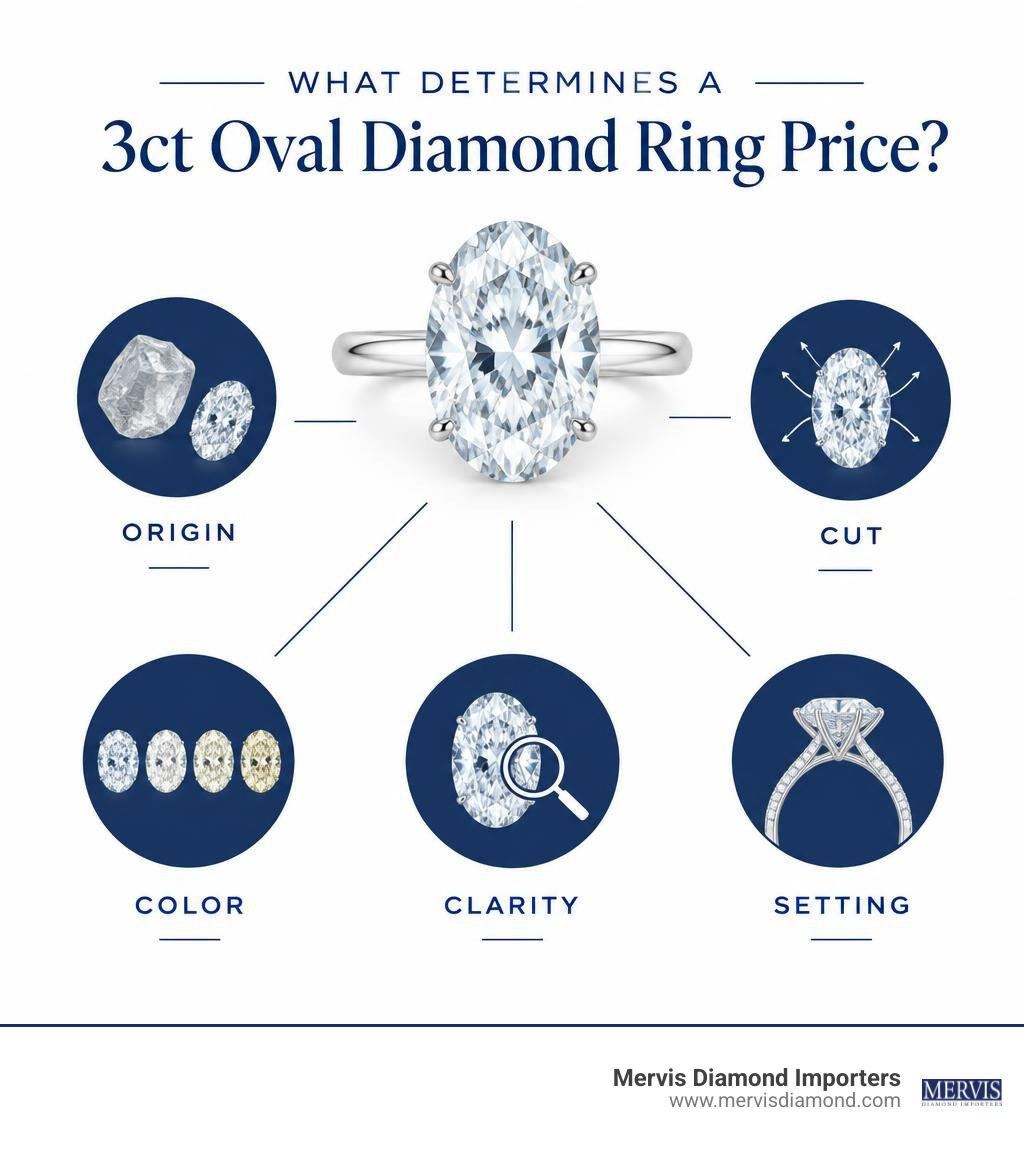
What Determines a 3ct Oval Diamond Ring Price?
When looking at a diamond of this caliber, the final cost is shaped by several distinct market dynamics and physical characteristics. Diamond pricing is primarily quoted on a per-carat basis, and as carat weight increases, the price per carat jumps significantly due to the rarity of larger rough crystals.
For a 3-carat stone, the price per carat typically ranges from $7,000 to over $20,000 for earth-mined diamonds, depending entirely on quality attributes. Natural diamonds require mining vast amounts of rock to unearth a gem-quality rough stone capable of yielding a clean 3-carat polished gem. That fundamental rarity establishes a strong pricing foundation.
Conversely, technological advances have made lab-grown diamonds widely accessible, dramatically shifting the entry price point for luxury jewelry. Understanding how these factors balance out helps you identify where your investment is actually going.
| Diamond Specification | Natural 3ct Oval Diamond | Lab-Grown 3ct Oval Diamond |
|---|---|---|
| Average Price Range | $20,000 – $60,000+ | $2,500 – $7,000+ |
| Typical Price per Carat | $7,000 – $20,000+ | $800 – $2,500 |
| Growth / Origin Method | Mined geological formation | HPHT or CVD synthesis |
| Visual Light Performance | Identical physical sparkle | Identical physical sparkle |
| Market Rarity | High finite natural rarity | Replicable laboratory production |
| Long-Term Retained Value | Established secondary trade market | Minimal secondary market retention |
How the 4Cs Influence Your 3ct Oval Diamond Ring Price
The classic 4Cs—Cut, Color, Clarity, and Carat Weight—serve as the global language of diamond valuation. With a 3-carat oval, each "C" interacts with the stone's physical proportions in specific ways:

- Cut Quality: Unlike round diamonds, gemological laboratories do not assign a single standardized cut grade (such as "Excellent") to fancy shapes like ovals. Instead, cut is evaluated by symmetry, polish, table percentage (ideal: 53–63%), and depth percentage (ideal: 58–63%). A masterfully cut oval ensures light bounces evenly across the crown.
- The Bow-Tie Effect: Every oval diamond exhibits some degree of a dark, bowtie-shaped shadow across its central facets due to head and body light blockage. In poorly cut stones, this bowtie is stark, lifeless, and distracting. In exceptional cuts, the bowtie is subtle, blending naturally into the diamond’s brilliant scintillation patterns without diminishing brightness.
- Color Grading: Diamond color is graded alphabetically from D (colorless) down to Z (light color). Because an oval cut diamond concentrates color at its rounded tips, lower color grades (like J or K) are more noticeable in a 3-carat stone than in a 1-carat stone. Opting for G, H, or I offers exceptional face-up whiteness while saving substantial budget compared to D through F grades.
- Clarity Grades: The larger the diamond, the larger its facet "windows." An eye-clean VS1 or VS2 grade provides pristine beauty to the unaided eye. A 3-carat oval with an excellent cut and VS1 clarity typically commands between $35,000 and $50,000 in the natural category, avoiding the steep premium of Flawless (FL) or Internally Flawless (IF) grades that carry microscopic differences you cannot see without a 10x loupe.
- Carat Weight & Length-to-Width (L/W) Ratio: Carat measures pure mass (1 carat = 0.2 grams), but how that weight is distributed makes all the difference. An oval cut with a classic 1.35 to 1.50 L/W ratio creates an elegant, flattering silhouette on the hand. Higher ratios create a narrower, longer look, while lower ratios lean toward a plumper, rounded profile.
Natural vs Lab-Grown: 3ct Oval Diamond Ring Price Differences
The choice between a natural and lab-created center stone is one of the most consequential budget decisions you will make. Both options are physically, chemically, and optically identical carbon crystals that sparkle with equal brilliance.
Lab-grown diamonds are produced using either Chemical Vapor Deposition (CVD) or High Pressure High Temperature (HPHT) techniques. Because laboratories can manufacture these stones on demand, their production costs have fallen rapidly. This allows you to purchase a lab-grown 3-carat oval for roughly 50% to 70% less than a natural counterpart of equal grading.
The key distinction lies in long-term market behavior. Natural diamonds maintain enduring value underpinned by geological scarcity and historical supply limits. Lab-grown diamonds trade primarily as manufactured luxury goods, meaning secondary resale prices can soften as laboratory production capacity expands.
The Impact of Settings, Metals, and Customization
While the center diamond represents the largest share of your budget, the ring setting plays a vital aesthetic and structural role. The precious metal, complexity of accent stones, and bench craftsmanship determine your total investment.
Here is how common metal and style selections impact overall pricing:
- Platinum: Renowned for its natural white sheen, hypoallergenic properties, and density, platinum holds heavy center stones with unmatched security. Expect platinum mountings to cost approximately $1,500 to $3,500 depending on design complexity.
- 18k & 14k Gold: Yellow, rose, and white gold offer classic warmth and durability. A warm 18k yellow gold band is an excellent stylistic complement to slightly warmer diamond color grades (such as H or I), neutralizing subtle tint. Gold settings generally range between $900 and $2,500.
- Pavé & Accent Diamonds: Incorporating micro-pavé diamonds along the shank or wrapping a hidden halo beneath the center basket introduces extra sparkle, adding roughly $500 to $1,800 to the base setting price.
- Halo Settings: Surrounding your 3-carat oval with a halo of smaller diamonds creates the illusion of a 4-carat or larger spread, though it requires meticulous bench work to ensure the prongs hold each accent stone securely over decades of daily wear.
Historic jewelry appraisal standards evaluate not only the metal weight and diamond tally, but also the structural integrity and precision finishing of the mounting. A secure, custom-fitted basket protects your investment for generations. You can review a variety of handcrafted designs in our comprehensive review of oval engagement rings to find the setting that best complements your aesthetic.
Smart Buying Strategies: Maximizing Value on a 3-Carat Oval
Maximizing your budget requires prioritizing the characteristics that your eyes can actually appreciate every day.
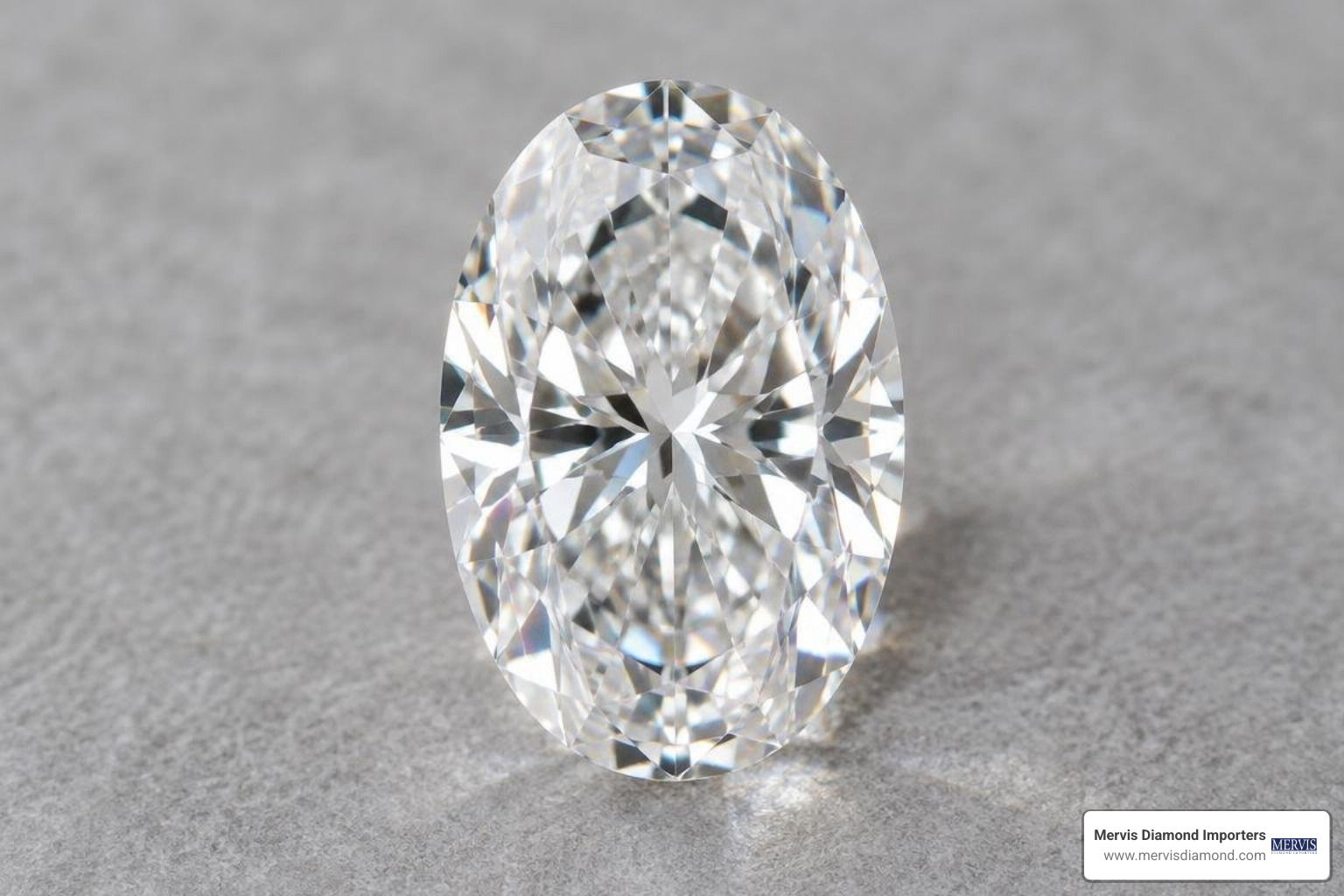
- Target the "Sweet Spot" for Color and Clarity: Choosing an F or G color paired with an eye-clean VS2 clarity grade delivers a center stone that looks completely pure and brilliant under ordinary and direct lighting, saving thousands over an E/VVS1 combination without sacrificing visual performance.
- Capitalize on Surface Spread: Oval diamonds spread their carat weight across a broad top surface area. A well-proportioned 3-carat oval diamond typically measures approximately 11.5 mm x 7.5 mm, creating a visual profile noticeably larger than a 3-carat round brilliant (roughly 9.3 mm diameter).
- Insist on Independent Certification: Always demand an independent grading report from recognized authorities like the Gemological Institute of America (GIA) or the International Gemological Institute (IGI). Verify the laser inscription on the diamond's girdle against the physical certificate to ensure authenticity.
- Compare Curated Estate & Marketplace Benchmarks: If you are shopping the broader market, you will notice prices for 3-carat oval engagement rings fluctuate based on vintage provenance, designer signatures, and mounting styles. Comparing independent market benchmarks against hand-curated inventory ensures you receive competitive pricing without hidden structural compromises.
Frequently Asked Questions About 3-Carat Oval Diamonds
What is the average cost range for a natural 3-carat oval diamond?
The typical price for a natural 3-carat oval diamond spans from $20,000 to $60,000+. Entry-level stones with slight inclusions or warmer body color (J–K color, SI2 clarity) start near the $20,000 mark. Premium stones exhibiting near-colorless grades (G–H) and eye-clean clarity (VS1–VS2) typically fall between $35,000 and $50,000, while top-tier colorless, flawless stones exceed $60,000.
Does a 3-carat oval look larger than a 3-carat round diamond?
Yes. Due to its shallow pavilion distribution and elongated oval geometry, an oval diamond has up to 10% more visible surface area than a round diamond of identical carat weight. When worn, the elongated silhouette flatters the finger, offering greater finger coverage and a distinctly larger appearance from above.
What is the ideal length-to-width ratio for an oval diamond?
The most sought-after length-to-width ratio for an oval diamond is 1.35 to 1.50. Ratios within this range offer a classic, balanced aesthetic that avoids appearing too round (below 1.30) or excessively narrow (above 1.55). Proportions inside this window also make it easier for master diamond cutters to control internal facet angles, effectively minimizing severe bow-tie shadows.
Conclusion
A 3-carat oval diamond engagement ring represents a striking balance of classical romance, modern brilliance, and visual presence. By understanding how the 4Cs, length-to-width ratios, metal choices, and origin paths influence the bottom line, you can confidently select a center stone that delivers maximum sparkle and lasting personal value.
At Mervis Diamond Importers, our family has spent generations hand-selecting premier natural and lab-grown diamonds directly from global sources. We invite you to visit our private showrooms across the Washington DC, Maryland, and Virginia metropolitan areas—including Tysons, VA, and Rockville, MD—to examine diamonds side-by-side in a relaxed, pressure-free environment. Let our master diamond consultants help you craft a timeless, handcrafted engagement ring tailored perfectly to your story.