

The Ultimate Guide to Buying a 3 Carat Lab Grown Diamond Solitaire
Why a 3 Carat Lab Grown Diamond Solitaire Is the Smartest Choice Right Now
A 3 carat lab grown diamond solitaire gives you a stunning, certified diamond — identical to a mined diamond in every physical and optical way — at a fraction of the price. Here's what you need to know at a glance:
| Question | Quick Answer |
|---|---|
| What is it? | A solitaire ring featuring a single lab-created diamond weighing 3 carats |
| How does it compare to mined? | Identical in hardness, brilliance, and chemical structure — only the origin differs |
| How much does it cost? | Typically $3,000–$12,000, vs. $30,000–$60,000+ for a comparable mined diamond |
| Is it certified? | Yes — graded by GIA, IGI, or other top labs, just like mined diamonds |
| Is it ethical? | Yes — no mining required, with a 30–40% lower carbon footprint |
| Who's buying them? | About 70% of millennials now consider lab-grown diamonds for engagement rings |
Three carats is a significant size. It turns heads. And for most buyers, the biggest obstacle has always been price — until now.
Lab-grown diamonds have changed that equation completely. You can now get a D-color, VS1-clarity 3-carat diamond — the kind of quality that's exceptionally rare in mined stones — without spending a small fortune. The global lab-grown diamond market is growing fast for good reason.
But size and savings alone don't make a great purchase. Cut quality, certification, setting choice, and knowing what to look for in a grading report all matter just as much.
I'm Morris Mervis, and after decades of helping buyers find the right diamond without the guesswork, I want to walk you through everything you need to know before you buy.
Understanding the 3 Carat Lab Grown Diamond Solitaire
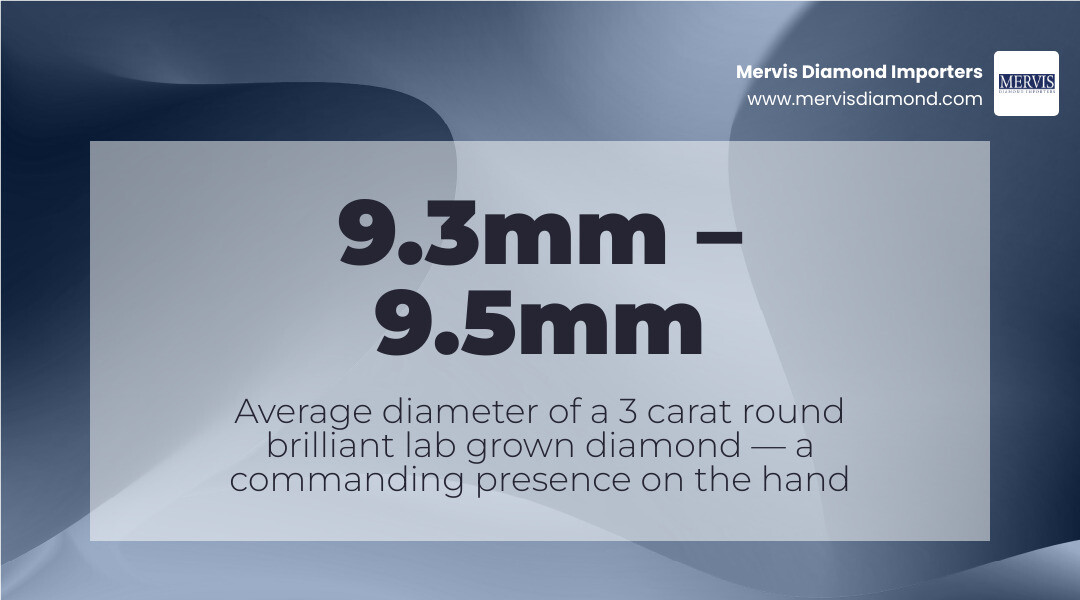
When you begin searching for a 3 carat lab grown diamond solitaire, it is vital to understand exactly what you are purchasing. A 3-carat diamond is a statement piece, measuring approximately 9.3mm to 9.5mm in diameter for a classic round brilliant cut. This size offers an undeniable presence on the hand, commanding attention with its sheer scale and fire.
To appreciate this gemstone, we must first look at how it compares to its earth-mined counterpart. Chemically, physically, and optically, lab-grown diamonds are identical to mined diamonds. They are not "fake" diamonds, nor are they diamond simulants like cubic zirconia or moissanite. Both are composed of pure carbon crystallized in an isometric cubic system. They share the exact same refractive index (2.42) and the maximum rating of 10 on the Mohs hardness scale.
If you are weighing your options between these two origins, our detailed comparison of Mined vs Lab Grown Diamonds breaks down the structural similarities in greater depth.
To understand how these gems are made, we look to the modern laboratories that replicate the extreme conditions of the earth’s mantle. The two primary methods are High Pressure High Temperature (HPHT) and Chemical Vapor Deposition (CVD). While HPHT uses massive presses to apply extreme pressure and heat to a carbon seed, CVD takes a different approach.
In a CVD chamber, a hydrocarbon gas mixture is ionized into plasma, causing carbon atoms to rain down and crystallize layer-by-layer on a seed plate. If you want to dive into the science of this technique, you can read more about What Is a CVD Diamond and why it is highly favored for producing high-clarity gem-quality stones.
When we talk about a "solitaire" ring, many people immediately picture a single round diamond on a plain metal band. However, the term solitaire simply refers to a design where the focus of the ring is a single, magnificent center stone. You can have a solitaire setting that features subtle design elements, hidden halos, or intricate metalwork, as long as the center diamond remains the undisputed star of the show. For a deeper look at what this classic style truly entails, read our article on how Solitaire Doesn't Mean Single Stone.
Comparing Lab-Grown and Mined Diamonds
Because lab-grown diamonds share the exact same tight carbon lattice as mined diamonds, they behave identically under scientific scrutiny. They conduct heat and disperse light in the exact same manner.
This brings up a very common question from our clients visiting us in Washington DC, Tysons, and Rockville: Do Lab Diamonds Pass a Diamond Tester? The short answer is yes. Because they possess the same thermal and electrical conductivity as mined diamonds, standard hand-held diamond testers will register them as genuine diamonds. Only highly specialized, sophisticated laboratory equipment (the kind used by major grading institutions like the GIA and IGI) can detect the subtle growth patterns that distinguish a lab-grown diamond from one pulled from the earth.
Evaluating Quality and Settings for a 3 Carat Diamond
Buying a larger diamond means that any imperfections or structural issues will be much easier to spot with the naked eye. While a tiny inclusion might go unnoticed on a 1 Ct Man Made Diamond, a 3-carat stone has a much larger surface area. Therefore, evaluating the "4Cs"—Cut, Color, Clarity, and Carat Weight—becomes incredibly important.
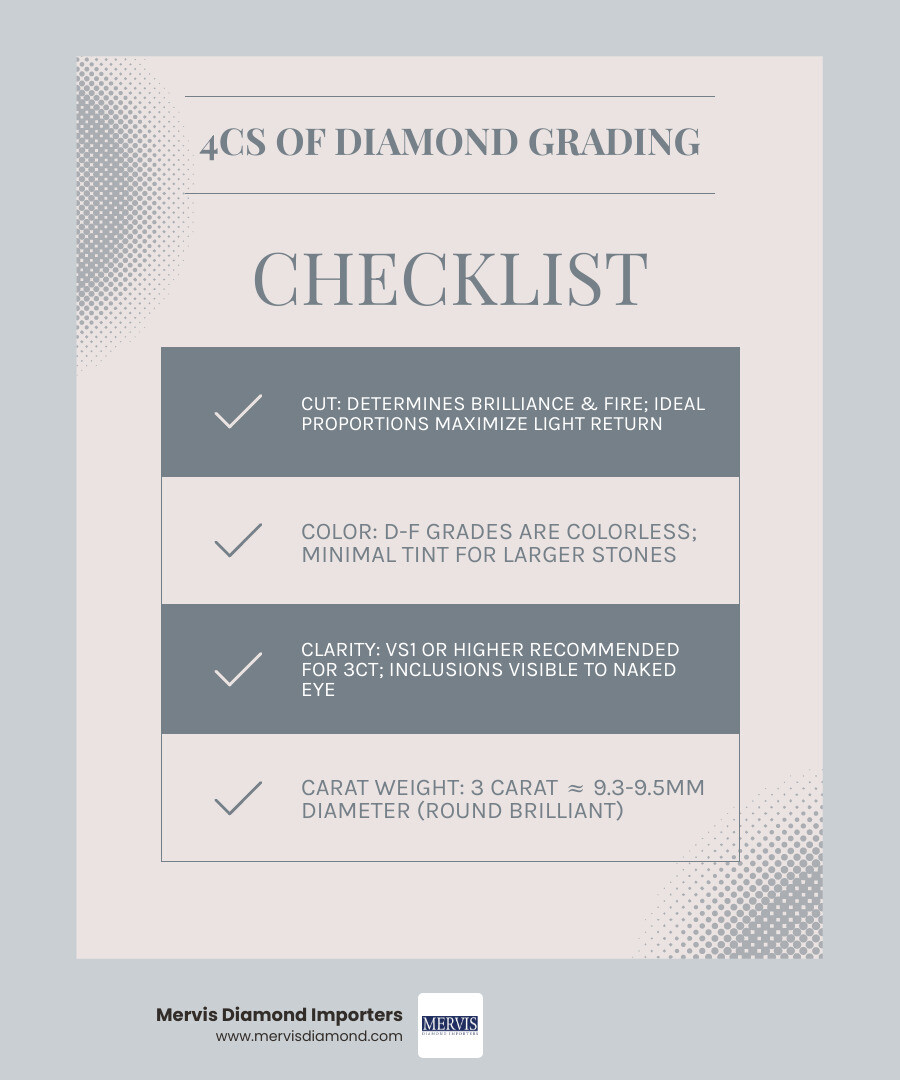
Before committing to a specific size, it is helpful to understand how carat weight translates to visual impact. Carat is a measure of weight, not physical dimensions, meaning different shapes can look larger or smaller than others of the same weight. If you are still deciding on the perfect size for your budget and hand shape, you should explore What Diamond Carat Size Is Right for You as well as our guide on How Many Carats Should an Engagement Ring Be.
Choosing the Perfect Cut for a 3 Carat Lab Grown Diamond Solitaire
The cut is the single most important factor in determining the beauty and brilliance of your diamond. A poorly cut diamond will look dull and lifeless, regardless of how high its color or clarity grades are. When a diamond is cut to ideal proportions, light enters through the crown, reflects off the pavilion facets, and bounces back to the eye in an explosion of brilliance (white light reflection), fire (colored light flashes), and scintillation (sparkle when the stone moves).
For a comprehensive look at how cut grades are determined, you can reference the GIA guide on diamond cut quality. Because lab-grown diamonds are grown in controlled environments, cutters do not have to make compromises to preserve weight from an irregularly shaped rough stone. This means you can easily find an Ideal or Excellent cut when browsing a high-quality 3 Carat Diamond Assortment.
Color and Clarity Considerations
For a 3 carat lab grown diamond solitaire, we generally recommend focusing on the sweet spot of color and clarity to maximize your value:
- Color: Look for diamonds in the colorless (D-F) range. Because a 3-carat diamond is large, it can trap and show body color more easily than smaller stones. A D, E, or F grade ensures your diamond looks icy white, even when set in platinum or white gold.
- Clarity: Aim for VS1 or VS2 (Very Slightly Included) clarity grades. At 3 carats, inclusions can sometimes be visible to the naked eye if they are dark and centrally located. A VS1 or VS2 diamond will almost always be "eye-clean," meaning you cannot see any imperfections without magnification.
If you want to see how these quality considerations scale as carat weight increases, you can read our 2 Carat Man Made Diamond Complete Guide to compare the visual differences.
Best Settings for a 3 Carat Lab Grown Diamond Solitaire
A 3-carat diamond is a valuable asset and a heavy stone, which means your setting must offer excellent security without sacrificing style.
- Prong Settings: A classic 4-prong setting allows the maximum amount of light to enter the diamond, enhancing its sparkle. However, for a 3-carat stone, a 6-prong setting (like the classic Tiffany style) is highly recommended. The extra two prongs offer superior security and help maintain the round silhouette of the stone.
- Bezel Settings: For those with active lifestyles, a bezel setting wraps a thin collar of metal entirely around the diamond’s girdle. This offers the ultimate protection against chips and prevents the stone from snagging on clothing.
For a complete overview of your options, consult A Comprehensive Guide to Engagement Ring Settings and learn How to Choose a Diamond Ring Setting that matches your personal taste.
If you want to explore design ideas specifically tailored to this weight class, our 3 Carat Man Made Diamond Ring Guide and our curated list in the Best Cheap Man Made Diamond Engagement Rings Guide provide excellent inspiration.
Pricing, Value, and Investment Potential
The most compelling reason consumers choose a 3 carat lab grown diamond solitaire in July 2026 is the incredible price difference. While a mined 3-carat diamond of exceptional quality can easily cost as much as a luxury vehicle, a lab-grown alternative makes this dream size accessible to many more couples.
| Diamond Type (3 Carat, Round, F, VS1, Ideal Cut) | Average Price Range | Cost Savings |
|---|---|---|
| Earth-Mined Diamond | $30,000 - $60,000+ | Baseline |
| Lab-Grown Diamond | $3,000 - $12,000 | 60% to 85% Less |
To put this into perspective, you can read about the factors that influence Three Carat Diamond Cost and get a detailed breakdown of How Much Is a 3 Carat Diamond Ring depending on the metal and setting complexity. The ultimate driver of this price difference is supply chain efficiency. While mining requires moving tons of earth, heavy machinery, and complex global logistics, lab-grown diamonds are grown in highly controlled facilities with streamlined distribution. You can read more about these industry dynamics in our guide on the Average Cost of Lab Grown Diamonds.
Resale Value and Long-Term Investment
It is important to have realistic expectations regarding the financial aspect of your purchase. Neither mined nor lab-grown diamonds should be viewed as traditional financial investments that will appreciate in value. Both experience immediate depreciation upon purchase. However, because lab-grown diamonds have a lower entry price, your capital risk is significantly lower.
We address this transparently in our article, Do Lab Grown Diamonds Have Resale Value. If you are looking to balance size, cost, and long-term satisfaction, comparing different carat weights can be helpful. For those considering going even larger, our Ultimate 4 Carat Man Made Diamond Guide offers an excellent point of comparison.
Frequently Asked Questions about 3 Carat Lab Diamonds
Do lab-grown diamonds look identical to mined diamonds?
Yes. To the naked eye, and even under a jeweler's loupe, they are completely indistinguishable. They possess the exact same optical characteristics, meaning they will display the same level of fire, brilliance, and scintillation. They are real diamonds.
Can you insure a 3 carat lab-grown diamond?
Absolutely. Because a 3-carat diamond represents a significant emotional and financial asset, we always recommend insuring your jewelry. You can insure a lab-grown diamond against loss, theft, or damage just like any other precious gem. For a step-by-step guide on how to obtain an appraisal and secure coverage, read our article: Can You Insure a Lab Grown Diamond.
What are the environmental benefits of lab-grown diamonds?
Choosing a lab-grown diamond significantly reduces the environmental impact of your jewelry. Lab-grown diamonds typically have a 30% to 40% lower carbon footprint compared to mined diamonds. They eliminate the need for open-pit mining, which can disrupt local ecosystems, divert water sources, and cause soil erosion. By choosing a laboratory-grown gem, you are opting for a sustainable and modern path forward.
Conclusion
Buying a 3 carat lab grown diamond solitaire is a thrilling milestone. It allows you to own a breathtaking, high-quality piece of jewelry that stands out in any crowd, without compromising on your financial goals.
At Mervis Diamond Importers, we take pride in our curated selection of both natural and lab-grown diamonds. We hand-select our stones to ensure they meet our strict standards for cut, brilliance, and overall beauty. Our expert team is ready to guide you through the process in a relaxed, pressure-free environment.
If you are located in the Washington DC metro area, including Tysons, VA, and Rockville, MD, we invite you to book a consultation with us. Explore the latest styles and find your perfect ring by reading our guide to Trending Lab Grown Diamonds Washington DC and schedule your visit today!