

The Smart Buyer's Guide to Choosing a 3 Carat Diamond Advisor
How to Choose a 3-Carat Diamond Advisor
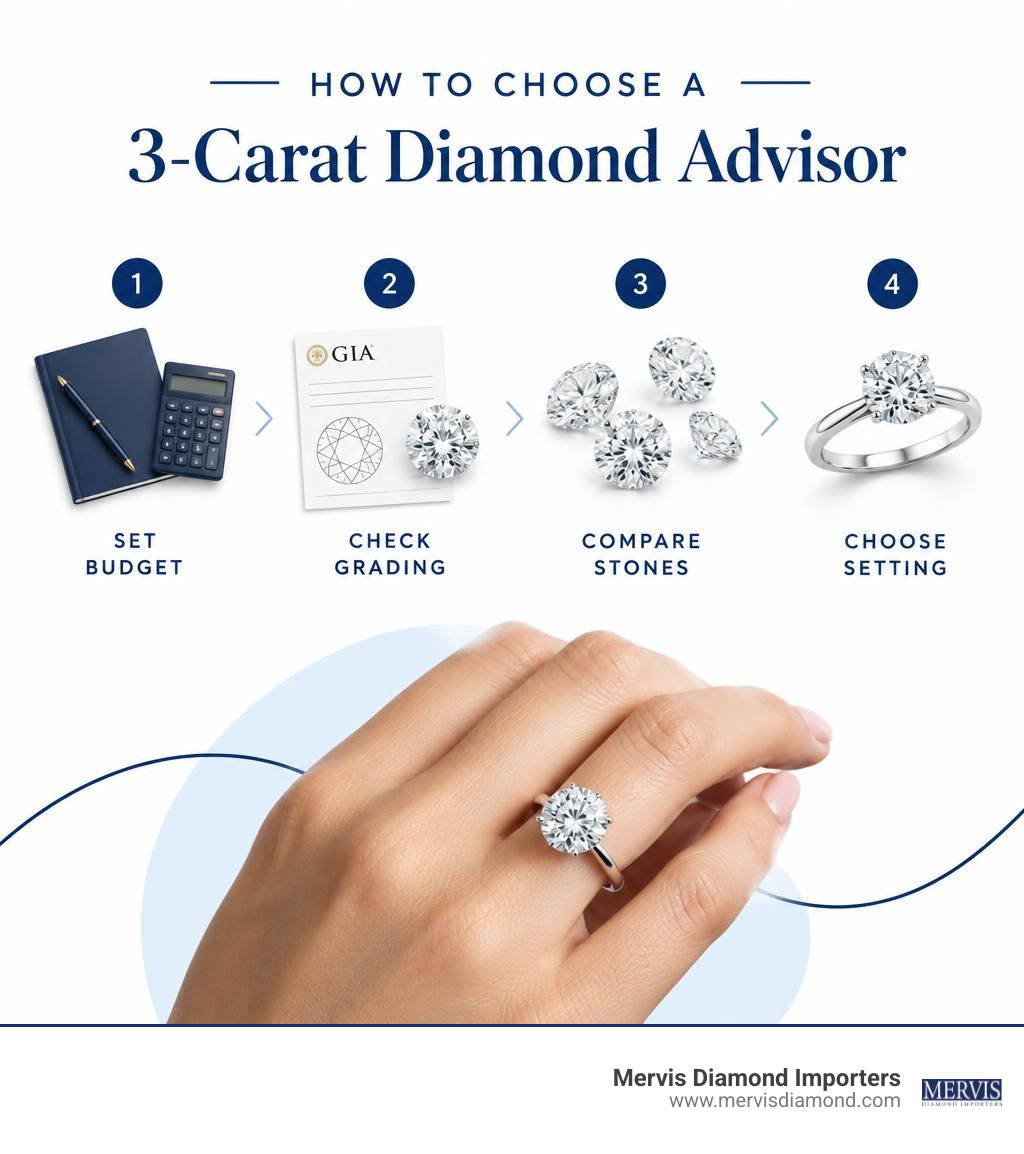
Start with your budget and the grading report. Ask a 3-carat diamond advisor to show you stones with strong cut quality, then compare color, clarity, and shape in person. For a round diamond, look for an Excellent cut grade. G or H color and eye-clean VS2 clarity can be a smart starting point, but judge each stone by how it looks to you.
A 3-carat diamond has clear presence without needing to feel impractical for daily wear. The right setting matters, too. A good advisor will explain the trade-offs, answer questions about origin and grading, and give you room to decide without pressure.
I'm Morris Mervis, and I'll walk you through the choices that matter most.
Why You Need a Professional 3 Carat Diamond Advisor
Reaching the three-carat milestone is an extraordinary moment. At this level, a diamond is no longer just a piece of fine jewelry; it is a serious financial commitment, an heirloom piece, and a statement of personal style. However, moving into larger carat weights fundamentally changes how diamond grading characteristics behave in real life.
In smaller gems, minor inclusions or subtle body warmth often remain hidden to the naked eye. In a diamond weighing 3.00 carats or more, the physical facets are substantially larger. Windows into the stone become wider, meaning clarity imperfections, tint, and minor cut flaws can be far more noticeable. Navigating these grading nuances requires seasoned expertise to ensure that you are maximizing your budget while avoiding expensive visual compromises.
Furthermore, diamond market valuations fluctuate based on supply, cut performance, and origin. Working with a dedicated professional protects you against overpaying for characteristics that do not improve real-world beauty. An advisor will also ensure that any natural or lab-grown gem is backed by an independent grading report from an internationally recognized laboratory, giving you total peace of mind regarding the authenticity and documented characteristics of your gem.
What to Expect from an Expert 3 Carat Diamond Advisor
A trusted consultant does far more than simply pull stones from a vault or show you a list of certificate numbers. Your consultation should feel personalized, educational, and completely pressure-free. When you consult with our team, we curate a bespoke selection of gems tailored precisely to your aesthetic desires and financial goals.
An experienced advisor assists you with:
- Sourcing Premier Rough and Polished Inventory: Gaining access to exceptional stones before they reach the broader open market.
- Understanding Key Carat Weight Thresholds: Explaining how hitting exact carat marks (like 3.00 carats versus 2.90 carats) impacts wholesale market pricing.
- Pairing Diamonds with Tailored Settings: Ensuring the ring architecture safely cradles the stone without adding unnecessary bulk.
For a deeper look into the fundamentals of choosing this significant carat size, explore our comprehensive 3 Carat Diamond Buying Guide 2026 to prepare for your consultation.
How a 3 Carat Diamond Advisor Evaluates Quality and Cut
When reviewing prospective stones, an advisor looks beyond the basic 4Cs on paper. Diamond grading reports provide static measurements, but they cannot show you how a gem dances under direct sunlight, office lighting, or candlelight.
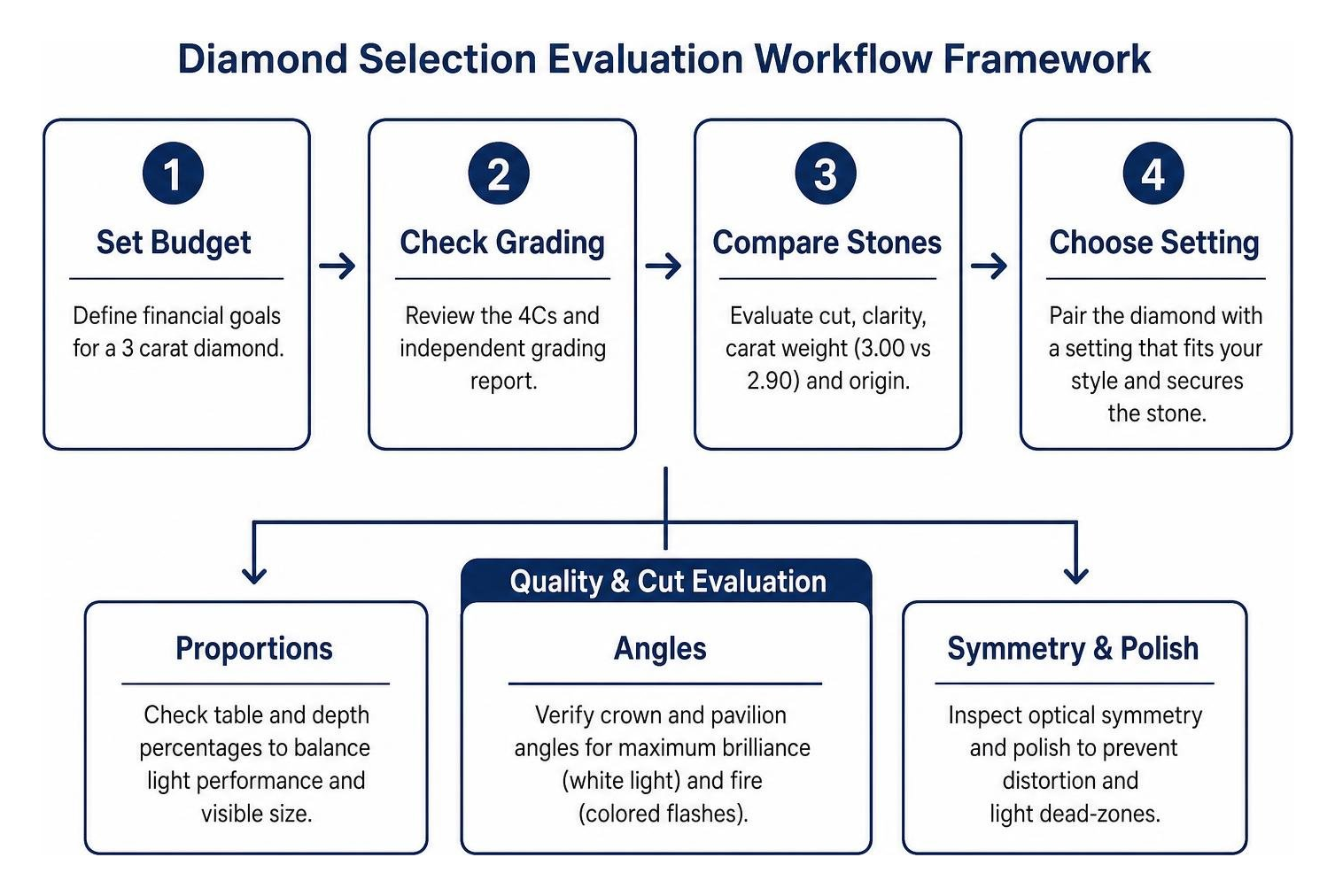
We evaluate several technical factors under specialized magnification and varied lighting environments:
- Table and Depth Percentages: Ensuring the proportions are neither too shallow (causing light to leak through the bottom) nor too deep (hiding carat weight where you cannot see it).
- Crown and Pavilion Angles: Confirming that internal facets act like a set of mirrors, reflecting maximum white light (brilliance) and colored flashes (fire) back through the crown.
- Optical Symmetry and Polish: Inspecting the alignment of each facet to prevent visual distortion and light dead-zones.
Following these essential diamond selection steps allows us to eliminate lacklustre stones and present only diamonds that exhibit exceptional life and sparkle.
Selecting the Ideal Diamond Shape for Maximum Visual Spread
A diamond's carat weight is strictly a measure of physical mass (where 1.00 carat equals 200 milligrams, meaning a 3-carat stone weighs 600 milligrams), not its surface dimensions. Two diamonds sharing the exact same 3.00-carat weight can look dramatically different in physical size depending on how their geometry distributes that weight.
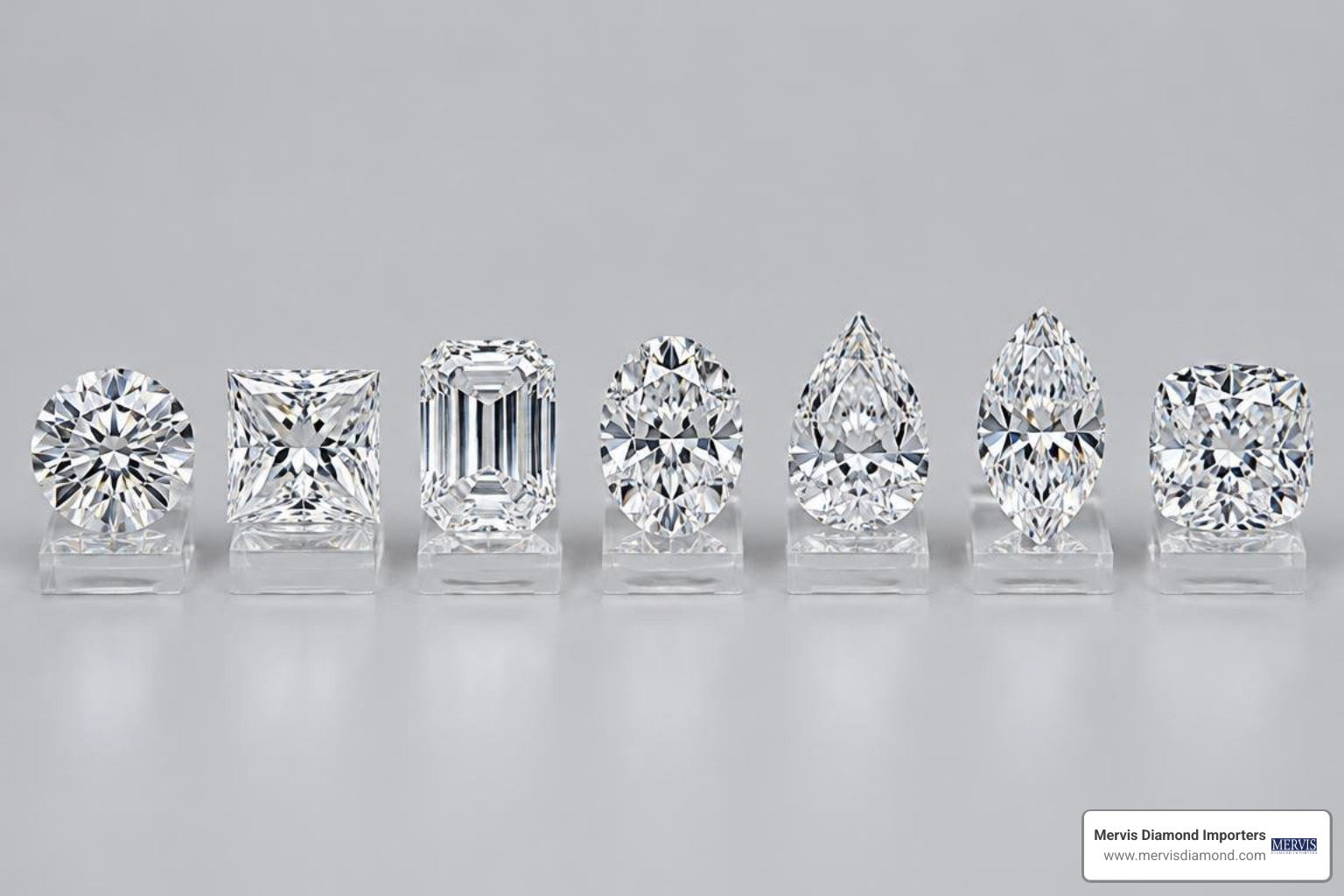
When selecting a shape, you must consider both personal silhouette preference and how much finger coverage you want. Below is a comparison of typical face-up millimeter dimensions and perceived visual spreads across popular cuts:
| Diamond Shape | Typical Dimensions (mm) | Visual Surface Spread | Key Visual Characteristic |
|---|---|---|---|
| Round Brilliant | 9.20 – 9.40 mm diameter | Standard baseline | Maximum fire, sparkle, and classic brilliance |
| Oval Cut | 11.50 × 8.00 mm | Very Large (appears larger) | Elongated silhouette, brilliant facet pattern |
| Emerald Cut | 9.50 × 7.00 mm | Large (long face-up spread) | Elegant step-cut facets, "hall-of-mirrors" effect |
| Pear Shape | 12.00 × 7.50 mm | Very Large (slenderizing) | Distinctive teardrop contour, brilliant sparkle |
| Cushion Cut | 8.20 × 8.20 mm (Square) | Moderate (deeper weight distribution) | Romantic pillow outline, large flashes of fire |
| Princess Cut | 8.00 × 8.00 mm | Moderate to Large | Crisp geometric lines, modern edge-to-edge sparkle |
| Asscher Cut | 8.00 × 8.00 mm | Moderate (concentrated depth) | Vintage step-cut, mesmerizing geometric depth |
Elongated Shapes: Oval, Emerald, and Pear Cuts
Elongated shapes are exceptional choices for buyers seeking the largest possible footprint on the hand. Because these cuts distribute their carat weight across length and width rather than concentrating it in a deep pavilion, they naturally appear larger than round diamonds of the identical carat weight.
- Oval Cut Diamonds: Ovals combine the fiery brilliance of a round cut with an elongated profile that flatters and lengthens the wearer's finger. A primary consideration when evaluating ovals is managing the optical "bow-tie effect"—a dark shadow pattern across the center. A knowledgeable advisor helps you select an oval with an optimal length-to-width ratio (typically 1.35 to 1.50) that minimizes center darkness. To discover detailed pricing dynamics for this shape, review our 3 Carat Oval Diamond Cost Guide.
- Emerald Cut Diamonds: Developed historically with roots stretching back centuries, the emerald cut showcases sophisticated parallel step facets. Instead of scattering light in tiny bursts, it creates a stately "hall-of-mirrors" aesthetic. Because the open table provides an unobstructed view into the stone's interior, clarity takes center stage. Learn more about selecting this refined cut in our dedicated guide to the 3 Carat Emerald Cut.
- Pear Shaped Diamonds: Combining the curves of a round with the tapered tip of a marquise, pear cuts offer a dramatic silhouette and exceptional surface area. Symmetry is paramount here; an expert ensures the rounded shoulders are perfectly balanced and the point aligns cleanly along the central axis.
Classic and Geometric Cuts: Round Brilliant, Cushion, Princess, and Asscher
If your taste leans toward traditional symmetry or vintage architectural lines, classic and geometric shapes provide distinct character:
- Round Brilliant: The round brilliant remains the gold standard of sparkle, engineered with 57 or 58 facets to maximize total internal reflection. Measuring approximately 9.2 to 9.4 millimeters in diameter—roughly the width of a standard dime or the size of a fresh cherry—a 3-carat round diamond offers striking presence. Check out our 3 Carat Diamond Size Guide for comprehensive visual comparisons.
- Cushion Cut: Featuring soft, rounded corners and a pillow-like form, cushions blend vintage charm with modern brilliance. They often carry more weight in the belly (pavilion), resulting in a slightly smaller face-up spread than a round diamond, but they compensate with broad, colorful flashes of dispersion.
- Princess Cut: For lovers of contemporary design, the princess cut delivers sharp, square corners and lively brilliance. It commands attention while offering a lower price-per-carat than round diamonds due to higher rough diamond yield during cutting.
- Asscher Cut: Developed in 1902, the Asscher cut is a square step cut with cropped corners and an unmistakable Art Deco personality. Its deep pavilion draws the eye into a mesmerizing concentric square pattern.
Establishing Quality Standards: Cut, Color, and Clarity
Buying a 3-carat diamond requires balancing the 4Cs (Cut, Color, Clarity, and Carat Weight) so that your investment is concentrated where it matters most: visible beauty.
Prioritizing Cut Grade and Optical Symmetry
Cut is undeniably the most critical of the 4Cs. Even a diamond with flawless clarity and perfect color will appear dull and lifeless if it is poorly cut. Conversely, a diamond with an Excellent cut grade reflects virtually all entering light, maximizing brightness and fire while masking subtle color tints and minor inclusions.
For round brilliants, insist on an Excellent cut grade with Excellent Polish and Excellent Symmetry (often referred to in the industry as "Triple Excellent"). For fancy shapes (ovals, emeralds, pears, cushions), where cut grades are not standardized across all grading certificates, your advisor will evaluate the length-to-width ratios, table and depth percentages, and overall facet harmony to prevent light leakage.
Color and Clarity Sweet Spots for 3 Carat Stones
When dealing with a 3-carat diamond, you do not need to pay for perfection on paper to own a breathtaking stone. You simply need to target the "sweet spot" of the grading scales:
- Color Grades (G to H Tier): The diamond color scale ranges from D (completely colorless) down to Z (light tint). In a 3-carat stone, diamonds in the G to H range face up bright and icy white when set in platinum or white gold, offering tremendous savings compared to D–F colorless stones. If you are setting your diamond in yellow gold or rose gold, you can comfortably explore I or J colors, as the warm metal naturally complements the stone's subtle warmth. Explore our 3 Carat Diamond Color Guide for side-by-side color comparisons.
- Clarity Grades (VS1 to VS2 Tier): Clarity measures the presence of microscopic internal inclusions or surface blemishes. In a 3-carat diamond, a grade of VS2 (Very Slightly Included) or VS1 represents the optimal value zone. Reputable industry standards recommend selecting a VS2 clarity grade or higher to ensure the diamond is completely "eye-clean"—meaning no inclusions are visible without 10x magnification. While step cuts like emeralds and Asschers may require a VS1 for absolute transparency, brilliant cuts hide inclusions effortlessly at the VS2 level.
Pricing, Rarity, and Value Across Diamond Categories
A 3-carat diamond represents a natural sweet spot in fine jewelry. It delivers an unforgettable visual impact without the steep, exponential price increases encountered once stones surpass the 4- and 5-carat thresholds.

Understanding 3 Carat Diamond Price Tiers and Value Sweet Spots
Natural diamond pricing is governed by rarity. As rough diamonds grow larger in the earth, the occurrence of clean, high-color crystals drops precipitously.
- Baseline Entry Tier ($50,000 – $56,000): A beautifully cut 3-carat fancy-shaped natural diamond with G–H color and eye-clean VS2 clarity typically begins around $50,000. A round brilliant of comparable high quality starts at approximately $56,000 due to higher cutting loss during manufacturing.
- Collector and Investment Tier ($150,000 – $200,000+): Top-tier natural diamonds boasting D color, Flawless or Internally Flawless clarity, and pristine Triple Excellent cutting command premium prices well exceeding $150,000 to $200,000.
For a detailed breakdown of retail pricing across all cuts, review our analysis on 3 Carat Diamond Cost.
If you love the grandeur of a 3-carat stone but want to maximize your budget efficiency, lab-grown diamonds present an exceptional modern option. Chemically, physically, and optically identical to mined diamonds, lab-grown gems allow clients to secure pristine color and clarity grades at an accessible investment level. You can evaluate the options in our guide to 3 Carat Lab Grown Diamond Cost.
Fancy Colored 3 Carat Diamonds: Yellow, Pink, and Blue
While white diamonds are prized for their lack of color, fancy colored diamonds are celebrated for the intensity and purity of their natural hues.
- Fancy Yellow Diamonds: Also known as Canary diamonds, natural yellow stones are the most accessible fancy color. A lovely 3-carat Fancy Yellow diamond with VS2 clarity typically starts around $45,000, making it a distinctive, vibrant alternative to a classic white diamond.
- Fancy Pink and Blue Diamonds: These represent some of the rarest treasures on earth. Their natural supply is extraordinarily limited. In major international auctions, high-quality 3-carat pink and blue diamonds regularly command hundreds of thousands—or even millions—of dollars. For instance, in November 2023, an exquisite 3.19-carat fancy light purplish pink pear-shaped diamond ring achieved over $300,000 at auction.
Frequently Asked Questions About 3 Carat Diamonds
Is a 3 carat diamond considered too large for everyday wear?
Not at all. While a 3-carat diamond makes an unmistakable statement, it remains very comfortable for daily wear when set in a thoughtfully designed ring.
The secret lies in the setting's profile height. Selecting a low-profile basket, cathedral setting, or protective bezel ensures the diamond sits close to the finger, preventing it from catching on clothing or knocking against hard surfaces during routine activities.
Which 3 carat diamond shape looks the largest on the finger?
Elongated shapes—specifically oval, pear, and emerald cuts—appear the largest on the hand. Because these cuts possess a greater surface-area-to-weight ratio than square or round stones, an oval or pear cut can present a visual spread that looks up to 10% to 15% larger than a round diamond of identical carat mass.
What is the most cost-effective way to purchase an eye-clean 3 carat diamond?
To secure the highest value for your budget:
- Prioritize Cut Quality above all else to guarantee maximum sparkle.
- Select an eye-clean VS2 clarity rather than paying a steep premium for VVS or Flawless grades that look identical to the naked eye.
- Choose a G or H color grade, which appears completely bright and white when mounted.
- Consider fancy shapes, which carry a lower price-per-carat than traditional round brilliants.
You can explore further cost-saving strategies in our guide to finding affordable 3 carat diamond options.
Conclusion
Acquiring a 3-carat diamond ring is an exciting, meaningful milestone. Whether you choose a fiery round brilliant, an elongated oval, or a vintage-inspired emerald cut, having seasoned guidance ensures that you select a stone that balances beauty, rarity, and enduring value.
At Mervis Diamond Importers, we have spent generations curating exceptional, hand-selected diamonds for clients throughout the Washington DC, Virginia, and Maryland regions. We invite you to visit our convenient showrooms in Tysons, VA, Rockville, MD, or Washington, DC for a private, pressure-free consultation.
Ready to begin your journey? Learn more about budgeting and design possibilities by calculating how much a 3 carat diamond ring costs, or schedule an appointment with our master gemologists today.