

1 ct Man Made Diamond: How to Get the Best Sparkle for Your Buck
The Rise of the 1 ct Man Made Diamond: What You Need to Know
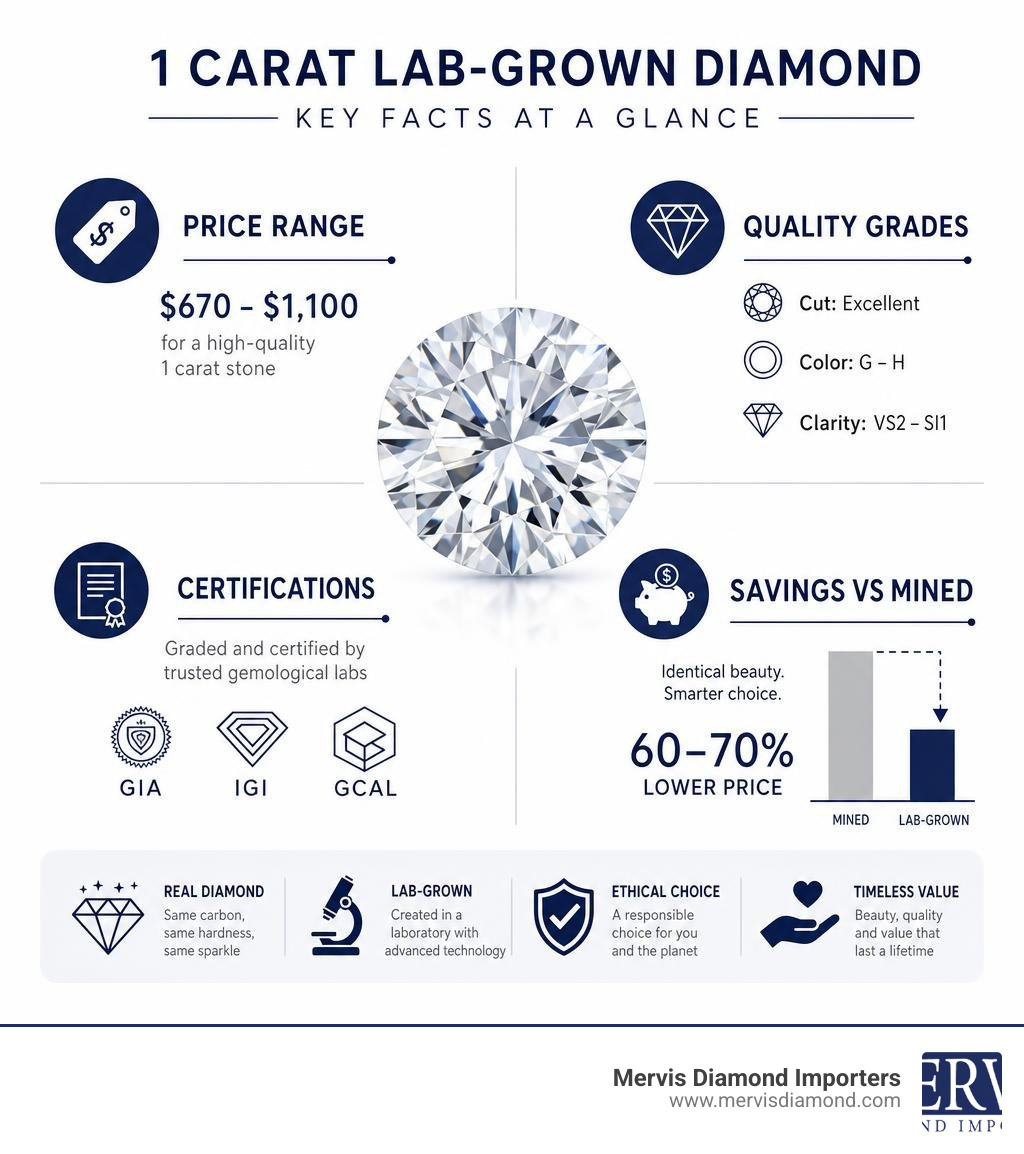
A 1 ct man made diamond is a real diamond — identical in every physical and chemical way to a mined diamond — grown in a laboratory instead of pulled from the earth. And right now, it's one of the smartest purchases you can make in fine jewelry.
Quick answer for shoppers:
| What you want to know | The short answer |
|---|---|
| Is it a real diamond? | Yes — same carbon, same hardness, same sparkle |
| How much does it cost? | Roughly $670–$1,100 for a high-quality stone in June 2026 |
| How does it compare to mined? | Identical appearance, 60–70% lower price |
| What quality grades should I target? | Excellent cut, G–H color, VS2–SI1 clarity |
| Is it certified? | Yes — by GIA, IGI, or GCAL |
One carat is the single most requested diamond size. It's noticeable on the hand, versatile in any setting, and carries a timeless weight — literally and symbolically. For decades, that size came with a price tag that put it out of reach for many buyers.
Lab-grown diamonds changed that equation completely.
Prices for 1 carat lab-grown diamonds have been falling — dropping nearly 6% in just the past three months — while inventory has grown by over 29%. That means more choice and lower prices than at any point before.
But more options also means more chances to make the wrong call. Cut quality, certification, and knowing how to read a grading report all matter. This guide walks you through everything so you buy with confidence, not guesswork.
What is a 1 Carat Lab-Grown Diamond?
To understand a 1 ct man made diamond, we first have to demystify what "carat" actually means. Many people assume carat refers to the physical size of the stone, but it is actually a unit of weight. Specifically, one metric carat weighs exactly 200 milligrams (0.2 grams).
When a diamond is grown in a laboratory, it undergoes the exact same physical crystallization process as a natural stone. It is not an imitation like cubic zirconia or moissanite; it is pure, crystallized carbon. Because it is grown under highly controlled conditions, a lab-grown diamond is visually indistinguishable from a mined diamond, even to the trained eyes of expert gemologists.
Understanding the Creation of a 1 ct Man Made Diamond
Man-made diamonds do not simply appear overnight. They are grown using highly sophisticated, cutting-edge technology that replicates the extreme conditions found deep within the Earth's mantle. Today, there are two primary methods used to create a 1 ct man made diamond:
- HPHT (High Pressure High Temperature): This method mimics the natural geological process. A small diamond seed is placed into a press with pure carbon. The machine subjects the seed to temperatures exceeding 2,000 degrees Fahrenheit and pressures of over 1.5 million pounds per square inch. Under these extreme conditions, the carbon melts and begins to structure itself atom-by-atom around the seed, growing a larger diamond crystal.
- CVD (Chemical Vapor Deposition): Think of this as 3D printing a diamond with gas. A diamond seed is placed inside a vacuum chamber (a plasma reactor) filled with carbon-rich gases like methane. When the chamber is heated to intense temperatures, the gas ionized into plasma, breaking the chemical bonds. The pure carbon then rains down and deposits itself onto the seed, building the diamond layer by layer.
At Mervis Diamond Importers, we specialize in providing stunning, hand-selected options using both methods. To explore our curated selection, you can view our Mervis Diamond Importers Lab Grown Diamonds collection online or visit us in person.
Physical and Chemical Properties
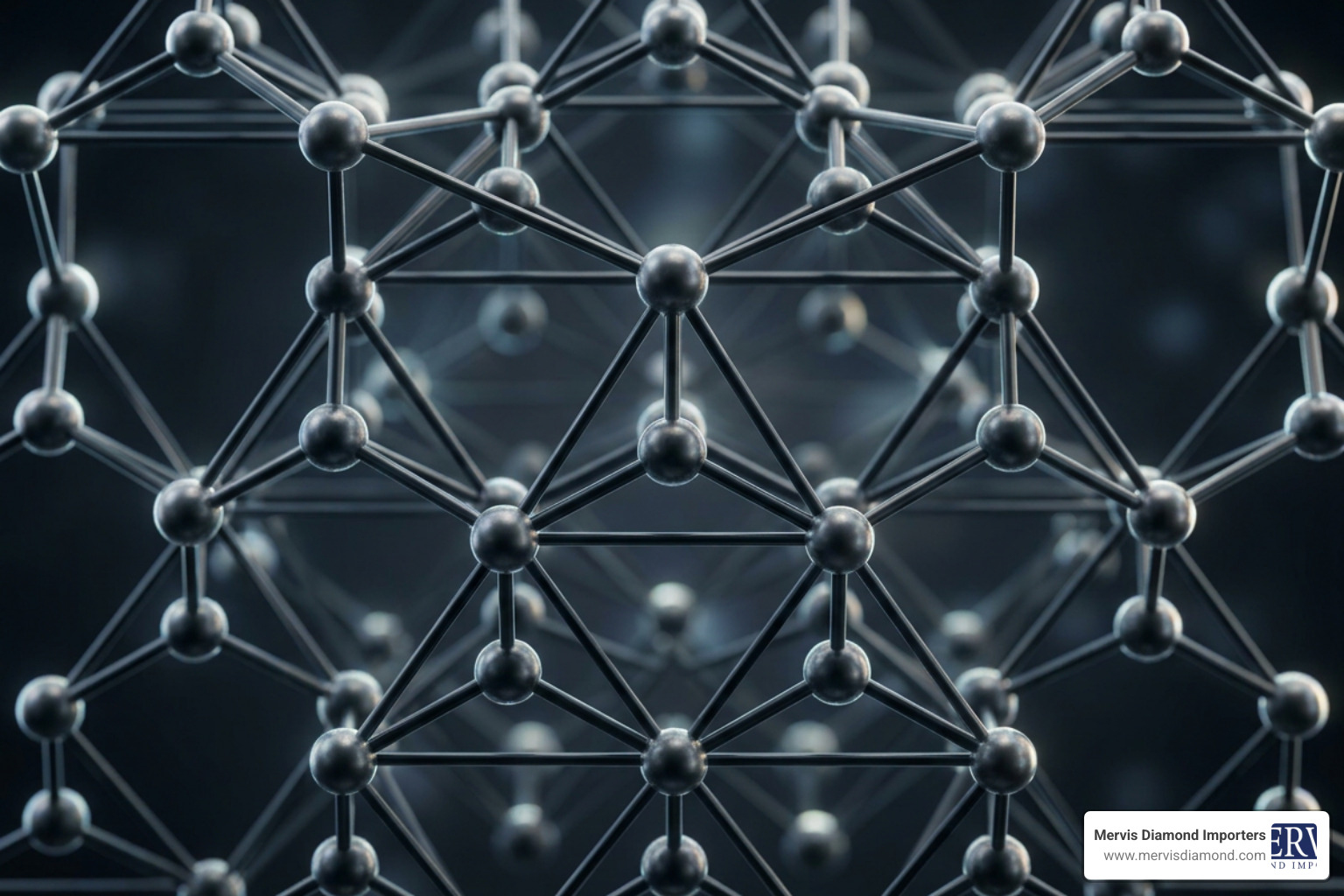
Regardless of whether a diamond is formed via CVD or HPHT, the end result is chemically identical to a natural diamond. Both consist of carbon atoms tightly bound in a isometric-cubic crystal lattice structure.
This specific molecular arrangement gives the diamond its legendary hardness—scoring a perfect 10 on the Mohs hardness scale. It also dictates its optical properties, such as its high refractive index (how it bends light to create sparkle) and its exceptional thermal conductivity. Because the chemical makeup is identical, lab-grown diamonds exhibit the exact same fire, brilliance, and scintillation as mined stones. If you are curious about specific clarity details or want to dive deeper into the structure of high-clarity stones, check out our guide on Are VVS Diamonds Real to see how lab-grown VVS diamonds stack up.
Why a 1 ct Man Made Diamond is the Smart Modern Choice
Choosing a 1 ct man made diamond is no longer just a budget-conscious alternative; it has become the preferred choice for modern couples and jewelry collectors alike. It represents a shift toward sustainable luxury where you do not have to compromise on size, beauty, or ethics to get a jaw-dropping piece of jewelry.

Ethical and Environmental Advantages
Traditional diamond mining is incredibly resource-intensive. Moving tons of earth to find a single carat of diamond can disrupt local ecosystems, displace wildlife, and leave behind massive open pits. Furthermore, historical concerns around "conflict diamonds" have made trace-ability a priority for modern consumers.
In contrast, lab-grown diamonds offer:
- Conflict-Free Origins: Because these stones are grown in secure, state-of-the-art laboratories, there is zero risk of funding regional conflicts.
- Lower Carbon Footprint: Many modern diamond foundries utilize renewable energy sources, meaning your diamond can be produced with minimal environmental disruption.
- Responsible Sourcing: The entire supply chain is transparent. You know exactly where your stone was grown, cut, and polished.
Choosing a man-made diamond is a beautiful, eco-conscious statement that aligns your personal values with your luxury purchases.
Mined vs. Lab-Grown Diamonds
To help you visualize the differences, let's look at how a lab-grown stone compares directly to a mined stone of the exact same weight:
| Feature | Mined Diamond (1.00 Carat) | Lab-Grown Diamond (1.00 Carat) |
|---|---|---|
| Chemical Composition | Pure Carbon (C) | Pure Carbon (C) |
| Physical Hardness | 10 on Mohs Scale | 10 on Mohs Scale |
| Face-Up Visual Size | Identical (approx. 6.5mm round) | Identical (approx. 6.5mm round) |
| Refractive Index | 2.42 | 2.42 |
| Average Cost (High Quality) | $5,000 - $8,000+ | $670 - $1,100 |
| Price Ratio | Baseline | 60% to 70% lower cost |
As you can see, the physical and visual attributes are exactly identical. The only true differences lie in their origin and their price tags. If you want to dive deeper into how these two paths diverge in terms of creation, value, and history, read our comprehensive breakdown on Mined vs Lab Grown Diamonds.
Evaluating Quality: The 4Cs at the 1-Carat Mark
When shopping for a 1 ct man made diamond, you evaluate quality using the exact same framework as mined diamonds: the 4Cs (Cut, Color, Clarity, and Carat Weight). However, because lab-grown diamonds are much more affordable, you can easily optimize these grades to get the absolute best sparkle for your money.
The Importance of Cut Grade
If you take only one piece of advice from this guide, let it be this: Cut is the most important of the 4Cs.
The cut grade determines how well a diamond interacts with light. If a diamond is cut too shallow or too deep, light leaks out of the sides or bottom, leaving the stone looking dull and lifeless. An Ideal or Excellent cut grade ensures that light enters through the top, bounces off the internal facets, and shoots back out to your eye in an explosion of brilliance (white light sparkle) and fire (colored light flashes).
At the 1-carat mark, a poorly cut diamond will look smaller and less impressive than a slightly smaller, perfectly cut stone. Always prioritize an Excellent or Ideal cut grade over color or clarity.
Finding the Sweet Spot for Color and Clarity
Because you are saving significantly by choosing a lab-grown diamond, you do not need to settle for low-quality grades. At the same time, you do not need to pay a premium for "Flawless" or "D-color" stones unless you absolutely want to, as these differences are invisible to the naked eye.
Here is how to find the "sweet spot" for a 1-carat stone:
- Color (G to H): Diamonds are graded from D (colorless) to Z (light yellow). While D, E, and F are colorless, G and H color diamonds look completely white when set in white gold or platinum, saving you hundreds of dollars.
- Clarity (VS2 to SI1): This measures internal inclusions. At 1 carat, inclusions in a VS2 (Very Slightly Included) or SI1 (Slightly Included) diamond are microscopic and cannot be seen by the naked eye. Buying an "eye-clean" stone in this range offers the ultimate value.
Recommended 4Cs Combinations for a 1 Carat Lab Diamond:
- The Showstopper (Maximum Quality): Ideal Cut | F Color | VVS2 Clarity
- The Smart Buyer (Best Value for Money): Excellent Cut | G-H Color | VS2 Clarity
- The Budget Optimizer: Excellent Cut | H Color | SI1 Clarity (verified eye-clean)
Pricing and Market Trends in June 2026
The market for lab-grown diamonds has matured rapidly. As of June 2026, production efficiencies have reached an all-time high, making these stunning gems more accessible than ever.
Currently, we are tracking over 331,428 live diamond prices across the 10 most popular diamond shapes for 1ct lab-grown stones. Across major online spaces, there are approximately 19,931 lab-grown diamonds available in the 1-carat range alone. This massive inventory increase—growing by 29.15% recently—has driven prices down by about 5.92% over the past three months.
Smart Budgeting for Your 1 ct Man Made Diamond
Over the last month, average prices for a 1ct lab-grown diamond have ranged consistently between $638 and $781. Depending on the exact cut, color, and clarity, you can find specific stones starting as low as $400, while exceptionally high-quality stones typically average between $670 and $1,100.
To compare live, current pricing options and browse loose stone options, you can consult industry price indexes or explore our curated selection online to get an idea of the competitive landscape. However, viewing stones in person under proper gemological lighting is the only way to truly judge their beauty.
Certification and Long-Term Value
Never buy a 1 ct man made diamond without a grading report from a reputable gemological laboratory. The most trusted institutions are:
- GIA (Gemological Institute of America): The gold standard in diamond grading. You can verify grading standards on the official GIA website.
- IGI (International Gemological Institute): The most common and highly respected grader for lab-grown diamonds.
- GCAL (Gem Certification & Assurance Lab): Known for incredibly strict grading protocols and light performance analysis.
These certificates guarantee that the stone you are purchasing has been independently verified for its 4Cs, ensuring you get exactly what you pay for.
Frequently Asked Questions
Do lab-grown diamonds pass a diamond tester?
Yes. Because lab-grown diamonds have the exact same chemical, physical, and thermal properties as mined diamonds, they will pass a standard thermal or electrical conductivity diamond tester every single time. To learn more about how these devices work and why lab diamonds react identically, read our detailed article: Do Lab Diamonds Pass a Diamond Tester.
Can you insure a lab-grown diamond?
Absolutely. You can insure a lab-grown diamond engagement ring or jewelry piece in the exact same way you would insure a natural diamond. Most major jewelry insurance providers offer comprehensive coverage against theft, loss, and damage. You will simply need to provide an independent appraisal and your diamond's grading certificate. For step-by-step guidance on protecting your investment, check out our guide: Can You Insure a Lab Grown Diamond.
Do lab-grown diamonds have resale value?
While lab-grown diamonds are an incredible value upfront, they do not retain resale value in the same way that natural, inherently rare diamonds do. Because technology continues to improve, the cost to grow diamonds has decreased over time. If long-term heirloom value or trade-in potential is highly important to you, we recommend reading our deep-dive analysis: Do Lab Grown Diamonds Have Resale Value.
Conclusion: Let Us Help You Find Your Perfect Sparkle
A 1 ct man made diamond represents the perfect harmony of modern technology, ethical luxury, and smart budgeting. By focusing your search on an Excellent or Ideal cut grade, a beautiful G-H color, and an eye-clean VS2 clarity, you can secure a breathtaking diamond that will turn heads for a lifetime—without breaking the bank.
At Mervis Diamond Importers, we pride ourselves on our curated, hand-selected inventory and our pressure-free, expert service. Our specialists are ready to guide you through the process of choosing the perfect stone, whether you prefer the unique charm of a natural diamond or the incredible value of a lab-grown gem.
We invite you to schedule a personalized consultation at one of our convenient showroom locations in Tysons, VA, Rockville, MD, or right here in Washington, DC. Let us help you find a diamond that perfectly tells your story.
Ready to see the sparkle in person? Learn more about the local market and book an appointment by visiting our guide on Trending Lab Grown Diamonds Washington DC.