

1 Carat Oval Diamond Rings on Hand Visual Inspiration and Advice
See How a 1 Carat Oval Diamond Ring Looks on Your Finger
A 1 carat oval diamond ring on finger usually looks elegant, bright, and slightly larger than its weight suggests because the oval shape spreads across more of the finger than many compact cuts. Its longer outline can also create a flattering lengthening effect, especially when set north-to-south on a slim band.
| What you will see on hand | Why it varies |
|---|---|
| A noticeable but balanced center stone | Finger size and width change how much coverage 1 carat provides |
| A longer, more slender visual shape | The oval's length-to-width ratio affects its outline |
| More apparent size than some 1 carat shapes | Ovals have a broad face-up surface area |
| Different sparkle from ring to ring | Cut quality and any visible bow-tie shadow matter |
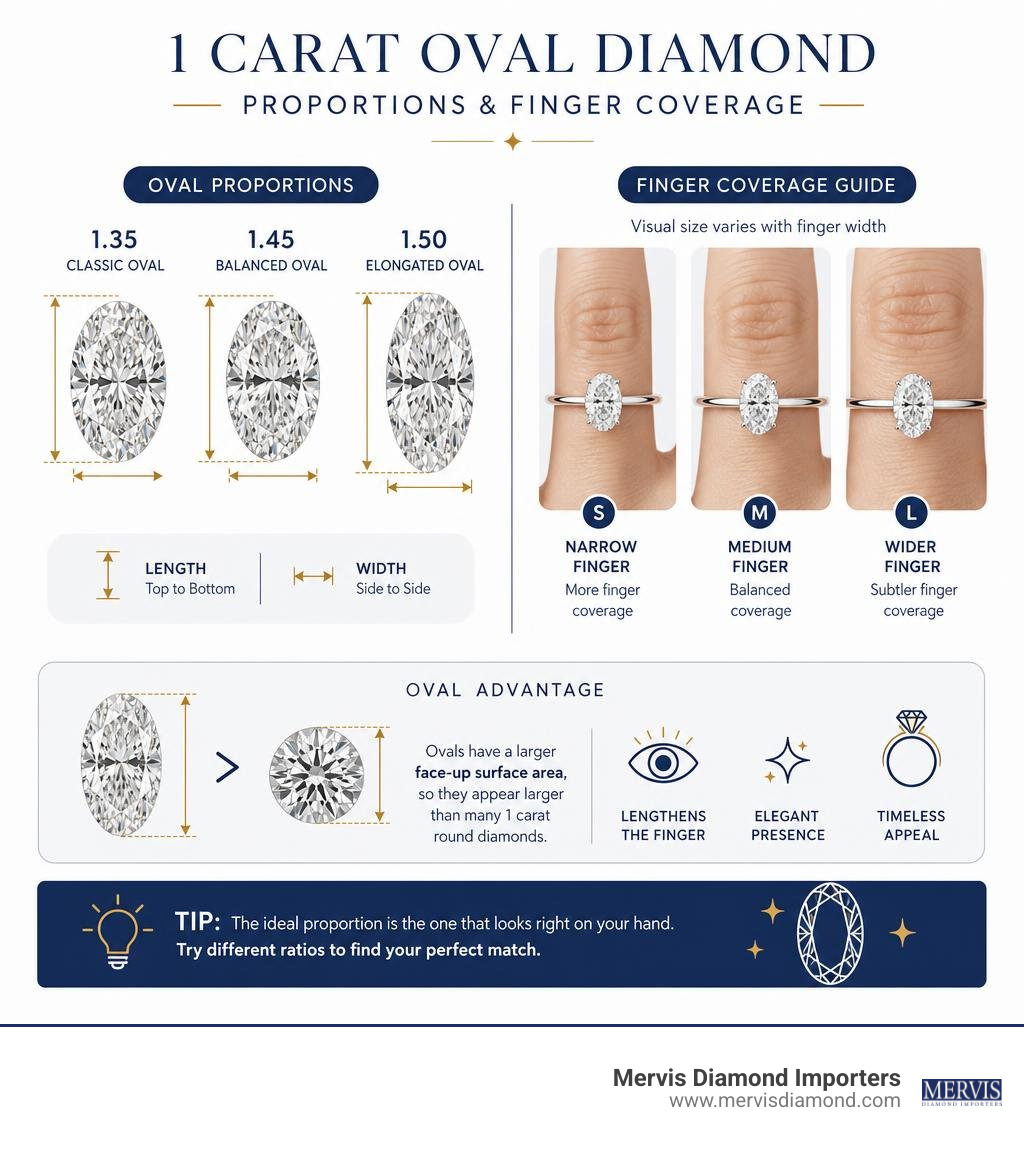
A 1 carat oval can look delicate on a broad hand or more substantial on smaller, slender fingers. The diamond's proportions matter as much as carat weight: a classic oval often has a length-to-width ratio around 1.35 to 1.50, but the best choice is the one whose shape looks right on your hand.
This guide will help you compare real-world proportions, settings, metals, pairing options, diamond quality, and value so you can choose confidently without paying for details that do not improve the ring's look.
I am Morris Mervis, and I will walk you through the visual and practical details that make a 1 carat oval ring feel personal, balanced, and well chosen.
How a 1 Carat Oval Diamond Ring on Finger Looks Across Hand Sizes and Shapes
When clients visit our showrooms in Tysons, Rockville, or Washington DC, their first reaction to trying on a 1 carat oval diamond ring on finger is almost always delight at how substantial it looks. Carat measures weight rather than visual diameter, but the oval cut maximizes surface area. Because the diamond is stretched into an elongated outline, it occupies more vertical space on your finger than a standard round brilliant of the exact same weight.
However, how large that center stone looks depends heavily on individual hand geometry. Finger size, finger length, and knuckles all change how a ring sits and scales visually.
Visual Impact of a 1 Carat Oval Diamond Ring on Finger on Small vs. Large Hands
If your ring size is between 3.5 and 5.5, a 1 carat oval cut diamond delivers impressive finger coverage. On a slender hand, a 1 carat center stone occupies a significant portion of the space between your knuckle and lower joint, giving the impression of a much larger ring.
On ring sizes 6.5 through 9, a 1 carat oval still maintains an elegant, classic presence. While it won't dominate a larger hand, its elongated profile draws the eye up and down, creating an inherent elongating effect that flatters wider fingers.
When considering budget and scale, comparing the 1 Carat Oval Diamond Ring Cost across different hand shapes reveals why this carat weight is so hugely popular. It offers a striking balance of elegance, practicality, and visual punch. If you are debating between carat targets, reading up on What Diamond Carat Size Is Right for You will help clarify how finger width interacts with visual proportions.
Comparing a 1 Carat Oval Diamond Ring on Finger to 1.5, 2, and 2.5 Carat Weights
As you move up in carat weight, the visual dimensions of an oval diamond expand, though not in a strictly linear 1:1 visual ratio. A 2 carat diamond does not look twice as large face-up as a 1 carat diamond—it looks roughly 25% to 30% wider and longer because the weight is distributed three-dimensionally throughout the depth of the stone.
Understanding How Many Carats Should an Engagement Ring Be comes down to personal taste, lifestyle, and visual comfort. Below is a quick comparison of average surface dimensions across popular oval carat weights:
| Carat Weight | Average Length x Width (mm) | Approximate Visual Finger Coverage (Size 6 Finger) | Visual Impression |
|---|---|---|---|
| 1.00 ct | ~7.7 mm x 5.7 mm | ~30% – 35% across finger width | Refined, flattering, ideal everyday proportions |
| 1.50 ct | ~8.7 mm x 6.2 mm | ~38% – 42% across finger width | Noticeably larger, bold presence without feeling overwhelming |
| 2.00 ct | ~9.5 mm x 7.0 mm | ~45% – 50% across finger width | Statement size, dramatic surface area, high finger coverage |
| 2.50 ct | ~10.2 mm x 7.4 mm | ~52% – 58% across finger width | High-impact luxury look, maximum visual pop |
For many brides, a 1 carat oval diamond ring on finger hits the sweet spot: it presents plenty of presence while remaining comfortable, practical, and resistant to snagging on clothing during daily wear.
Oval Cut Proportions, Ideal Ratios, and Diamond Quality Factors
An oval diamond's beauty is governed by its outline, table distribution, depth, and light performance. Unlike round brilliant diamonds, which have standard GIA cut grades (Excellent, Very Good, Good), fancy shapes like ovals do not receive an official GIA cut grade on their certificates. This means evaluating the cut of an oval requires a keen human eye and an understanding of key proportions.
Ideal Length-to-Width Ratios and Bow-Tie Avoidance
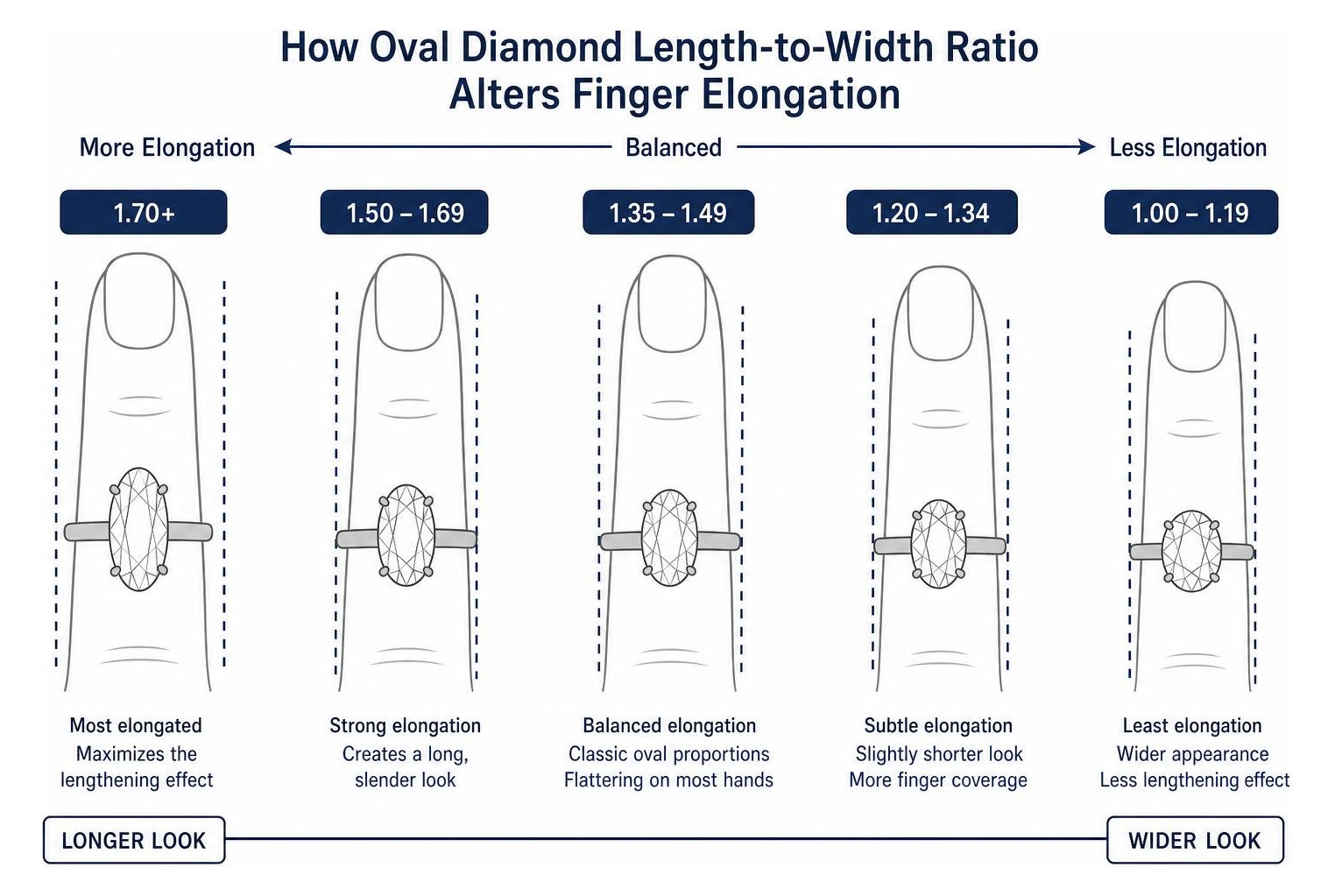
The length-to-width ratio is calculated by dividing the length of the diamond by its width. This ratio dictates whether your oval diamond looks short and chubby, sleek and elongated, or classic and balanced.
- Classic Oval Ratio (1.35 to 1.50): This is the traditional standard. It provides a graceful balance of length and width that beautifully elongates the finger without appearing stretched.
- Slender/Elongated Ratio (1.51 to 1.65+): These ovals appear noticeably long and thin. They create a dramatic lengthening visual on the hand, though they can sometimes appear slightly narrower.
- Chubby/Soft Ratio (1.20 to 1.34): Closer to a rounded shape, these ovals offer soft, curved lines and wider finger coverage.
Another crucial factor in ovals is the bow-tie effect. Because of how light rays refract through an oval's facet pattern, almost every oval cut exhibits a darker, bow-tie-shaped shadow across its center section. While a subtle bow-tie is normal and adds contrast, a dark or prominent bow-tie restricts light return and dulls sparkle. At Mervis Diamond Importers, our expert buyers hand-inspect every oval stone to ensure the bow-tie shadow is minimal and unobtrusive.
Evaluating Color, Clarity, and Cut Quality
Because oval diamonds have broad, open top facets (tables), selecting the right color and clarity parameters ensures your ring sparkles brightly without unnecessary expenses.
- Clarity: Oval diamonds conceal small inclusions remarkably well thanks to their crushed-ice facet reflections. Selecting a VS2 or VS1 clarity grade provides an eye-clean diamond where no imperfections are visible to the naked eye. In many stones, an SI1 clarity grade is also completely eye-clean, offering phenomenal value.
- Color: Ovals tend to retain slightly more body color in their narrow end tips than round diamonds. If you choose a white metal setting like platinum or white gold, aimed for a color grade of G or H to ensure a crisp, white appearance. If you prefer a yellow gold or rose gold setting, an I or J color diamond looks beautifully warm and brilliant without showing unwanted contrast.
To dive deeper into diamond grading and practical ring buying strategies, explore our comprehensive guides on Engagement Ring Shopping 101: The Ultimate Guide and How to Shop for Engagement Rings.
Best Ring Settings, Metals, and Bands for 1 Carat Oval Rings
The setting style you pick not only secures your center stone but dramatically influences how large and prominent a 1 carat oval diamond ring on finger looks.
Solitaire vs. Hidden Halo and Pavé Bands
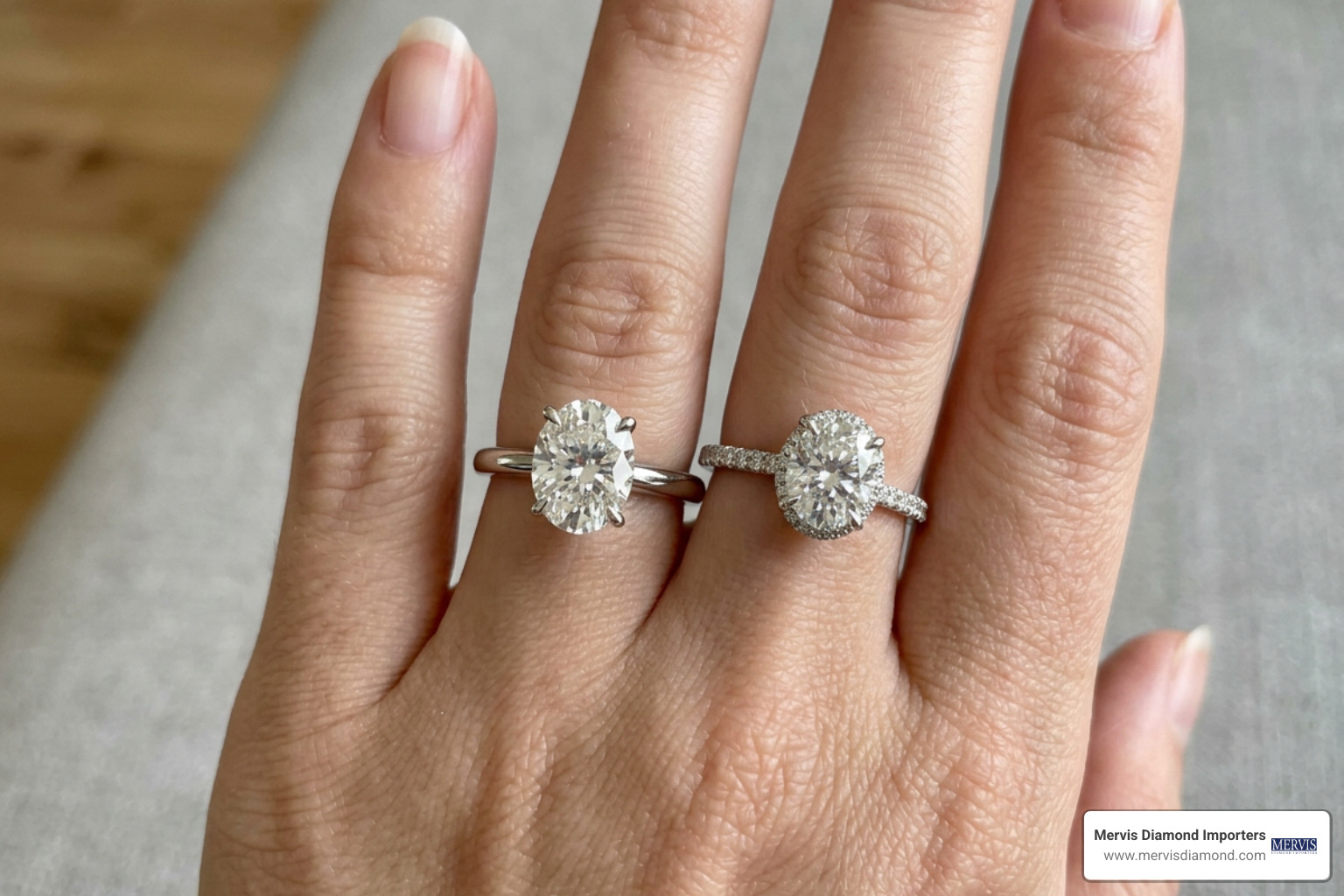
The classic solitaire setting—whether featuring 4 prongs or 6 prongs—remains a timeless choice for an oval cut. A slim 1.5mm to 1.8mm plain solitaire band isolates the center diamond, making a 1 carat stone look noticeably larger by comparison.
If you desire subtle extra brilliance without cluttering the center diamond's face-up profile, consider a hidden halo. A hidden halo features a delicate row of micro-pavé diamonds wrapped around the basket underneath the center oval. It adds a secret flash of light from the side profile while supporting the center stone.
For maximum sparkle, a pavé diamond band sets tiny round brilliant diamonds along the shank of the ring. This adds texture and overall fire across the top of your hand. Learn more about choosing structural support and visual styles in our articles on How to Choose a Diamond Ring Setting and How to Choose a Diamond Ring Setting 1.
Metal Choices: Yellow Gold, Rose Gold, White Gold, and Platinum
Metal choice sets the backdrop for your center diamond and influences the ring's overall tone and durability:
- Yellow Gold (14k or 18k): Warm, romantic, and highly fashionable. A slender yellow gold band creates a striking visual contrast against a bright white diamond, emphasizing the stone's crisp outline on your hand.
- Platinum: Naturally white, hypoallergenic, and extremely durable. Platinum prongs securely hold your oval diamond in place over decades of daily wear without wearing down over time.
- White Gold (14k or 18k): Offers the bright white sheen of platinum at a slightly lower initial price point, perfect for seamlessly blending band brilliance with white diamonds.
- Rose Gold: Soft and vintage-inspired, rose gold offers a warm pinkish tone that complements a wide variety of skin tones.
How to Pair a 1 Carat Oval Engagement Ring with a Wedding Band
Finding the right wedding band to stack with an oval engagement ring requires thoughtful planning. Because the center oval diamond extends outward past the central bridge of the setting, standard straight wedding bands may not sit completely flush against the engagement ring unless the ring was specifically designed with a high gallery bridge.
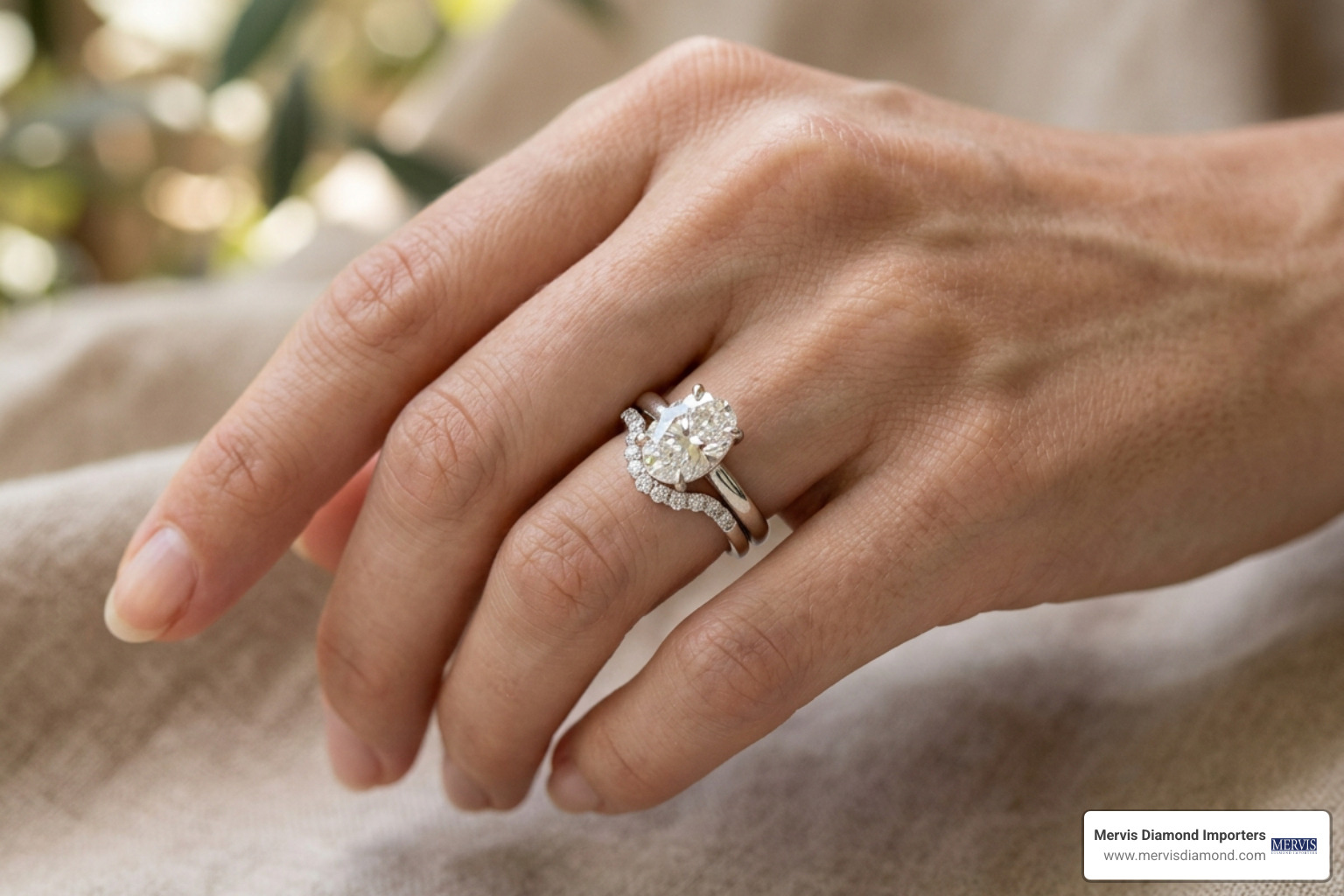
If you prefer a seamless, gap-free look, a curved or contoured wedding band hugs the lower curve of your oval engagement ring. Alternatively, a subtle gap between a straight diamond eternity band and a solitaire oval engagement ring has become a chic, highly popular modern stacking trend.
How you arrange and stack your bridal set reflects long-standing customs and personal preferences. Explore detailed stacking guides and historic context in these helpful resources:
- How to Wear Your Engagement and Wedding Rings
- How to Wear a Wedding Ring Set
- How Are You Supposed to Wear Your Wedding Band
- Wedding Rings Worn on 4th Finger Left Hand
Pricing and Value Guide for 1 Carat Oval Diamond Rings
Pricing for a 1 carat oval engagement ring varies depending on whether you choose a natural diamond or a lab-grown diamond, as well as the cut precision, clarity, and color combination.
Natural 1 carat oval diamonds balanced nicely in color (G-H) and clarity (VS2-SI1) generally range between $4,500 and $8,500 for the center stone alone, depending on market conditions and specific light performance characteristics. Premium color (D-F) and higher clarity (VVS2+) natural ovals will command higher prices.
By comparison, high-quality lab-grown 1 carat oval diamonds provide the exact same optical, physical, and chemical qualities at a fraction of the cost—typically between $800 and $1,800 for the loose gem.
Key Factors Impacting 1 Carat Oval Diamond Pricing:
- Origin (Natural vs. Lab-Grown): Natural diamonds carry historic rarity value, while lab-grown diamonds offer incredible visual size for modest budgets.
- Cut Precision & Bow-Tie Suppression: Premium oval cuts with optimal sparkle and minimal bow-tie shadows carry a slight premium but deliver superior brilliance on your hand.
- Setting Metal and Complexity: A simple 14k gold solitaire setting starts around $600–$1,000, whereas intricate platinum pavé or halo mountings range from $1,500 to $3,500+.
Whether you are planning a surprise romantic pop-the-question moment or selecting a ring together, our guides on How to Choose the Perfect Ring for Your Holiday Proposal and understanding What Does a Wedding Ring Symbolize will keep your purchasing journey smooth and meaningful.
Frequently Asked Questions About 1 Carat Oval Engagement Rings
What is the typical price range for a quality 1 carat oval diamond engagement ring?
A high-quality 1 carat natural oval engagement ring (complete with setting) usually ranges between $5,500 and $10,000. If you select a lab-grown 1 carat oval diamond, a complete finished ring typically ranges from $1,500 to $3,000 depending on setting metal and accent diamonds.
What is the most flattering length-to-width ratio for an oval diamond on hand?
The most flattering and classic ratio for an oval diamond is between 1.35 and 1.50. This creates an elegant elongated outline that stretches the look of your finger while maintaining optimal light reflection across the diamond's surface.
How does a 1 carat oval compare in size to a 1 carat round diamond?
Even though both stones weigh exactly 1.00 carat, a 1 carat oval diamond generally appears about 10% larger to the human eye than a 1 carat round brilliant diamond. This is because the oval cut spreads weight across a larger surface area (length x width), providing more visual coverage on your finger.
Conclusion
Choosing a 1 carat oval diamond ring on finger gives you an exceptional combination of modern elegance, finger-lengthening magic, and unmatched value. By paying attention to the length-to-width ratio, minimizing visible bow-tie shadows, and selecting a setting style that complements your hand size, you create a heirloom ring that will bring a smile to your face every single day.
At Mervis Diamond Importers, we take immense pride in helping you find or custom-craft the ideal engagement ring. Whether you prefer to inspect loose natural and lab-grown ovals under a loupe in person or browse our online gallery, our expert non-commission consultants in Tysons, VA, Rockville, MD, and Washington, DC are here to assist you without pressure.
Ready to find the stone that speaks to your heart? Browse Oval Engagement Rings today and discover how stunning an oval cut looks on your own hand!